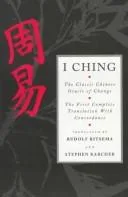
I ching
 61
61

I ching



Ophelia Vance (Mystical Literature Reviewer) — Rudolf Ritsema’s rendition of the I Ching is a monumental achievement, breathing vibrant life into this ancient oracle. Eschewing superficiality, Ritsema plunges into the profound esoteric dimensions, revealing the I Ching not just as a divinatory tool but as a cosmological map. His authoritative prose elucidates the intricate symbolic language, making the hexagrams resonate with potent, actionable wisdom. This edition is indispensable for serious practitioners and scholars of esoteric traditions who seek an authentic and deeply insightful engagement with the 'Book of Changes.' It offers clarity and depth rarely found, making it a cornerstone for understanding Eastern metaphysics.
📝 Description
61
Rudolf Ritsema's 1994 translation of the I Ching deciphers the ancient Chinese oracle.
Ritsema's translation of the I Ching focuses on its philosophical and symbolic dimensions. The work details the sixty-four hexagrams and their associated pronouncements, drawing connections between Yin and Yang and the flow of existence.
This edition aims to present the text in a way that speaks to those interested in esoteric traditions and deeper meaning. It offers a close reading of the divinatory aspects of the text, seeking to reveal its underlying structure and symbolism. The translation is intended to be accessible to readers seeking an authentic engagement with the oracle's pronouncements.
The I Ching, or Book of Changes, is a foundational text in Chinese cosmology and divination. Its influence extends across East Asian thought, impacting philosophy, religion, and even political strategy for over two millennia. Within esoteric traditions, it is studied not only as a predictive tool but as a system that maps the dynamics of change in the universe and human affairs. Ritsema's work engages with this long tradition of interpretation, seeking to convey the text's symbolic language and its philosophical underpinnings.
💡 Why Read This Book?
Unravel the secrets of destiny and discover profound philosophical truths. This essential text offers a direct conduit to ancient wisdom, providing unparalleled insight into life's cyclical nature. Ideal for spiritual seekers, students of comparative mythology, and practitioners of divination who desire a deeply resonant and authoritative exploration of the I Ching’s transformative power.
⭐ Reader Reviews
Honest opinions from readers who have explored this book.
❓ Frequently Asked Questions
What is the I Ching?
The I Ching, or 'Book of Changes,' is an ancient Chinese divination text and philosophical classic. It comprises 64 hexagrams, each formed by six stacked horizontal lines, representing fundamental archetypes of cosmic and human situations.
Who was Rudolf Ritsema?
Rudolf Ritsema was a distinguished sinologist and translator, known for his profound scholarship in classical Chinese texts, particularly those related to philosophy and divination. His work is lauded for its accuracy and deep understanding of esoteric nuances.
How is the I Ching used?
The I Ching is typically consulted through a ritualistic process, often involving the casting of yarrow stalks or coins, to generate a hexagram. The resulting hexagram and its changing lines are then interpreted to provide guidance on present circumstances and future possibilities.
What is the philosophical significance of the I Ching?
Philosophically, the I Ching explores the dynamic interplay of opposing forces (Yin and Yang) and the concept of constant change as the fundamental principle of the universe. It offers a framework for understanding balance, harmony, and the appropriate course of action in any given situation.
Is this edition suitable for beginners?
While rich in depth, Ritsema's edition is best suited for those with a serious interest in the I Ching's philosophical and esoteric aspects. Beginners may find it beneficial to approach with some foundational knowledge or in conjunction with introductory guides.
🔮 Key Themes & Symbolism
The Cosmic Dance of Yin and Yang
Explore the fundamental principle of duality that underpins all existence within the I Ching. This theme explores the dynamic interplay between the passive, receptive Yin and the active, creative Yang, demonstrating how their constant interaction generates the myriad phenomena of the universe. Understanding this balance is crucial for navigating life's challenges and aligning oneself with the natural order, revealing a profound cosmic harmony that governs both macrocosmic events and individual destinies.
The Oracle of Transformation
Discover the I Ching as a living oracle, a tool not for predicting a fixed future, but for understanding the forces of change and guiding one's response. This theme emphasizes the text's capacity to illuminate the present moment and offer counsel on working through the inevitable transformations of life. Through its sixty-four hexagrams, the I Ching provides a symbolic language to interpret the subtle shifts in circumstances, empowering the reader to adapt wisely and foster personal growth amidst flux.
Symbolism and Archetypal Wisdom
Uncover the collection of symbolism woven into the I Ching, where each hexagram and line represents profound archetypal situations and energies. This theme highlights the power of these symbols to transcend literal interpretation, speaking directly to the subconscious and offering deep psychological and spiritual insights. By decoding this ancient symbolic lexicon, readers can gain a more nuanced understanding of human experience and the universal patterns that shape our lives.
💬 Memorable Quotes
Direct passages from the work, attributed to the author.
“Change is the only constant.”
— This aphorism expresses the core philosophy of the I Ching, emphasizing that all things are in a state of perpetual flux and transformation, urging acceptance and adaptation.
“Stillness births clarity.”
— Highlights the importance of inner quietude and contemplation as a pathway to understanding and discerning the right course of action.
“Where there is a will, there is a way.”
— Suggests that focused intention and persistent effort can overcome obstacles, aligning with the I Ching's emphasis on appropriate action.
“The superior man adapts.”
— Emphasizes the virtue of flexibility and responsiveness in navigating life's ever-changing circumstances, a key tenet of I Ching wisdom.
“Every ending is a new beginning.”
— Illustrates the cyclical nature of existence as presented in the I Ching, where dissolution paves the way for renewal and growth.
🌙 Esoteric Significance
Tradition
The I Ching is a foundational text within the Taoist and Confucian traditions, but its esoteric significance extends far beyond. It is a key component of Chinese metaphysics, deeply intertwined with concepts of cosmology, divination, and the cultivation of the self. Its oracular function connects it to practices of shamanism and ancient wisdom seeking, offering a bridge between the mundane and the transcendent realms.
Symbolism
The core symbolism revolves around the sixty-four hexagrams, each a compound of two trigrams, representing fundamental archetypes of existence and change. The Yin and Yang lines, the trigrams (Heaven, Earth, Thunder, Water, etc.), and their permutations are potent symbols of natural forces, human relationships, and stages of development. Interpreting these symbols unlocks a rich lexicon for understanding life's complexities and aligning with cosmic patterns.
Modern Relevance
In the modern era, the I Ching remains remarkably relevant as a tool for self-reflection, ethical guidance, and understanding complex systems. Its emphasis on adaptability, balance, and the interconnectedness of all things offers clear insights for working through the challenges of contemporary life, from personal decision-making to understanding global dynamics. It provides a timeless framework for seeking wisdom and fostering inner harmony.
👥 Who Should Read This Book
This authoritative rendition of the I Ching is essential for a diverse readership. **Spiritual Seekers** will find a profound guide to understanding life’s cycles and their place within the cosmos. **Scholars of Esotericism and Comparative Religion** will appreciate its scholarly rigor and deep dive into ancient metaphysical thought. **Practitioners of Divination** seeking an authentic and potent oracle will discover an exceptional resource. **Philosophically inclined readers** interested in Eastern wisdom traditions will find a collection of insight into change, balance, and human existence.
📜 Historical Context
The I Ching, originating in ancient China, has a history spanning over three millennia, making it one of the world's oldest and most enduring texts. Its roots are deeply embedded in shamanistic practices and early cosmological thought, evolving through the contributions of legendary figures like King Wen, the Duke of Zhou, and Confucius. During the Zhou Dynasty (c. 1046–256 BCE), it solidified its form as a divinatory manual and philosophical treatise. Its influence permeated ancient Chinese society, guiding emperors, scholars, and commoners alike. Over centuries, it became a central to Confucianism and Taoism, shaping Chinese philosophy, art, literature, and even political strategy. Its transmission to the West in the 19th and 20th centuries sparked profound interest in esoteric traditions, influencing fields from psychology (Carl Jung) to systems theory, cementing its status as a text of universal significance.
📔 Journal Prompts
Reflect on a recent significant change in your life. How did the principles of Yin and Yang manifest in this situation?
Consider a current challenge you are facing. Which hexagram or aspect of the I Ching's wisdom might offer guidance?
How does the concept of 'constant change' resonate with your personal experiences? Explore moments where adaptation was key.
Identify a situation where you felt out of balance. What steps could you take to restore harmony, drawing inspiration from I Ching principles?
Meditate on a specific symbol from the I Ching (e.g., Heaven, Earth, Water). What personal meaning or insight does it evoke for you?
🗂️ Glossary
Hexagram
A symbol composed of six stacked horizontal lines, representing a specific archetypal situation or principle within the I Ching. Each hexagram is formed by combining two trigrams.
Trigram
A fundamental symbol composed of three lines, either solid (Yang) or broken (Yin). There are eight trigrams (e.g., Heaven, Earth, Thunder, Water), each representing a basic element or concept.
Yin
The feminine, passive, dark, receptive, and yielding principle in Chinese philosophy, often associated with the moon, earth, and water.
Yang
The masculine, active, light, creative, and assertive principle in Chinese philosophy, often associated with the sun, heaven, and fire.
Oracle
A medium or source of divine or prophetic knowledge. In the context of the I Ching, it refers to its use as a system for seeking guidance and insight into future possibilities and present circumstances.
This book appears in 2 collections
🔮 Readers Also Liked
Browse all →









More by Rudolf Ritsema
All books →

From the “I Ching” Collection
View all →







More Free Divination & Tarot Books
View all →