Annual Conference Staff International Society for Neoplatonic Studies
Alchemy is an ancient philosophical and protoscientific tradition aiming to purify, mature, and perfect materials, with both practical and spiritual dimensions.
Alchemy, originating from the Arabic "al-kīmīā," is an ancient practice rooted in natural philosophy, historically found in China, India, the Muslim world, and Europe. Its Western form emerged in Greco-Roman Egypt, where practitioners called it "the Art" and associated it with mystical and divine knowledge. Alchemists sought to transform base metals into noble ones, create an elixir of immortality, and develop panaceas, believing these pursuits led to the perfection of the human body and soul through a "Great Work" often linked to the philosopher's stone.
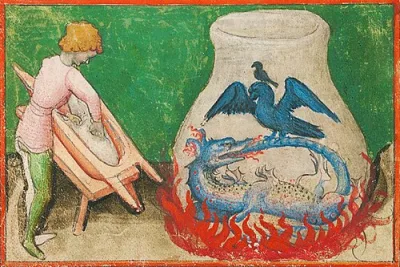
While developing foundational laboratory techniques and terminology, alchemists guarded their work with secrecy, using ciphers and symbols. They adhered to the ancient Greek concept of four elements. The translation of Islamic scientific works and the rediscovery of Aristotelian philosophy in 12th-century Europe spurred a significant Latin alchemy tradition that influenced early modern science. Modern study of alchemy is divided between its practical applications (early chemistry, medicine, charlatanism) and its esoteric spiritual aspects, both considered complementary by some scholars. Alchemy has also left a significant mark on literature and the arts.
Origins and Etymology
The term "alchemy" derives from the Arabic "al-kīmīā," itself a borrowing from the Late Greek "khēmeía." Proposed etymologies for the Greek term include a connection to the name of a book, "Khemeu," or to "chýma," referring to cast metallic objects. A prominent theory links it to the Egyptian word "kēme," meaning "black earth," referencing the fertile Nile valley, suggesting "the Egyptian [science]." This connects to the ancient Egyptian word "kmt," referring to both the land and the color black. The practice itself spans four millennia across three continents, with distinct traditions in China, India, and the West, making tracing mutual influences challenging.
Western Alchemy's Development
Western alchemy's roots are often traced to Hellenistic Egypt, particularly Alexandria, which remained a center of alchemical knowledge through the Greek and Roman periods. Scholars view its practice as an amalgamation of Egyptian goldsmithing, Greek philosophy, and various religious traditions. Early texts are often pseudepigraphic, but figures like Zosimos of Panopolis (c. 300 AD) are historically attested, referencing earlier authors. Zosimos linked alchemical arts to Egyptian metallurgical and ceremonial practices, suggesting a connection to ancient Egyptian deities and priests, viewing the tradition as rooted in temple rites.
Mythology and Hermeticism
Alchemical writings frequently incorporated figures from Greek, Roman, and Egyptian mythology to allegorize transmutation, including deities associated with planets, Isis, Osiris, and Jason. Central to this mythology is Hermes Trismegistus, a figure combining the Egyptian god Thoth and the Greek Hermes. He was believed to have authored numerous books covering all knowledge. The Hermetica, a collection of texts attributed to Hermes Trismegistus, are closely tied to Western alchemical philosophy. These texts are categorized as "technical" (covering alchemy, astrology, medicine, magic) and "religio-philosophical."
The Emerald Tablet and Later Influence
Among the "technical" Hermetica, the Emerald Tablet (Tabula Smaragdina) is a particularly influential, compact, and cryptic text. Its earliest known versions are Arabic recensions from the 8th to 10th centuries AD. Latin translations from the 12th century onwards introduced the Emerald Tablet to Europe, where it was interpreted as a foundational guide for alchemical processes, including the creation of the philosopher's stone and gold. The tradition of alchemy significantly influenced the development of early modern science, particularly chemistry and medicine.
Key Ideas
- Chrysopoeia (transmutation of base metals into noble metals)
- Elixir of immortality
- Panaceas (cures for all diseases)
- Magnum opus (Great Work: perfection of body and soul)
- Philosopher's stone
- Four elements theory
- Secrecy and symbolism in alchemical practice
Books by Annual Conference Staff International Society for Neoplatonic Studies
12 free public domain books · Read online or download