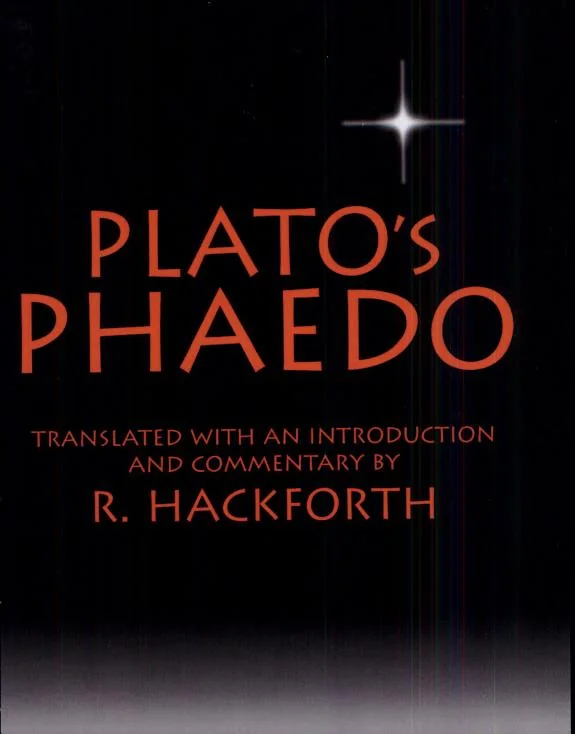
Plato's Phaedo
 73
73

Plato's Phaedo
Plato's *Phaedo* offers a powerful examination of mortality and the soul's potential for transcendence. The strength of this dialogue lies in its dramatic presentation of Socrates' final moments, imbuing abstract philosophical arguments with palpable emotional weight. The contrast between the relentless logic of Socrates' discourse and the sorrow of his companions creates a compelling intellectual and emotional landscape. A notable passage is Socrates’ discussion on recollection, suggesting that learning is a form of remembering innate knowledge, a concept that profoundly influenced later Neoplatonists. However, the sheer density of argumentation, particularly the later sections on the Forms, can be challenging for readers unaccustomed to Platonic dialectic. While the original blurb highlights its relevance to literary theory, its core philosophical exploration of the soul's fate after death is its most enduring aspect. It remains a foundational text for understanding Western metaphysics.
📝 Description
73
Plato's *Phaedo* records Socrates' final discussions on the soul's immortality before his 399 BCE execution.
Plato's *Phaedo* depicts Socrates' last hours in Athens, engaging his followers in a philosophical debate about the soul and the afterlife. Awaiting his execution, Socrates presents arguments for the soul's inherent immortality. The dialogue contrasts rational discourse with the use of mythic narratives to convey deeper philosophical truths. It is more than a historical account; it is a carefully constructed argument.
The work is of interest to students of ancient philosophy, especially those studying Plato's ideas and their impact on Western thought. Scholars of rhetoric and literary theory may also find value in its persuasive language and argumentative structure. Individuals curious about historical perspectives on the soul, death, and divinity will find its content engaging, irrespective of their background in classical studies.
Plato composed *Phaedo* after Socrates' death in 399 BCE, situating it within the intellectual climate of Classical Athens. Socrates, a figure condemned by the Athenian assembly, is presented here through Plato's philosophical lens. The dialogue engages with ideas prevalent in 4th century BCE Greece, contrasting with the Sophists' focus on rhetoric and incorporating Pythagorean notions of reincarnation and soul purification.
Within occult philosophy, *Phaedo* is significant for its early articulation of dualism and the soul's independent existence from the body. The Pythagorean influences, particularly regarding reincarnation and the soul's purification through philosophical knowledge, resonate with esoteric traditions that seek liberation from material existence. Socrates' arguments for recollection also touch upon the idea of innate knowledge or memories accessible through deeper consciousness, a concept found in various mystical systems.
💡 Why Read This Book?
• Understand the Socratic method's application to existential questions, particularly Socrates' arguments for the soul's immortality, as presented in the dialogue's final hours before his execution in 399 BCE. • Explore the philosophical concept of recollection (anamnesis), where learning is framed as remembering innate knowledge from a previous existence, a core tenet explored in the text. • Grasp Plato's theory of Forms, the eternal, perfect archetypes of which earthly objects are mere imperfect copies, as discussed by Socrates during his final discourse.
⭐ Reader Reviews
Honest opinions from readers who have explored this book.
❓ Frequently Asked Questions
What is the primary philosophical question addressed in Plato's Phaedo?
The primary philosophical question is the immortality of the soul. Socrates presents several arguments aiming to demonstrate that the soul survives the death of the body and potentially continues to exist in an afterlife.
Who are the main characters involved in the dialogue?
The central figure is Socrates, who is on trial and awaiting execution. Key interlocutors include Simmias and Cebes, who engage Socrates in philosophical debate about the soul, and Phaedo, the narrator.
When and where does the dialogue take place?
The dialogue is set in Socrates' prison cell in Athens, on the very day of his execution in 399 BCE, shortly after his condemnation by the Athenian court.
What is the argument from recollection as presented in the Phaedo?
The argument from recollection posits that learning is essentially remembering knowledge the soul possessed before its incarnation in a physical body, suggesting a pre-existence and thus survival beyond death.
How does the Phaedo relate to Plato's broader philosophical system?
The *Phaedo* is crucial for understanding Plato's theory of Forms and his dualistic view of reality, separating the imperfect material world from the perfect realm of Forms, and his conception of the soul's purification.
Does the book require prior knowledge of ancient Greek philosophy?
No, the blurb explicitly states that no knowledge of Greek is required. The arguments are presented in a way accessible to those interested in philosophy and rhetoric without specialized linguistic background.
🔮 Key Themes & Symbolism
The Soul's Immortality
The *Phaedo* is fundamentally concerned with proving the soul's eternal nature. Socrates presents multiple arguments, including the cyclical nature of existence (opposites), the theory of recollection from a prior state, and the soul's affinity with the divine and unchanging Forms. This exploration moves beyond mere speculation, positing the soul as an entity distinct from the body, capable of surviving death and achieving a state of purification or knowledge.
Theory of Forms
Central to the dialogue is Socrates' exposition of the Theory of Forms. He argues that the physical world is merely a shadow of a higher reality composed of perfect, eternal, and unchanging archetypes—the Forms. The soul, in its quest for true knowledge, strives to apprehend these Forms, a pursuit facilitated by philosophical discipline and the separation from bodily distractions.
Philosophy as Preparation for Death
Socrates frames the philosophical life as a continuous practice of dying to the body and its desires. True philosophers, he contends, are those who actively seek to free their souls from the limitations of the physical world. This perspective transforms the act of dying from a feared end into an anticipated transition towards a higher, more authentic existence.
Argumentation and Myth
The dialogue masterfully balances formal philosophical argumentation with the use of myth and vivid imagery. Socrates acknowledges the limitations of purely rational proof when discussing such transcendent topics, employing persuasive myths to complement his logical arguments. This interplay highlights Plato's rhetorical skill and his understanding of how different modes of discourse can convey profound truths.
💬 Memorable Quotes
Direct passages from the work, attributed to the author.
“The true lover of wisdom is ready to face death.”
— This statement captures Socrates' view that philosophical pursuit is a lifelong preparation for the soul's liberation from the body, making death not a feared end but a desired transition.
“Learning is nothing else than recollection.”
— This core tenet of the argument from recollection suggests that the soul possessed knowledge before its current life, implying a pre-existence and continuity beyond physical death.
“The soul is like the divine, and the body is like the mortal.”
— This analogy highlights the inherent difference in nature between the soul and the body, positing the soul as belonging to an eternal, incorporeal realm and the body to the transient, physical world.
“What is dear to us is often harmful, and what we hate is beneficial.”
— This reflects a Socratic paradox where conventional human desires and aversions are inverted; true goods are often found in what appears difficult or unpleasant, a concept tied to philosophical discipline.
“Let us assume that there is such a thing as the beautiful itself, and that we, grasping it, can perceive it.”
— This introduces the concept of the Forms, asserting the existence of perfect, abstract essences (like Beauty itself) that are distinct from and superior to their imperfect manifestations in the physical world.
🌙 Esoteric Significance
Tradition
The *Phaedo* is a foundational text for Western esoteric traditions, particularly Neoplatonism and later Hermeticism. Its emphasis on the soul's transcendence of the material world, its pre-existence, and its journey towards divine knowledge aligns with Gnostic and Hermetic ideals of spiritual liberation. The concept of purification and the ascent of the soul through philosophical contemplation mirrors practices found in various mystical lineages.
Symbolism
The dialogue employs the symbol of the prison cell not just literally but as a metaphor for the soul's entrapment within the physical body. Socrates' hemlock draught symbolizes the final, voluntary release from this corporeal prison. The recurring motif of 'purification' signifies the ethical and intellectual discipline required to detach the soul from sensory illusions and prepare it for its post-mortem journey.
Modern Relevance
Contemporary thinkers in consciousness studies and transpersonal psychology often draw upon the *Phaedo*'s arguments for the soul's non-material existence. Its exploration of near-death experiences and altered states of consciousness finds echoes in modern spiritual practices and metaphysical inquiries into the nature of reality and the self.
👥 Who Should Read This Book
• Students of Ancient Philosophy: Those seeking to understand the core arguments of Socrates and Plato concerning the soul, death, and the nature of reality will find this dialogue indispensable. • Scholars of Literary Theory and Rhetoric: Individuals interested in the sophisticated interplay between formal argument and persuasive myth in classical texts will benefit from Plato's masterful execution. • Seekers of Metaphysical Truth: Readers exploring questions about life after death, the nature of consciousness, and the relationship between the spiritual and material realms will find profound philosophical engagement.
📜 Historical Context
Plato's *Phaedo*, likely written in the 380s BCE, emerges from the vibrant intellectual range of Classical Athens, shortly after Socrates' death in 399 BCE. Socrates, a central figure who challenged Athenian norms, was condemned by the city's assembly. Plato, his devoted student, used dialogues like the *Phaedo* to disseminate Socrates' philosophy and defend his legacy against critics, including the Sophists, who prioritized rhetoric over truth. The dialogue also engages with Pythagorean ideas about reincarnation and the purification of the soul, reflecting the diverse spiritual and philosophical currents of the 4th century BCE. While contemporary philosophers like Aristippus of Cyrene pursued different ethical paths, Plato's focus on the soul's immortality and the theory of Forms in the *Phaedo* set a distinct metaphysical agenda that would profoundly shape Western thought.
📔 Journal Prompts
Socrates' arguments for the soul's immortality: Which argument do you find most compelling and why?
The concept of recollection (anamnesis): How might this idea apply to learning or understanding in your own experience?
The prison cell as a metaphor for the body: Reflect on the soul's perceived entrapment and its potential for liberation.
The role of myth alongside formal argument: Consider instances where non-rational or symbolic narratives aid understanding of abstract ideas.
Socrates' view of philosophy as preparation for death: How does this reframe the purpose of philosophical inquiry?
🗂️ Glossary
Anamnesis
The Platonic concept that learning is a process of recollection, where the immortal soul remembers knowledge acquired before its incarnation in a physical body.
Forms (Ideas)
In Plato's philosophy, the perfect, eternal, and unchanging archetypes or essences that exist in a transcendent realm, of which physical objects are imperfect copies.
Dialectic
A method of philosophical argument involving a dialogue between opposing viewpoints, aiming to resolve contradictions and arrive at truth, central to Socratic and Platonic inquiry.
Purification
The process of cleansing the soul from bodily desires and sensory distractions, considered essential for philosophers to attain true knowledge and prepare for the afterlife.
Simmias
One of Socrates' interlocutors in the *Phaedo*, who raises objections to the soul's immortality, notably the 'harmony' argument.
Cebes
Another interlocutor in the *Phaedo*, who presents the 'cloak' analogy to question the soul's persistence after death.
Socratic Method
A form of cooperative argumentative dialogue between individuals, based on asking and answering questions to stimulate critical thinking and draw out ideas and underlying presuppositions.
This book appears in 1 collection
🔮 Readers Also Liked
Browse all →








From the “Immortality” Collection
View all →









More Free Occult Philosophy Books
View all →