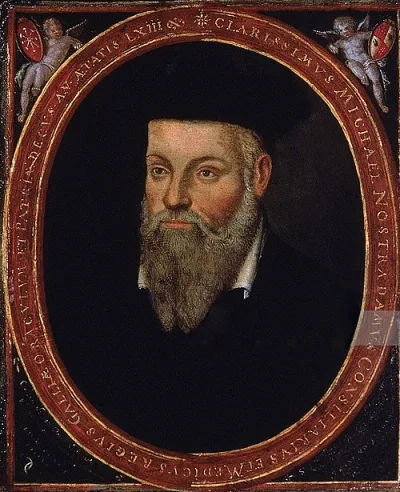
Michel Nostradamus was a 16th-century French astrologer and physician known for his book of prophecies.
Michel de Nostredame, known as Nostradamus, was a French astrologer, physician, and apothecary of the 16th century. Born into a family that had converted from Judaism to Catholicism, he pursued studies at the University of Avignon and later Montpellier, though his academic career was interrupted by plague outbreaks and his expulsion from Montpellier for practicing as an apothecary. After losing his first wife and children to the plague, he remarried and had six more children. He gained prominence through his successful almanacs, which led him to work as an astrologer for wealthy patrons, including Catherine de' Medici. His most famous work, Les Prophéties, published in 1555, contains poetic quatrains that some believe predict future events. Despite his later life being marked by illness, he died in 1566. While popular interpretations credit him with supernatural foresight, academic analyses suggest his predictions are vague and subject to misinterpretation.
Early Life and Education
Michel Nostradamus was born in southern France in December 1503. His paternal ancestors were originally Jewish but converted to Catholicism before his birth. He began his university studies at Avignon but was forced to leave due to a plague epidemic. After working as an apothecary for some years, he attempted to earn a doctorate at the University of Montpellier. However, he was expelled from Montpellier because university rules prohibited manual trades like that of an apothecary. He continued his work, gaining fame for a supposed plague-preventing "rose pill."
Career and Prophecies
Nostradamus married and had two children, who tragically died along with his wife during a plague outbreak in 1534. He later remarried and had six more children. He began writing annual almanacs, which proved successful and led him to offer astrological services to influential patrons. Catherine de' Medici became a significant supporter. His most well-known publication, Les Prophéties (The Prophecies), appeared in 1555. This collection of quatrains, written in a cryptic style blending multiple languages, was intended to obscure its meaning. The work received mixed reactions, with some viewing him with suspicion and others, like Catherine de' Medici, holding him in high regard.
Later Life and Legacy
In his later years, Nostradamus suffered from severe gout that developed into edema. He died in July 1566. While many have attributed genuine supernatural prophetic abilities to him, crediting his quatrains with accurately predicting major historical events, academic scholars generally dispute this. They argue that the supposed predictions are often vague, open to interpretation or mistranslation, and lack any basis in genuine foresight. Despite these scholarly critiques, Nostradamus remains a significant figure in the history of prophecy and esoteric literature.
Books by
6 free public domain books · Read online or download