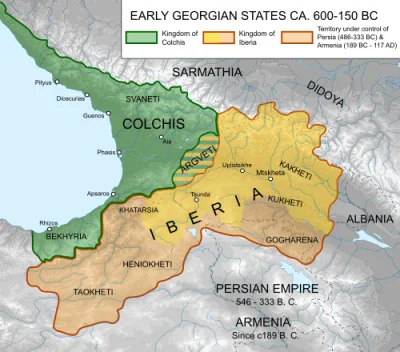
Colchis, an ancient Georgian polity on the Black Sea, is known for its rich resources, diverse population, and mythological connections.
Colchis was an ancient polity situated on the eastern coast of the Black Sea, corresponding to modern western Georgia and encompassing regions like Abkhazia. Historically identified as an early Georgian formation, its population, the Colchians, are believed to be ancestral to modern Laz and Mingrelian peoples and spoke early Zan languages. The region was renowned in Greek mythology as the destination of the Argonauts, the home of Medea, and the source of the Golden Fleece. Ancient sources describe Colchis as a land abundant in resources such as gold, iron, timber, and honey, which were exported to Hellenic city-states. The area likely had a highly diverse population, with estimates suggesting numerous languages were spoken in its settlements.
Geographically, Colchis existed from approximately the 13th to the 1st centuries BC. Its territory extended across modern western Georgia, parts of Turkey, and Russia. The region's physical geography includes the Colchis Plain, surrounded by the Greater and Lesser Caucasus mountains, and it experiences a mild, humid climate with high rainfall, supporting temperate rainforests and wetlands. The area is notable for its unique flora and fauna, with many relict species. Economically, Colchis was known for its staple crops like millet, local wines, cattle, and horses. It also exported pheasants, which became a symbol in Roman culture. Slaves were also a significant export, notably to the Achaemenid Empire and Ancient Greece.
Mythological Significance and Resources
In classical Greek mythology, Colchis held a prominent place as the legendary home of Medea and the ultimate destination for the Argonauts in their quest for the Golden Fleece. Ancient writers depicted Colchis as a land exceptionally rich in natural resources, including abundant gold, iron, timber, and honey. These valuable commodities were a significant part of its economy, primarily exported to the ancient Hellenic city-states. This rich endowment of resources contributed to its reputation and likely played a role in its historical interactions with neighboring regions and empires.
Linguistic and Ethnic Diversity
The population of Colchis, known as the Colchians, is generally understood to have been composed of early Zan-speaking tribes, who are considered ancestral to the modern Laz and Mingrelian peoples. Scholarship views Colchis as a foundational element in the development of the Georgian nation. The region was characterized by a remarkably diverse population. Classical sources indicate that in the settlement of Dioscourias (modern Sukhumi) alone, a substantial number of languages, estimated between 70 and 300, were spoken, reflecting a complex ethnic and cultural tapestry.
Geographical Extent and Ancient Identity
Colchis, also referred to by names such as Kolkha and Qulḫa, existed as a polity from roughly the 13th to the 1st centuries BC. It is widely regarded as an early Georgian state formation, with its people being early Kartvelian tribes. The geographical area of Colchis encompassed much of what is now western Georgia, extending into parts of modern Turkey and Russia. Its boundaries were defined by the Black Sea to the west, the Greater Caucasus to the north, the Lesser Caucasus and Likhi Range to the east and south, and Pontus to the southwest. Ancient authors provided varying descriptions of its precise extent, with some placing its western edge as far as Trabzon.
Books by
3 free public domain books · Read online or download