John Williamson Nevin
John D. Rockefeller Sr. was a titan of industry and philanthropy, founding Standard Oil and revolutionizing charitable giving.
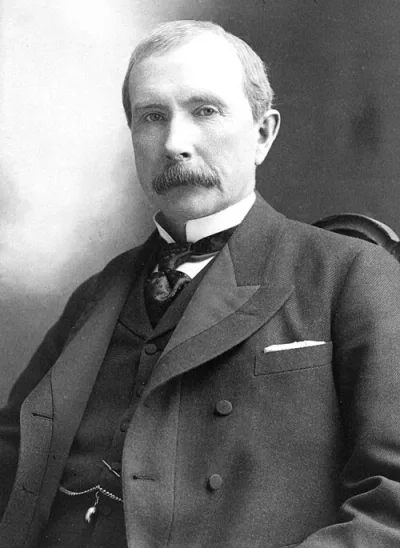
John D. Rockefeller Sr. (1839–1937) was a prominent American businessman and philanthropist, recognized as one of history's wealthiest individuals. Born in Upstate New York, his family eventually settled in Cleveland, Ohio. Rockefeller began his career in business at a young age, eventually concentrating on oil refining. He founded the Standard Oil Company in 1870, which grew to dominate the American oil industry, controlling approximately 90% of the nation's oil production by 1900 through innovative business practices and consolidation.
Facing criticism for monopolistic practices, Standard Oil was ordered to be dismantled by the Supreme Court in 1911, breaking into 34 separate companies. In his later years, Rockefeller dedicated his fortune to philanthropy, establishing foundations that significantly advanced medical research, education, and the modernization of the Southern United States. His approach to systematic, targeted giving influenced modern philanthropic structures. He was a devout Baptist, guided by his faith throughout his life, and believed in capitalism tempered by a social Darwinist perspective.
Early Life and Influences
Born in Richford, New York, John D. Rockefeller Sr. was the second of six children. His mother, Eliza Davison, was a devout Baptist who instilled in him values of thrift and diligence, teaching him the importance of saving and tracking money. His father, William A. Rockefeller Sr., was a traveling salesman known for his unconventional morality and business schemes, who often engaged in questionable practices and was frequently absent from the family. Eliza's influence was paramount in John's upbringing, shaping his early understanding of financial discipline and hard work, contrasting with his father's more opportunistic approach. Despite frequent family moves and his father's erratic presence, Rockefeller was a serious, studious, and reserved child, deeply influenced by his mother's faith and teachings.
Founding and Dominance of Standard Oil
Rockefeller entered the business world at sixteen as an assistant bookkeeper, quickly developing a keen understanding of business operations and negotiation, particularly regarding transportation costs and rebates. By twenty, he entered into business partnerships, eventually focusing on oil refining. In 1870, he co-founded the Standard Oil Company, which he led until 1897. Through strategic consolidation, technological advancements, and a favorable business environment, Standard Oil achieved unprecedented market control, refining and distributing kerosene and gasoline. By 1900, the company controlled about 90% of the nation's oil production, making Rockefeller one of the wealthiest individuals in history.
Philanthropy and Legacy
Following the forced dissolution of Standard Oil in 1911 due to antitrust violations, Rockefeller shifted his focus to philanthropy. He, alongside figures like Andrew Carnegie, pioneered modern systematic philanthropy by establishing foundations. These institutions significantly funded medical research, education, and scientific endeavors. His foundations played a crucial role in advancing medical understanding, leading to efforts to eradicate diseases like hookworm and yellow fever in the American South. Rockefeller also founded the University of Chicago and Rockefeller University, and supported educational institutions globally. His charitable work was deeply intertwined with his religious convictions and his belief in applying principles of efficiency and systematic organization to societal betterment.
Key Ideas
- Systematic philanthropy
- Capitalism based on social Darwinism
- Importance of saving and diligent work
Notable Quotes
“Competition is a sin.”
“The growth of a large business is merely a survival of the fittest.”
“I wanted to go in the army and do my part... But it was simply out of the question. There was no one to take my place. We were in a new business, and if I had not stayed it must have stopped—and with so many dependent on it.”
“From the beginning, I was trained to work, to save, and to give.”
“willful waste makes woeful want”
Books by John Williamson Nevin
4 free public domain books · Read online or download