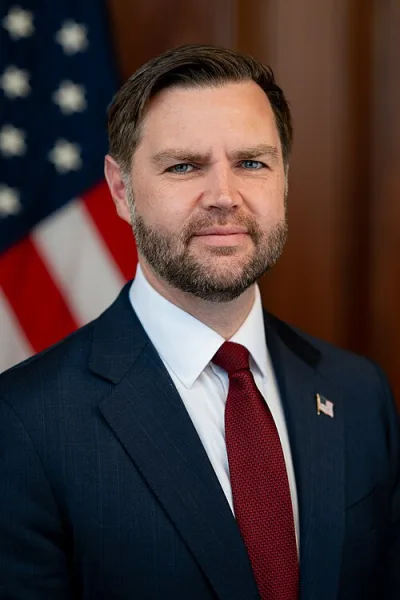
J.D. Vance is an American politician and author known for his memoir 'Hillbilly Elegy,' later becoming Vice President.
J.D. Vance, born James Donald Bowman in 1984, grew up in Middletown, Ohio, experiencing poverty and family struggles. After enlisting in the U.S. Marine Corps, he served as a journalist and later pursued higher education, earning degrees from Ohio State University and Yale Law School. He briefly practiced corporate law before entering the venture capital world, working for Peter Thiel's firm, Mithril Capital.
Vance gained national attention with his 2016 memoir, "Hillbilly Elegy," which explored his Appalachian background and the challenges faced by the white working class. The book became a bestseller and sparked discussions about cultural and political shifts in the United States. Initially critical of Donald Trump's candidacy, Vance later became a supporter. He converted to Roman Catholicism in 2019.
He transitioned into politics, serving as a U.S. Senator for Ohio from 2023 to 2025. In 2024, he was chosen as the Republican vice-presidential nominee and subsequently resigned from the Senate upon his inauguration. As Vice President, Vance has aligned himself with national conservatism and the 'postliberal' New Right movement, advocating for policies that oppose immigration, abortion, same-sex marriage, and gun control, and has been critical of childlessness. He cites Catholic theology as an influence on his views.
Early Life and Military Service
James David Vance was born James Donald Bowman on August 2, 1984, in Middletown, Ohio. His childhood was marked by his mother's struggles with drug addiction and poverty, leading him and his sister to be raised primarily by their maternal grandparents. Vance's family lineage traces back to Scots-Irish heritage. After graduating from high school in 2003, he enlisted in the United States Marine Corps, serving as a combat correspondent. During his four-year service, he was deployed to Iraq in a non-combat role, documenting his experiences through writing and photography. He attained the rank of corporal and received several military decorations.
Education and Literary Breakthrough
Following his military service, Vance utilized the G.I. Bill to attend Ohio State University, where he earned a Bachelor of Arts degree with high honors. He then proceeded to Yale Law School, where he was involved with The Yale Law Journal. During his time at Yale, he was encouraged by Professor Amy Chua to begin writing his memoir. He also developed connections with figures like Peter Thiel and fellow Ohio native Vivek Ramaswamy. Vance legally changed his surname to Vance in 2013, shortly before graduating from Yale Law School and being admitted to the bar.
Career in Venture Capital and Politics
After law school, Vance worked briefly as a corporate lawyer before moving into the technology sector as a venture capitalist, notably with Peter Thiel's firm, Mithril Capital. In 2016, he published his bestselling memoir, "Hillbilly Elegy: A Memoir of a Family and Culture in Crisis," which examined his family's history and the cultural dynamics of Appalachia. The book's success brought him significant public attention and influenced his later political views. He later co-founded the venture capital firm Narya Capital and invested in platforms favored by the political right. Vance also established Our Ohio Renewal, an advocacy organization, and served as a CNN contributor before entering electoral politics.
Political Career and Vice Presidency
Vance was elected to the U.S. Senate representing Ohio in 2022, defeating his Democratic opponent with the endorsement of Donald Trump. He resigned from the Senate in 2025 following his inauguration as the 50th Vice President of the United States. Vance identifies as a national conservative and aligns with the 'postliberal' New Right movement. His political platform includes opposition to immigration, abortion, same-sex marriage, and gun control, and he has voiced criticism of childlessness. He has stated that Catholic theology influences his perspectives, though his interpretations have drawn criticism from Pope Francis and Pope Leo XIV.
Key Ideas
- Exploration of Appalachian culture and the challenges of the white working class
- Critique of "highly educated transplants" and perceived condescension from elite tech crowds
- National conservatism and alignment with the "postliberal" New Right movement
- Opposition to immigration, abortion, same-sex marriage, and gun control
- Criticism of childlessness
Books by
16 free public domain books · Read online or download