Jacob Boehme
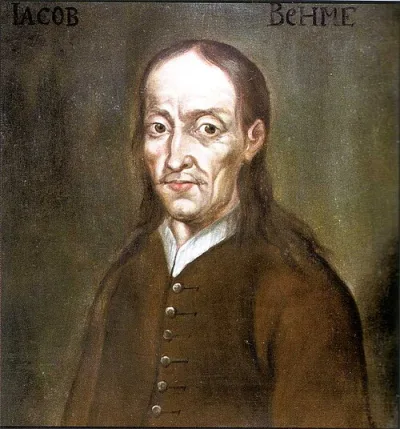
Jakob Böhme was a 17th-century German mystic and philosopher whose writings explored the nature of God, evil, and redemption.
Jakob Böhme (1575-1624) was a German philosopher, Christian mystic, and theologian who emerged from the Lutheran tradition. Despite lacking formal education, his profound mystical experiences led him to develop a unique theological system that influenced later philosophical movements like German idealism and Romanticism. His contemporaries recognized him as an original thinker, though his first major work, "Aurora," caused significant controversy and led to him being denounced by religious authorities.
Böhme's early life involved an apprenticeship as a shoemaker, during which he engaged in prayer and read works by other visionaries. A pivotal mystical vision in 1600, reportedly inspired by sunlight on a pewter dish, revealed to him the spiritual structure of the world and the relationship between the divine and humanity. This experience marked the beginning of his extensive writings, which explored complex themes of sin, evil, and salvation, often diverging from mainstream Lutheran doctrines. Despite facing persecution and exile, Böhme continued to write, leaving behind a substantial body of work that was later circulated and translated throughout Europe.
Mystical Experiences and Early Life
Born in 1575 in Upper Lusatia, Jakob Böhme began his working life as a herd boy before being apprenticed as a shoemaker. His apprenticeship was challenging, exposing him to religious debates of the era. He pursued spiritual understanding through prayer and reading the works of mystics like Paracelsus and Weigel, rather than formal schooling. Böhme experienced significant mystical visions, notably one in 1600 that he believed unveiled the spiritual architecture of existence and the interplay of divine and human forces, good and evil. He also had a further vision in 1610 concerning cosmic unity and a divine calling. After completing his shoemaking apprenticeship and establishing himself as a master craftsman, Böhme married and raised a family, while continuing his spiritual explorations.
Writings and Theological Controversies
Böhme's first major work, "Morgenröte im Aufgang" (later known as "Aurora"), was written over a decade after his 1600 vision. Initially circulated in manuscript form, it was deemed heretical by local clergy, particularly Gregorius Richter, the chief pastor of Görlitz. This opposition led to Böhme ceasing his writing for a period. However, encouraged by friends, he resumed writing in 1618, producing numerous treatises on theological and mystical subjects, including "The Three Principles of the Divine Essence" and "The Signature of All Things." His writings were initially copied by hand and shared among his followers. The publication of "The Way to Christ" in 1624 caused a further scandal, leading to Böhme being summoned by the Town Council and warned to leave Görlitz.
Theology and Philosophical Impact
Böhme's theology centered on the nature of sin, evil, and redemption, aiming to reconcile divine grace with human suffering. He diverged from strict Lutheran orthodoxy in rejecting justification by faith alone and proposed a novel interpretation of the Trinity. He viewed the Fall not just as a human error but potentially as a necessary stage in the universe's evolution. Böhme posited that to reach God, one must first confront the infernal. His complex system, which described God as an eternal self-regenerating principle, influenced thinkers of German idealism and Romanticism, with Hegel famously calling him the first German philosopher. Despite controversy, his works were eventually compiled and published, solidifying his legacy as a significant mystical philosopher.
Key Ideas
- The spiritual structure of the world revealed through mystical vision.
- The unity of the cosmos and the divine vocation.
- The nature of sin, evil, and redemption.
- A novel interpretation of the Trinity and the Fall.
- The necessity of confronting 'hell' to reach God.
Notable Quotes
“There are as many blasphemies in this shoemaker's book as there are lines; it smells of shoemaker's pitch and filthy blacking. May this insufferable stench be far from us. The Arian poison was not so deadly as this shoemaker's poison.”
“For he that will say, I have a Will, and would willingly do Good, but the earthly Flesh which I carry about me, keepeth me back, so that I cannot; yet I shall be saved by Grace, for the Merits of Christ. I comfort myself with his Merit and Sufferings; who will receive me of mere Grace, without any Merits of my own, and forgive me my Sins. Such a one, I say, is like a Man that knoweth what Food is good for his Health, yet will not eat of it, but eateth Poison instead thereof, from whence Sickness and Death, will certainly follow.”
“[I]n the order of nature, an evil thing cannot produce a good thing out of itself, but one evil thing generates another.”
Books by Jacob Boehme
19 free public domain books · Read online or download