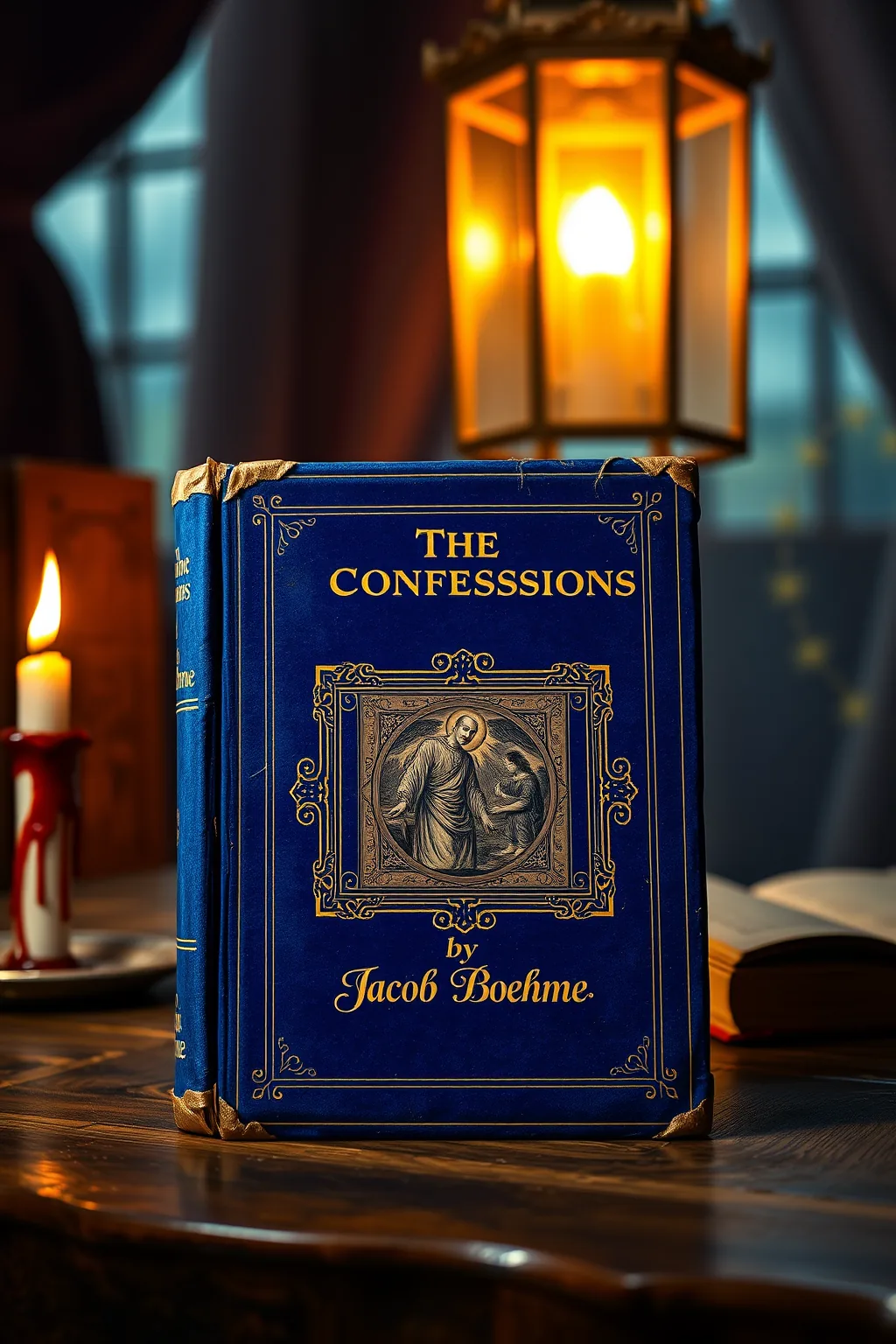
The Confessions of Jacob Boehme
 80
80

The Confessions of Jacob Boehme



Silas Hawthorne, Hermetic Studies Editor: Jacob Boehme's 'Confessions' is a monumental testament to inner revelation. Eschewing academic dogma, Boehme, through sheer spiritual wrestling, maps a universe of stark dualities and divine trinities. His insight into the 'Ungrund' and the fiery genesis of manifestation offers unparalleled depth for hermetic practitioners and theologians alike. The work's strength lies in its raw, unadulterated vision, a direct conduit to the mystical heart of German Pietism and its alchemical underpinnings. This is not light reading, but essential nourishment for the serious student of the occult and divine philosophy, revealing the deep structure of reality beyond conventional perception.
📝 Description
80
Jacob Boehme, a 17th-century cobbler, detailed his visions of the divine and creation in his writings.
Jacob Boehme's confessions offer a direct account of his intense spiritual experiences. He describes a cosmos structured by three intertwined worlds: the divine light of God, the dark chaos before creation, and the transformative fire that unites them. Boehme asserts that concepts like heaven and hell are not separate places but states within reality itself. His work uses rich symbolism to articulate the connection between all things and presents a Christian esoteric view on existence, duality, and divine unity.
The book moves beyond a simple life story to reveal Boehme's unique metaphysical system. He explains creation, the fall of man, and redemption through the lens of his mystical insights. Readers encounter a complex cosmology where opposites are reconciled and divine will is manifest. This text invites a reconsideration of fundamental theological concepts through a deeply personal and visionary perspective.
Boehme's writings emerged from the Pietist and theosophical movements of 17th-century Germany. He drew upon Christian scripture but interpreted it through a unique visionary lens, often using alchemical and Neoplatonic concepts. His system sought to explain the origin of evil and suffering within a divine framework, a departure from more orthodox Christian theology. Boehme's influence extended to later esoteric traditions, including Rosicrucianism and various forms of Western mysticism.
💡 Why Read This Book?
Embark on a journey beyond ordinary perception with Jacob Boehme's 'Confessions.' This book offers direct access to a uniquely Christian esoteric worldview, revealing the intricate dance of spirit, light, and darkness. Ideal for seekers, mystics, and scholars of hermeticism and alchemy who crave profound philosophical and theological insights into the nature of reality, divine will, and the cosmic struggle between opposing forces. Discover a universe where the sacred and the profane are inextricably linked, offering a transformative lens through which to view existence.
⭐ Reader Reviews
Honest opinions from readers who have explored this book.
❓ Frequently Asked Questions
Who was Jacob Boehme?
Jacob Boehme (1575-1624) was a German Christian mystic and theologian whose profound spiritual experiences led him to write complex philosophical and theological works, despite his humble origins as a shoemaker.
What are the three worlds Boehme describes?
Boehme outlines three primary worlds: the World of Light (divine essence), the World of Darkness (primordial chaos and unmanifest potential), and the World of Fire (the transformative, active principle that bridges the other two).
What is the significance of duality in Boehme's philosophy?
Duality (e.g., light/darkness, good/evil) is central to Boehme's cosmology, representing the inherent tension and dynamic interplay from which all manifestation arises, ultimately resolved in divine unity.
Is this book a literal autobiography?
While it contains autobiographical elements, 'The Confessions' is primarily a spiritual and philosophical treatise, detailing Boehme's visionary experiences and his interpretation of cosmic and divine processes.
What kind of spiritual practice does Boehme advocate?
Boehme's path is one of deep inner contemplation, spiritual wrestling, and direct communion with God, leading to profound insights into the divine nature and the structure of reality.
🔮 Key Themes & Symbolism
The Tripartite Cosmos
Boehme's cosmology is defined by his radical conception of three interwoven worlds: the serene World of Light, the tumultuous World of Darkness, and the dynamic, alchemical World of Fire. This tripartite structure is not merely a theoretical framework but a lived, spiritual reality that governs all existence, from the smallest atom to the grandest divine principle. He posits that these realms are not spatially separate but interpenetrate, creating a complex range of being where divine will and primordial chaos engage in perpetual, creative tension. Understanding this dynamic is key to grasping Boehme's unique vision of God and creation.
The Divine Ungrund and Primordial Duality
Central to Boehme's thought is the concept of the 'Ungrund,' the abyss of divine potential that precedes all manifest reality. From this unmanifest source, a primordial duality emerges, not as an inherent flaw but as a necessary principle for creation to occur. This initial separation, a divine 'yes' and 'no,' gives rise to the dynamic interplay of opposites that characterize the created order. Boehme's genius lies in presenting this duality not as a Manichaean struggle, but as a dialectical process that ultimately leads back to divine unity, a core tenet of his mystical alchemy.
Spiritual Alchemy and Transformation
Boehme's work is deeply imbued with alchemical symbolism and a profound understanding of spiritual transformation. He views the entire cosmic process, and the human soul's journey, as a form of divine alchemy. The 'Great Work' is not merely the transmutation of base metals but the purification and re-integration of the divine spark within the soul, which has been obscured by the 'fall.' His descriptions of fiery essences, spiritual distillations, and the dissolution of ego are direct parallels to alchemical procedures, offering a roadmap for the soul's ascent back to its divine origin through suffering and divine grace.
💬 Memorable Quotes
Direct passages from the work, attributed to the author.
“The deepest abyss is God's essence.”
— This profound statement points to the boundless, unmanifest nature of God prior to creation, a mystery that can only be approached through deep contemplation and spiritual insight.
“When God would create, He drew Himself into His abyss.”
— Boehme illustrates the concept of creation as an act of divine self-contraction, a necessary step to make space for the emergence of duality and the manifest universe.
“The Devil is God's own shadow.”
— This provocative quote highlights the intrinsic link between good and evil, suggesting that darkness is a necessary counterpoint to light, arising from the same divine source.
“Heaven and hell are the same place.”
— Boehme suggests that spiritual states, not physical locations, define heaven and hell, and these states can co-exist within the same reality or soul.
“The outward man is a shadow of the inward man.”
— This reflects the esoteric principle of correspondence, where the physical realm is a reflection of a deeper spiritual reality, and the true self resides within.
🌙 Esoteric Significance
Tradition
Boehme stands as a central figure in Christian Esotericism and German Mysticism, bridging the gap between scholastic theology and direct visionary experience. His work is a core part of the Hermetic tradition, offering a unique synthesis of Christian dogma with alchemical principles and Neoplatonic ideas. He provided a sophisticated, albeit often challenging, framework for understanding divine nature, cosmic creation, and the path of spiritual transformation, deeply influencing later figures in occultism and spirituality.
Symbolism
Boehme's writings are replete with potent symbolism derived from alchemy, scripture, and his own visionary experiences. Key symbols include: Fire (as the active, transformative principle of God), Light (divine essence), Darkness (primordial chaos), the Ungrund (divine abyss), Sulphur and Mercury (alchemical principles representing spirit and soul), and the Trinity (as the ultimate divine unity manifesting through duality). These symbols are not mere metaphors but represent fundamental energetic forces and states of being within his cosmic architecture.
Modern Relevance
Boehme's exploration of dualities, the interconnectedness of opposing forces, and the transformative power of divine fire offers profound resonance with contemporary discussions on consciousness, psychology, and spirituality. His insights into the nature of suffering, the potential for inner transformation, and the underlying unity of existence provide a rich philosophical basis for those seeking to reconcile spiritual and material realities, navigate personal crises, or deepen their understanding of the self and the cosmos in an increasingly complex world.
👥 Who Should Read This Book
This profound work is essential for advanced students of Western Esotericism, particularly those interested in Christian Mysticism, Hermeticism, and Alchemy. Scholars of comparative religion and philosophy will find Boehme's unique cosmology a rich area of study. For the dedicated spiritual seeker, 'The Confessions' offers a challenging yet deeply rewarding path to understanding the divine architecture of existence and the transformative journey of the soul. Practitioners of contemplative or alchemical paths may find invaluable insights into the energetic and spiritual processes involved in inner work.
📜 Historical Context
Jacob Boehme wrote during a tumultuous period in European history, the late 16th and early 17th centuries, marked by the Reformation, the Counter-Reformation, and widespread religious and philosophical ferment. This era was characterized by intense theological debate, the rise of scientific inquiry alongside persistent belief in magic and alchemy, and significant mystical movements. Boehme's work emerged from this milieu, drawing upon Christian scripture and tradition while simultaneously engaging with the burgeoning esoteric currents of Renaissance hermeticism and alchemy. His humble origins and lack of formal education made his profound philosophical insights all the more remarkable, challenging established religious hierarchies and influencing subsequent generations of mystics, philosophers, and artists.
📔 Journal Prompts
Reflect on a personal experience of 'duality' and how it might represent a divine interplay rather than simple opposition.
Imagine the 'World of Fire' as a concept. How does this 'transformative crucible' manifest in your life or the world around you?
Boehme speaks of God 'drawing Himself into His abyss' to create. What does this concept of divine self-limitation suggest about the nature of creation and free will?
Consider the idea that heaven and hell are not locations but states of being. Describe a time you experienced something akin to 'heaven' or 'hell' within yourself or your circumstances.
How can the principles of spiritual alchemy, as described by Boehme, be applied to a personal challenge or a desired inner transformation?
🗂️ Glossary
Ungrund
The primordial abyss or unmanifest ground of being from which God's essence and all creation arise. It represents the absolute divine potential prior to any differentiation.
Primordial Duality
The initial separation of opposites (e.g., light/dark, yes/no) that Boehme believed was necessary for God to manifest Himself and for the created world to come into existence.
World of Fire
The third realm in Boehme's cosmology, representing the active, transformative, and often painful principle that bridges the World of Light and the World of Darkness, essential for creation and regeneration.
Alchemical Principles
Boehme frequently uses alchemical terms like Sulphur, Mercury, and Salt to represent fundamental spiritual and energetic essences involved in the process of creation and soul transformation.
Spiritual Wrestling
The intense internal struggle and contemplative effort undertaken by the mystic to understand divine mysteries, overcome egoic limitations, and achieve spiritual union.
This book appears in 2 collections
🔮 Readers Also Liked
Browse all →









From the “Hermeticism” Collection
View all →








More Free Alchemy & Hermeticism Books
View all →