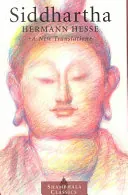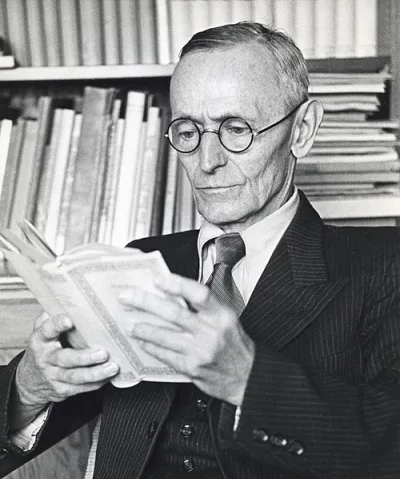
Hermann Hesse was a German-Swiss writer whose works explored the individual's quest for authenticity, influenced by Eastern philosophies and Jungian psychology.
Hermann Hesse, born in 1877, was a German-Swiss poet and novelist, recognized with the Nobel Prize in Literature in 1946. His literary output was significantly shaped by his deep engagement with Eastern religious thought, spirituality, and philosophy, alongside his experiences with Jungian psychoanalysis. This unique blend informed his most celebrated novels, including 'Demian,' 'Steppenwolf,' 'Siddhartha,' 'Narcissus and Goldmund,' and 'The Glass Bead Game.' These works consistently delve into the universal human journey of seeking genuine selfhood, profound self-understanding, and spiritual enlightenment.
While Hesse enjoyed considerable readership in German-speaking regions during his life, his widespread international acclaim emerged posthumously. It was in the mid-1960s, a few years after his passing in 1962, that his books resonated deeply with a post-World War II global audience, particularly in the United States and Europe. His background was marked by a family deeply involved in Protestant missionary work in India, influencing his early life and perspectives. Growing up, he experienced a tension between his Pietist upbringing and his father's Baltic German heritage, which he perceived as foreign and somewhat isolating.
Early Life and Influences
Born in Calw, Germany, in 1877, Hermann Hesse's family had strong ties to missionary work in India, with his maternal grandfather compiling a Malayalam dictionary and grammar. His mother, born in India, described her own childhood as unhappy, having been separated from her parents at a young age. Hesse's father, of Baltic German descent, brought a contrasting sense of a cheerful, almost paradisiacal Estonia to his son's upbringing. Hesse's childhood was characterized by a headstrong nature and early signs of depression. He found solace and inspiration in his grandfather's extensive library, fostering a global perspective and a sense of detachment from nationalism. Music and poetry were central to his family life, with both his mother and father involved in creative and literary pursuits.
Spiritual and Intellectual Development
Hesse's formal education included a challenging period at the Evangelical Theological Seminary in Maulbronn, which marked the beginning of a personal crisis, including a period of rebellion and an attempted suicide. Following this, he navigated various institutions and experienced conflicts with his parents. His early adulthood involved apprenticeships in bookselling and clockmaking, with the latter's monotony pushing him towards more spiritual exploration. His apprenticeship in a Tübingen bookshop exposed him to theological writings, classical literature, and importantly, the philosophy of Nietzsche, whose ideas on human dualities profoundly impacted his writing. This period also saw his first publications, including poetry collections and prose, though they met with limited commercial success and parental disapproval.
Literary Themes and Legacy
Hesse's literary career was deeply influenced by his exploration of Eastern traditions and his engagement with Jungian psychology. His most recognized novels, such as 'Siddhartha,' 'Steppenwolf,' and 'The Glass Bead Game,' are central to his legacy. These works consistently examine the individual's path toward self-discovery, authenticity, and spiritual awakening. He explored the internal struggles and quests for meaning that define the human experience. While recognized in German literary circles during his lifetime, his international fame surged significantly after his death, particularly among younger generations in the post-war era, solidifying his status as a globally influential author.
Key Ideas
- The individual's search for authenticity
- The quest for self-knowledge and spiritual enlightenment
- The influence of Eastern religious and philosophical traditions
- The integration of Jungian psychoanalysis
- The tension between spiritual and material worlds
- The artist's struggle for identity and meaning
Notable Quotes
“A happy child I was not ...”
“The little fellow has a life in him, an unbelievable strength, a powerful will, and, for his four years of age, a truly astonishing mind. How can he express all that? It truly gnaws at my life, this internal fighting against his tyrannical temperament, his passionate turbulence [...] God must shape this proud spirit, then it will become something noble and magnificent – but I shudder to think what this young and passionate person might become should his upbringing be false or weak.”
“an exceedingly cheerful, and, for all its Christianity, a merry world ... We wished for nothing so longingly as to be allowed to see this Estonia ... where life was so paradisiacal, so colourful and happy.”
“an important and potent fact”
“always seemed like a very polite, very foreign, lonely, little-understood guest”
Books by
14 free public domain books · Read online or download