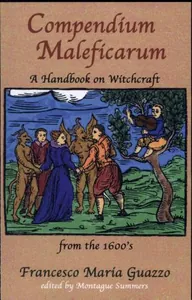
Francesco Maria Guazzo was an Italian priest and demonologist, best known for his 1608 book, Compendium Maleficarum.
Francesco Maria Guazzo, also known as Guaccio or Guaccius, was an Italian priest active in the early 17th century. He belonged to the Ambrosian order, a Catholic brotherhood with ancient roots in Milan. Guazzo gained recognition for his expertise in cases of demonic possession and the methods for their cure. His practical experience included performing several exorcisms for members of noble families, such as Cardinal Charles of Lorraine and Eric, Bishop of Verdun.
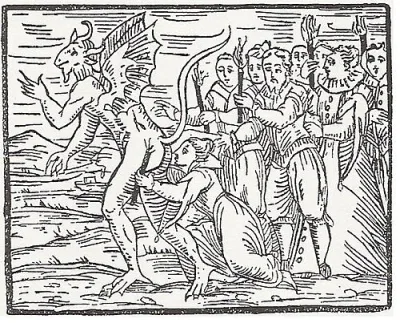
His most significant work, the Compendium Maleficarum, published in 1608, drew heavily from his direct involvement in exorcisms. This book was considered a definitive text on witchcraft by his contemporaries. In it, Guazzo explored pacts between witches and the devil, described various witchcraft powers and poisons, and presented a classification of demons that was influenced by the earlier work of Michael Psellus. The book also reflected the influence of demonologist Nicholas Remy, a lawyer associated with Duke Charles III of Lorraine.
Life and Ecclesiastical Affiliation
Francesco Maria Guazzo was an Italian priest who lived from 1570 until an unknown date in the 17th century. He was a member of the 'Fratres Sancti Ambrosii ad Nemus,' also known as 'The Brethren of the Grove.' This order was one of the oldest Catholic Ambrosian brotherhoods, originating in the Milan area. While many such religious groups existed, this particular congregation gained significant prominence. Guazzo was part of this congregation after it was officially unified by Pope Eugene IV in 1441, serving under Popes Sixtus V and Paul V. His ecclesiastical background provided a framework for his later studies and writings on demonology.
Exorcisms and Demonological Expertise
Guazzo was highly respected for his knowledge and practical experience in the field of demonic possession and its remedies. He is documented as having performed numerous exorcisms, including interventions with members of prominent ducal and princely families. Notable cases involved the bewitched Cardinal Charles of Lorraine and his relative, Eric, the Bishop of Verdun. Guazzo was also summoned to Düsseldorf to address the troubled mental state of John William, Duke of Jülich-Cleves-Berg. Initially diagnosing possession, Guazzo later revised his assessment to bewitchment after five months of unsuccessful spiritual treatments in 1604, highlighting the complexities he encountered in his practice.
The Compendium Maleficarum
The direct experiences from his exorcism work profoundly influenced Guazzo's decision to write the Compendium Maleficarum, published in 1608. This treatise quickly became recognized by his contemporaries as a leading authority on the subject of witchcraft. Within its pages, Guazzo meticulously detailed various aspects of the occult, including the infernal pacts made by witches with the devil, comprehensive descriptions of their purported abilities and the poisons they employed. Furthermore, he structured his own classification of demons, drawing inspiration from the earlier work of the Byzantine scholar Michael Psellus. The book also shows the influence of Nicholas Remy, a noted demonologist who served Duke Charles III of Lorraine.
Key Ideas
- Classification of demons
- Witches' pacts with the devil
- Descriptions of witches' powers and poisons
Books by
3 free public domain books · Read online or download