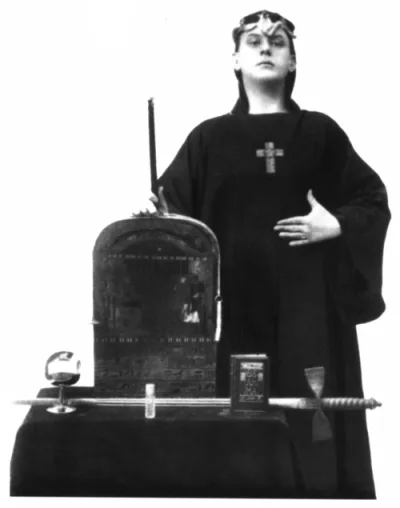
Ceremonial magic, revived by Aleister Crowley, uses ritual and specific tools to achieve spiritual understanding and enact change.
Ceremonial magic, also known as high magic or learned magic, involves a variety of rituals and specific accessories. This practice draws upon traditions such as Hermetic Qabalah, Enochian magic, and Thelema, and is considered a part of Western esotericism. The archaic spelling 'magick' was revived by Aleister Crowley to distinguish occult practices from stage magic, defining it as the art and science of causing change aligned with one's will. Crowley viewed magick as a fundamental method for self-discovery and acting in accordance with one's true will, a concept he detailed in "Magick, Book 4."
The practice incorporates tools like the Tree of Life, a system of ten spheres and twenty-two paths used to map mystical concepts and the spiritual journey. Another key element is the 'body of light,' an imagined, quasi-material aspect of the self developed through imagination and ritual. Grimoires, which are textbooks of magic, provide instructions for spells, rituals, and summoning entities. Magical formulae, or 'words of power,' are concise expressions of abstract concepts, understood through meditation. Detailed record-keeping of magical experiences is also emphasized, following a scientific approach to document effectiveness and preserve knowledge. Specialized tools, known as magical weapons, are consecrated for ritual use and often symbolize psychological or metaphysical elements.
The Nature and Purpose of Magick
The term 'magick' is an older spelling of 'magic,' notably revived by Aleister Crowley to differentiate occult practices from illusionary performances. Crowley defined magick as 'the science and art of causing change to occur in conformity with will.' He believed it was the essential path for individuals to achieve self-understanding and to act according to their true will, which he saw as a balance between freedom and destiny. This practice is deeply embedded within Western esotericism and draws from diverse occult traditions. The core purpose, according to Crowley, is the union of the microcosm with the macrocosm, often described as achieving Union with God through arduous ritualistic processes.
Key Esoteric Tools and Concepts
Central to ceremonial magic is the Tree of Life, a symbolic map comprising ten spheres (sephiroth) and twenty-two paths, used to organize mystical ideas and represent the spiritual journey. It serves as a framework for understanding concepts, deities, and the progression from the material world to unity. Another significant concept is the 'body of light,' also referred to as the astral or subtle body. This is an imagined, quasi-material aspect of the self that is developed through imagination, ritual, and discipline, sometimes linked to the 'Knowledge & Conversation of the Holy Guardian Angel.' Grimoires, or magic textbooks, are essential resources, containing instructions for spells, creating talismans, and invoking entities. Magical formulae, or 'words of power,' are concise linguistic tools that convey complex spiritual information through meditation and internalization.
Ritual Components and Practice
Ceremonial magic relies on specific components and practices. Magical records are crucial, serving as detailed journals of experiences, ideas, and the effectiveness of procedures, mirroring a scientific approach to occult study. Aleister Crowley stressed the importance of meticulous recording, including the practitioner's physical and mental state, time, place, and environmental conditions. Rituals often require consecrated tools known as 'magical weapons,' which can symbolize psychological states or metaphysical principles. Crowley's system includes items like a magic circle, altar, wand, cup, sword, and pentacle, each representing aspects of the magician's will, understanding, reason, and being. Additional elements like robes, crowns, and lamps also play symbolic roles in the ritual performance.
Key Ideas
- Ceremonial magic as a means to achieve spiritual understanding and enact change.
- The Tree of Life as a symbolic map for mystical concepts and spiritual journeys.
- The 'body of light' as a developed, quasi-material aspect of the self.
- Grimoires as instructional texts for magical practices.
- Magical formulae ('words of power') as concise conveyers of abstract information.
- The importance of detailed magical record-keeping for verification and knowledge preservation.
Notable Quotes
“It is theoretically possible to cause in any object any change of which that object is capable by nature”
“The Tree of Life has got to be learnt by heart; you must know it backwards, forwards, sideways, and upside down; it must become the automatic background of all your thinking. You must keep on hanging everything that comes your way upon its proper bough.”
“It is absolutely necessary that all experiments should be recorded in detail during, or immediately after, their performance ... The more scientific the record is, the better. Yet the emotions should be noted, as being some of the conditions. Let then the record be written with sincerity and care; thus with practice it will be found more and more to approximate to the ideal.”
Books by
4 free public domain books · Read online or download