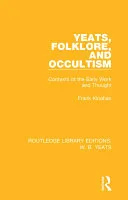
Yeats, Folklore and Occultism
 83
83

Yeats, Folklore and Occultism
Frank Kinahan's reappraisal of W. B. Yeats's oeuvre, *Yeats, Folklore and Occultism*, provides a necessary corrective to readings that sideline the poet's profound immersion in arcane matters. Kinahan effectively demonstrates how Yeats’s involvement with the Hermetic Order of the Golden Dawn and his extensive research into Irish folklore were not mere hobbies but foundational to his poetic vision. The chapter detailing Yeats's personal cosmology, influenced by figures like Madame Blavatsky, offers particularly sharp insights into poems that might otherwise seem abstract. While the analysis is consistently rigorous, a more extensive engagement with the critical reception of Yeats's occultism in his own time might have further enriched the historical perspective. Nevertheless, the book succeeds admirably in its aim to illuminate the esoteric currents within Yeats's poetry, offering a compelling argument for their centrality.
📝 Description
83
Frank Kinahan's 1988 study connects W. B. Yeats's poetry to Irish folklore and occult traditions.
Published originally in 1988 and reissued in 2019, Frank Kinahan's *Yeats, Folklore and Occultism* examines how W. B. Yeats's engagement with Irish folklore and occult traditions shaped his poetry. The book offers new interpretations of well known poems by placing them within the context of Yeats's active participation in magical societies and his extensive study of myth. Kinahan's work emerged during a time of increased academic attention to the connections between literature and the occult, a field that Yeats himself helped to shape. The study also considers the Irish Literary Revival and the growing scholarly attention to magical practices in the late 19th and early 20th centuries. Yeats's own statements about the influence of folklore and occultism on his formative years directly motivate this kind of analysis.
This book is for readers interested in literary analysis, especially those studying W. B. Yeats and seeking to grasp the hidden spiritual influences in his verse. It will appeal to students of Irish literature, comparative mythology, and the history of Western esotericism. Kinahan presents a scholarly but accessible method for approaching these complex subjects. The work looks at Yeats's interest in symbols from Irish myth, like the Sidhe and ancient Celtic gods. It also covers his membership in groups such as the Hermetic Order of the Golden Dawn and his personal creation of a unique symbolic system, often referring to ideas like the Great Wheel and its cycles.
Kinahan's analysis is situated within the broader history of Western esotericism, specifically examining how occult philosophies and practices informed literary creation. It connects Yeats's personal magical experiments and studies with the symbolic language found in his poetry. This approach is part of a tradition that seeks to understand the hidden currents within art and culture, recognizing that esoteric traditions have long influenced creative output. The book thus contributes to scholarship that views magic and occultism not as fringe phenomena, but as significant historical forces shaping intellectual and artistic movements.
💡 Why Read This Book?
• Understand the esoteric influences on W. B. Yeats's poetry, particularly his engagement with the Hermetic Order of the Golden Dawn, which shaped his symbolic language. • Explore the revival of Irish folklore and its integration into Yeats's verse, learning how myths of the Sidhe informed his imagery and thematic concerns. • Gain new readings of specific poems by examining the interplay between occult philosophy, Irish mythology, and Yeats's mature poetic style, as detailed in the book's analytical sections.
⭐ Reader Reviews
Honest opinions from readers who have explored this book.
❓ Frequently Asked Questions
When was Frank Kinahan's *Yeats, Folklore and Occultism* first published?
The book was first published on August 13, 2019, though its origins trace back to earlier work from 1988.
What role did Irish folklore play in Yeats's poetry according to this book?
The book argues that Irish folklore was a chief intellectual influence on Yeats's youth, providing him with rich material for his poetry, including myths of fairies and ancient Celtic traditions.
Which occult traditions are discussed in relation to Yeats?
The book examines Yeats's profound involvement with occultism, specifically mentioning his participation in magical traditions and societies like the Hermetic Order of the Golden Dawn.
How does this book offer new readings of Yeats's poems?
By connecting specific poems to Yeats's deep engagement with both Irish folklore and occultism, Kinahan provides interpretations that highlight the esoteric dimensions of his work.
Is *Yeats, Folklore and Occultism* suitable for beginners in Yeats studies?
Yes, it serves as a lively introduction, offering new readings for those familiar with Yeats and providing context for newcomers interested in the esoteric aspects of his poetry.
What is the relationship between Yeats's art and his occult interests?
Kinahan's work posits that Yeats's occult interests and his study of folklore were not separate pursuits but were integral to his development as an artist and the creation of his poetic universe.
🔮 Key Themes & Symbolism
Folklore as Poetic Source
This theme explores how W. B. Yeats drew extensively from Irish folklore, incorporating myths, legends, and supernatural tales into his poetry. Kinahan highlights Yeats's personal belief in the 'Little People' or Sidhe and how these figures function not just as characters but as potent symbols of the subconscious and the spiritual realm. The book examines how this engagement with indigenous mythology provided a unique vernacular for his artistic expression, moving beyond conventional literary influences to tap into a deeper cultural consciousness.
Occultism and Symbolic Systems
The book details Yeats's active participation in occult societies, most notably the Hermetic Order of the Golden Dawn, and his development of personal esoteric philosophies. Kinahan analyzes how Yeats constructed intricate symbolic systems, influenced by figures like Madame Blavatsky and Aleister Crowley, which informed his understanding of cosmic cycles, reincarnation, and spiritual evolution. These occult beliefs are presented not as mere background but as the very architecture upon which his poetic vision was built, imbuing his work with layers of hidden meaning accessible to those familiar with esoteric lore.
The Poet as Magus
Yeats's self-perception and his public persona are examined through the lens of the poet as a magician or magus. Kinahan argues that Yeats saw poetry itself as a form of magic, capable of shaping reality and revealing hidden truths. The book discusses Yeats's experiments with automatic writing and his belief in the power of symbols and rituals to access deeper states of consciousness. This perspective reframes Yeats's creative process as a deliberate act of occult invocation, where the poem becomes a potent artifact imbued with magical intent.
Irish Revival and Esoteric Nationalism
The study situates Yeats's work within the context of the Irish Literary Revival and explores the potential links between esoteric interests and nationalist sentiment. Kinahan investigates whether Yeats's engagement with ancient Irish myths and occult traditions was part of a broader effort to forge a distinct Irish spiritual and cultural identity, separate from English influence. The book considers how occultism offered a framework for reinterpreting Irish history and mythology in a way that empowered a sense of unique national destiny.
💬 Memorable Quotes
Direct passages from the work, attributed to the author.
“Yeats named folklore and occultism as the chief intellectual influences on his youth.”
— This direct statement from Yeats, as referenced by Kinahan, underscores the foundational importance of these two seemingly disparate fields to his intellectual and artistic development from an early age.
“The poems are analyzed in relation to his profound involvement with occultism and folklore.”
— This highlights the book's central methodology: re-interpreting Yeats's poetry not in isolation, but through the specific prisms of his esoteric studies and his deep connection to Irish mythical traditions.
“Two compelling movements were emerging: the revivals of interest in Irish folklore and in the magical tradition.”
— This contextualizes Yeats's formative years, placing his personal journey within broader cultural and intellectual currents of the late 19th and early 20th centuries that sought to revive ancient beliefs and practices.
“Kinahan provides a series of intriguing new readings of his work.”
— This suggests that the book offers fresh perspectives and unconventional interpretations of well-known Yeatsian poems, challenging existing critical consensus by foregrounding his occult and folkloric influences.
“The book examines Yeats's affiliation with organizations like the Hermetic Order of the Golden Dawn.”
— This points to a specific area of focus within the book, indicating that it will explore the practical impact of Yeats's membership in key esoteric societies on his creative output and philosophical outlook.
🌙 Esoteric Significance
Tradition
This work aligns with the study of Western Esotericism, particularly focusing on the Hermetic tradition as exemplified by Yeats's involvement with the Hermetic Order of the Golden Dawn. It also touches upon Theosophy through his interest in Madame Blavatsky. Kinahan's book fits within a lineage of scholarship that seeks to understand the wide impact of occult beliefs on modern literature, demonstrating how these traditions provided Yeats with a unique symbolic lexicon and a framework for his complex worldview, distinct from purely religious or philosophical systems.
Symbolism
Key symbols explored include the 'Great Wheel,' representing cosmic cycles and reincarnation central to Yeats's personal mythology derived from occult sources. The Sidhe, or Irish fairies, function not merely as folkloric figures but as potent symbols of the subconscious, the spiritual world, and the 'otherness' that fascinated Yeats. His engagement with symbols like the Tower and the Gyre, derived from his occult studies, served to structure his poetic explorations of history, consciousness, and spiritual evolution, offering layers of meaning beyond the literal.
Modern Relevance
Contemporary scholars of modernist literature and comparative mythology continue to draw on Kinahan's work. Thinkers interested in ecocriticism and animism find resonance in Yeats's deep connection to Irish folklore and landscape. Furthermore, practitioners of modern occultism and those exploring the intersection of spirituality and creativity look to Yeats, via studies like this, as an example of how esoteric traditions can profoundly inform artistic expression and personal philosophy in the 21st century.
👥 Who Should Read This Book
• Students of W. B. Yeats's poetry seeking a deeper understanding of his symbolic language and thematic concerns, particularly those interested in the esoteric influences. • Scholars of Irish literature and culture who wish to explore the connections between national identity, folklore revival, and occultism in the late 19th and early 20th centuries. • Readers of Western Esotericism interested in how magical traditions and occult philosophies were integrated into the work of significant modern artists and poets.
📜 Historical Context
Frank Kinahan's *Yeats, Folklore and Occultism*, first appearing in 1988, emerged during a resurgence of academic interest in the intersection of literature and the occult, a field significantly shaped by Yeats himself. The era saw scholars increasingly reassessing authors whose work engaged with esoteric traditions, moving beyond dismissive attitudes prevalent in earlier criticism. The book addresses the dual currents of the late 19th and early 20th centuries: the Irish Literary Revival, which sought to reclaim and celebrate Irish culture, and the parallel flourishing of organized magical orders like the Hermetic Order of the Golden Dawn. Yeats's explicit declarations about the importance of folklore and occultism to his youth provided direct justification for such studies. While not a direct engagement with a competing school of thought, the book implicitly challenges purely secular or formalist interpretations of Yeats, offering a counter-narrative grounded in his declared spiritual and mythological pursuits.
📔 Journal Prompts
Yeats's declaration of folklore and occultism as chief influences on his youth.
The function of the Sidhe within Yeats's poetic cosmology.
Connections between the Irish Literary Revival and esoteric thought.
The symbolic meaning of the Great Wheel in Yeats's work.
Yeats's concept of the poet as a practitioner of magic.
🗂️ Glossary
Hermetic Order of the Golden Dawn
A late 19th-century secret society dedicated to the study and practice of occultism, ceremonial magic, and metaphysics. Yeats was a prominent member, and its teachings heavily influenced his symbolic system and poetry.
Sidhe
In Irish folklore, the Sidhe (pronounced 'shee') are supernatural beings often referred to as fairies or the 'people of the mounds.' Yeats integrated them into his poetry as potent symbols of the spiritual realm and the subconscious.
Irish Literary Revival
A movement in the late 19th and early 20th centuries aimed at promoting and revitalizing Irish literature, often drawing on national folklore, history, and mythology. Yeats was a central figure.
Great Wheel
A complex symbolic system developed by Yeats, influenced by occult traditions, representing cosmic cycles, historical ages, and the progression of human consciousness. It features prominently in his later poetry and prose.
Occultism
A broad category of esoteric beliefs and practices concerned with hidden or supernatural forces and phenomena, including magic, alchemy, astrology, and mysticism. Yeats engaged deeply with various occult traditions.
Magus
A practitioner of magic, especially a high or powerful one. Yeats sometimes adopted the persona of the magus, viewing poetry as a form of creative magic capable of influencing consciousness and reality.
Symbolism
An artistic and poetic movement originating in late 19th-century France, which sought to express individual emotional experience through the symbolic use of static, concrete images. Yeats's poetry is deeply rooted in symbolism, often drawing from esoteric and folkloric sources.