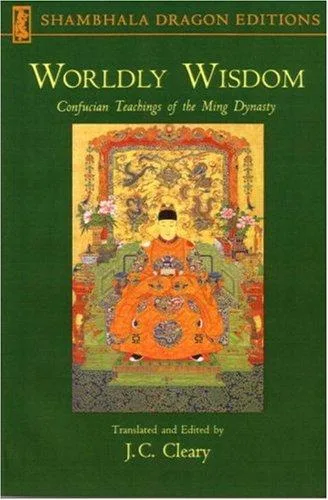
Worldly Wisdom
 75
75

Worldly Wisdom
J.C. Cleary’s "Worldly Wisdom" attempts to distill practical advice from a broad sweep of esoteric thought, a commendable if ambitious undertaking. The book’s strength lies in its ability to connect abstract philosophical ideas to actionable advice, particularly in its discussions of how to interpret daily events through the lens of universal principles. However, the work sometimes suffers from a lack of specific textual evidence for its claims; the assertion that "The Emerald Tablet of Hermes Trismegistus" (a key text in Hermeticism) directly advocates for a specific method of energy work, without deeper exegesis, feels unsubstantiated within the text itself. Despite this, the chapter on "The Law of Resonance" offers a particularly clear articulation of how one’s internal state influences external circumstances. "Worldly Wisdom" provides a useful, if occasionally generalized, guide for those seeking esoteric perspectives on practical living.
📝 Description
75
J.C. Cleary's 2001 book, Worldly Wisdom, studies practical philosophy and esoteric principles.
Worldly Wisdom examines how ancient traditions can guide contemporary life. Cleary does not promote one specific doctrine. Instead, the book combines various ideas into a system for personal growth and understanding. It is for readers who want to grasp the forces shaping human experience and society. The work appeals to those who find purely material explanations insufficient and are drawn to the overlap of philosophy, spirituality, and daily life. Those interested in applying abstract ideas to real situations will find the book valuable. Published at the start of the millennium, the book appeared during a time when interest in esoteric thought and perennial philosophy was reviving after the late 20th century's New Age movement. It connected with intellectual ideas that aimed to link ancient mystical practices with modern psychology and sociology.
Published in 2001, Worldly Wisdom fits within a broader resurgence of interest in esoteric philosophy and perennial wisdom traditions. It engages with intellectual currents that seek to synthesize ancient mystical thought with contemporary psychological and sociological frameworks. The book emerged in a period following the New Age movement, reflecting a continued search for meaning beyond purely materialistic worldviews. Cleary's work positions itself within this ongoing dialogue, drawing connections between historical spiritual teachings and the challenges of modern existence.
💡 Why Read This Book?
• Gain practical application of esoteric principles, such as understanding the "Law of Resonance" to influence your environment. • Discover how to identify and cultivate your "inner teacher" for improved decision-making, a concept explored through various wisdom traditions. • Learn to discern "right action" by aligning your choices with universal laws, as presented in Cleary’s synthesis of philosophical ideas.
⭐ Reader Reviews
Honest opinions from readers who have explored this book.
❓ Frequently Asked Questions
What esoteric traditions does "Worldly Wisdom" draw upon?
The work synthesizes concepts from various esoteric lineages, including Hermeticism, Neoplatonism, and Eastern philosophies, framing them as universal principles applicable to modern life.
Is "Worldly Wisdom" a beginner's guide to occultism?
While accessible, it assumes a certain intellectual curiosity. It's more for those already inclined towards philosophical inquiry than a strict introduction to occult practices.
When was "Worldly Wisdom" first published?
The book was first published in 2001, positioning it within a late 20th/early 21st-century resurgence of interest in spiritual and philosophical texts.
What is the "inner teacher" concept discussed in the book?
Cleary presents the "inner teacher" as an intuitive faculty or higher consciousness that guides individuals toward truth and right action, distinct from the rational intellect.
Does the book offer specific rituals or practices?
It focuses more on philosophical understanding and principles of awareness rather than detailing specific ceremonial or ritualistic practices, emphasizing internal alignment.
What makes "Worldly Wisdom" different from other self-help books?
Its distinction lies in its grounding in ancient esoteric frameworks and philosophical concepts, offering a more metaphysical and less purely psychological approach to personal development.
🔮 Key Themes & Symbolism
Inner Guidance and Discernment
The book emphasizes the development of an "inner teacher," a concept found across many mystical traditions. Cleary suggests this faculty allows for discerning truth from falsehood, guiding actions and perceptions beyond the limitations of the purely rational mind. This theme encourages readers to cultivate intuition and self-awareness as primary tools for navigating complex situations, moving beyond external validation to internal knowing.
The Principle of Correspondence
Central to "Worldly Wisdom" is the exploration of the Hermetic principle of "As Above, So Below." This idea posits that the macrocosm (universe) and microcosm (individual) are reflections of each other. Cleary uses this to illustrate how understanding universal patterns can unlock insights into personal challenges and vice versa, fostering a sense of interconnectedness and cosmic order.
Alignment and Right Action
The work advocates for living in accordance with natural and spiritual laws, termed "right action." This involves understanding one's place within a larger cosmic framework and acting in ways that promote harmony and growth, both individually and collectively. It moves beyond simple morality to a principle of energetic and philosophical congruence with universal forces.
The Nature of Reality
Cleary posits that conventional perceptions of reality are incomplete, influenced by materialist biases. The book encourages readers to consider a multi-layered view of existence, where consciousness and subtle energies play significant roles. This perspective invites a re-evaluation of what is considered "real" and the potential for conscious participation in shaping one's experience.
💬 Memorable Quotes
Direct passages from the work, attributed to the author.
“The "inner teacher" speaks not in loud pronouncements but in quiet nudges and intuitive certainties.”
— This highlights the subtle nature of inner guidance, suggesting that it requires attentive listening and a quieting of the external "noise" of the mind and the world to be perceived effectively.
“Action devoid of understanding is like a ship without a rudder.”
— This emphasizes the need for wisdom and conscious awareness to precede action. Acting without comprehending the underlying principles or consequences can lead to aimless or detrimental outcomes.
“The universe operates by laws, not by chance; to succeed is to align with them.”
— This interpretation underscores the deterministic yet orderly nature of the cosmos as presented in esoteric thought, suggesting that deliberate effort to understand and harmonize with these laws is the key to effective living.
“Wisdom is not accumulated knowledge, but the capacity to apply it appropriately.”
— This defines wisdom as a practical faculty rather than mere intellectual accumulation. It stresses the importance of discernment and skillful application of understanding in real-life situations.
💡 Key Ideas
Editorial paraphrase of the work's core concepts — not direct quotes.
Every external event is a mirror reflecting an internal state.
This paraphrase of the principle of correspondence suggests that challenges or opportunities encountered in life are not random but are external manifestations of one's inner thoughts, beliefs, and energetic patterns.
🌙 Esoteric Significance
Tradition
The work primarily draws from the Western Esoteric Tradition, particularly Hermeticism and Neoplatonism, while also incorporating elements resonant with Eastern philosophies like Vedanta. It positions itself as a modern interpretation of perennial wisdom, seeking to extract universal principles applicable across various spiritual and philosophical systems. Cleary doesn't strictly adhere to a single lineage but synthesizes concepts to create a practical philosophical system.
Symbolism
Key symbols explored include the "inner teacher," representing intuitive wisdom and direct spiritual cognition, often contrasted with the analytical intellect. The "principle of correspondence" (As Above, So Below) is a foundational motif, symbolizing the interconnectedness of all levels of existence, from the cosmic to the mundane. "Right action" functions as a symbolic directive for living in harmony with these perceived universal laws.
Modern Relevance
Contemporary thinkers and practitioners in fields like integral philosophy and consciousness studies often reference the synthesis of ideas found in works like "Worldly Wisdom." Its emphasis on the "inner teacher" and the "law of resonance" finds echoes in modern mindfulness practices, positive psychology, and the growing interest in subjective experience as a valid source of knowledge and guidance.
👥 Who Should Read This Book
• Students of comparative philosophy and religion seeking connections between diverse wisdom traditions. • Individuals interested in applying metaphysical principles to improve decision-making and personal understanding. • Seekers of a framework that integrates spiritual concepts with practical, everyday challenges.
📜 Historical Context
First published in 2001, J.C. Cleary's "Worldly Wisdom" emerged during a period of significant public engagement with alternative spiritualities and perennial philosophy. The late 20th and early 21st centuries saw a broad cultural interest in synthesizing diverse wisdom traditions, partly fueled by the legacy of the New Age movement and a growing dissatisfaction with purely materialistic worldviews. Cleary's work engaged with intellectual currents that sought to bridge ancient mystical insights with contemporary psychological and sociological understanding. It appeared in a landscape populated by authors like Fritjof Capra, whose "The Tao of Physics" (1975) had already explored the resonance between modern science and Eastern mysticism. "Worldly Wisdom" offered a more philosophically oriented approach, distinguishing itself from purely practical self-help guides by rooting its advice in established esoteric principles, such as those found in Hermeticism.
📔 Journal Prompts
The "inner teacher's" guidance in a recent decision.
Reflecting on the "principle of correspondence" in a current challenge.
How "right action" manifested or was absent in a past situation.
Interpreting a recurring external event through the lens of "The Law of Resonance."
Identifying moments where conventional perception may have limited understanding of a situation.
🗂️ Glossary
Inner Teacher
An intuitive faculty or higher consciousness within an individual that serves as a source of wisdom, guidance, and truth, distinct from the rational mind.
Principle of Correspondence
A Hermetic axiom stating that the macrocosm (universe) and microcosm (individual) are analogous and interconnected, reflecting similar patterns and laws across different levels of reality.
Right Action
Conduct aligned with universal laws and principles, promoting harmony, growth, and balance within oneself and in relation to the external world.
Law of Resonance
The concept that like attracts like; one's internal state (thoughts, emotions, beliefs) influences and attracts corresponding external circumstances and experiences.
Perennial Philosophy
The idea that all major religious and spiritual traditions share a common core of metaphysical teachings about the ultimate nature of reality and the human condition.
Macrocosm
The universe as a whole, considered as a great entity whose structure and development are reflected in the microcosm.
Microcosm
The individual human being, seen as a miniature model of the universe (macrocosm), reflecting its laws and principles.
🔮 Readers Also Liked
Browse all →









More Free Occult Philosophy Books
View all →