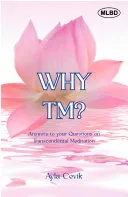
Why TM?: Answers to your Questions on Transcendental Meditation
 71
71

Why TM?: Answers to your Questions on Transcendental Meditation
Ayla Cevik’s "Why TM?" tackles the perennial questions surrounding Transcendental Meditation with a directness that serves its purpose. The book positions TM not merely as a personal development tool but as a potential catalyst for global peace, a bold claim that, while ambitious, is consistently argued. Cevik’s strength lies in demystifying the technique, presenting it as accessible to anyone regardless of prior experience. However, the work occasionally leans into the aspirational rather than the strictly analytical, particularly when discussing the global peace aspect. A specific passage detailing the "effortless" nature of the mental technique, contrasting it with concentration-based methods, effectively illustrates its unique approach. While the book provides a clear introduction, readers seeking deep comparative analysis of meditation techniques might find it less detailed. Ultimately, "Why TM?" functions effectively as a comprehensive primer for those initiating their inquiry into Transcendental Meditation.
📝 Description
71
Published in 2025, Ayla Cevik's 'Why TM?' addresses common questions about Transcendental Meditation.
Ayla Cevik's 2025 book, 'Why TM?', explains Transcendental Meditation as a simple, natural mental technique. The work aims to clarify the practice for those curious about its benefits, detailing how it promotes personal well-being and contributes to global harmony. Cevik posits that by reaching the source of one's thoughts, individuals can cultivate a more content, healthy, and effective life. The book emphasizes that TM's influence extends beyond the individual, fostering peace at societal and global scales.
This book is for anyone looking for practical ways to reduce stress, enhance personal development, and achieve greater mental clarity. It is particularly suited for those drawn to meditation but daunted by more complex methods, presenting TM as an easy introduction. Readers interested in larger issues of peace and societal betterment will also find value, as Cevik connects personal practice to collective accord. The book seeks to demystify TM's application and its effects.
While 'Why TM?' was published in 2025, it engages with the history of Transcendental Meditation, a practice popularized in the West during the mid-20th century. Maharishi Mahesh Yogi brought TM to global attention, sparking both widespread interest and academic debate regarding its psychological benefits and scientific validation. Cevik's work addresses contemporary inquiries within the context of TM's established presence over several decades, building on this historical foundation.
💡 Why Read This Book?
• You will learn the specific mechanism by which Transcendental Meditation is claimed to induce "restful alertness," a core concept detailed in the book, enabling a unique approach to stress reduction beyond mere relaxation. • You will understand the historical popularization of TM by Maharishi Mahesh Yogi in the 1960s and 1970s, providing context for the technique's global reach and its place within the broader landscape of spiritual movements. • You will discover the book's argument for how individual practice of TM, by accessing the "source of thoughts," can contribute to creating peace in one's immediate environment and extend to global harmony, a unique perspective on collective consciousness.
⭐ Reader Reviews
Honest opinions from readers who have explored this book.
❓ Frequently Asked Questions
What is the primary difference between Transcendental Meditation and other forms of meditation?
Transcendental Meditation (TM) is presented as an effortless, natural mental technique that does not involve concentration or contemplation. Unlike methods requiring focused attention, TM allows the mind to settle naturally to a state of restful alertness, accessing the source of thought as described in the book.
When was Transcendental Meditation first introduced to the public?
Transcendental Meditation, as popularized by Maharishi Mahesh Yogi, gained significant international attention and began its widespread introduction to the West primarily in the 1960s and 1970s, following its development in India.
Can practicing TM actually contribute to world peace, as the book suggests?
The book "Why TM?" posits that widespread individual practice of TM can create a cumulative effect, influencing collective consciousness and fostering greater harmony and peace globally. This concept is linked to accessing a unified field of consciousness.
Is Transcendental Meditation a religious practice?
No, TM is described as a secular mental technique, not a religion or philosophy. While its origins are in the Vedic tradition of India, its practice is open to all individuals regardless of their beliefs, focusing on the universal experience of consciousness.
What are the core benefits of practicing TM according to Ayla Cevik's book?
The book highlights benefits such as reduced stress, improved clarity of mind, increased happiness, better health, and enhanced success in life. It also suggests a contribution to creating peace within one's community and the wider world.
How does one learn Transcendental Meditation?
Learning TM typically involves instruction from a certified TM teacher. The book "Why TM?" serves as an informational guide, explaining the technique and its benefits, but formal instruction is usually required for proper practice.
🔮 Key Themes & Symbolism
Effortless Mental Technique
The book emphasizes that Transcendental Meditation is an easy, natural, and effortless mental technique, distinguishing it from methods requiring concentration or control. This core concept is presented as the key to its accessibility and effectiveness, allowing the mind to naturally settle inward. Cevik argues that this effortlessness is crucial for accessing deeper states of consciousness and achieving profound rest, which forms the basis for personal transformation and well-being.
Source of Thought
A central tenet explored is the idea of 'accessing the source of your thoughts.' The book suggests that TM provides a pathway to this fundamental level of awareness, where thoughts originate. By experiencing this source, individuals are said to gain clarity, reduce mental clutter, and tap into a reservoir of creativity and inner peace. This concept is presented as the mechanism through which TM influences all areas of life positively.
Individual to Global Peace
The work connects individual well-being fostered by TM practice to the creation of peace on a larger scale. It posits that as more individuals experience inner harmony and reduced stress through TM, this positive effect can radiate outwards, influencing communities, nations, and the entire world. This concept of 'Marmon' or world peace through collective consciousness is a significant aspect of TM's broader vision.
Holistic Well-being
TM is presented as a technique that promotes holistic well-being, impacting happiness, health, and success. The book argues that by providing deep rest and mental clarity, TM addresses the root causes of stress and unhappiness, enabling individuals to function at their full potential. This comprehensive approach suggests that TM is not just a stress-relief tool but a method for enhancing overall life quality.
💬 Memorable Quotes
Direct passages from the work, attributed to the author.
“TM Influences your life in a positive way and also contributes to creation of peace in your city, your country, and in our dear world.”
— This statement captures the book's dual focus: personal transformation and societal betterment. It asserts that the benefits of practicing Transcendental Meditation are not confined to the individual but have a ripple effect, contributing to a more harmonious environment on all levels.
“Transcendental Meditation (TM) is an easy, effortles, and natural mental technique.”
— This definition highlights the core accessibility of TM. By emphasizing its ease and naturalness, the book aims to dispel any notions that meditation requires difficult concentration or extensive practice, positioning it as a simple yet profound tool for mental development.
“All these benefits are possible, when your mind experiences the source of your thougts...”
— This highlights the proposed mechanism behind TM's effectiveness. The idea of directly experiencing the origin of one's thoughts is presented as the key to unlocking deeper states of awareness and achieving the promised benefits of happiness, health, and success.
“Do you want to have a happier, healthier, and more succesful life?”
— Framed as a direct question to the reader, this opening hook immediately addresses fundamental human desires. It serves to draw the reader in by connecting the book's subject matter directly to their personal aspirations for a better life.
“If your answer is yes, then the book "Why TM? Is for you.”
— This concluding statement to the introductory question acts as a clear call to action. It directly tells the potential reader that the book offers the solutions they are seeking, encouraging them to engage with the content to learn how TM can fulfill their desires.
🌙 Esoteric Significance
Tradition
While Transcendental Meditation is presented as a secular technique, its roots lie in the ancient Vedic tradition of India, particularly within the Upanishadic thought concerning consciousness and self-realization. It can be seen as a modern, accessible distillation of concepts related to accessing the 'transcendent' or 'absolute' state of consciousness, a common theme in many esoteric lineages seeking union with the divine or ultimate reality. It departs from more ritualistic or deity-focused traditions by emphasizing a direct, experiential approach to consciousness itself.
Symbolism
The core 'symbol' in TM is not visual but experiential: the 'transcendent' or 'pure consciousness' itself, often described as a state of 'restful alertness' or the 'source of thought.' This represents the unmanifest potential from which all manifest reality arises. The technique's simplicity and naturalness can be seen as symbolizing the idea that profound spiritual truths are often inherent and accessible, rather than requiring complex external forms or intellectual constructs.
Modern Relevance
In contemporary esoteric thought, TM continues to be relevant as a practical method for cultivating inner peace and mental clarity, which are foundational for many spiritual paths. Thinkers and practitioners in fields like consciousness studies, positive psychology, and mindfulness research often draw upon or compare TM's principles. Its emphasis on stress reduction and improved cognitive function also aligns with modern wellness movements that seek to integrate spiritual or contemplative practices into daily life for holistic health.
👥 Who Should Read This Book
['• Individuals new to meditation seeking an easy-to-learn and effortless technique, as the book clearly explains the basic principles of Transcendental Meditation and its accessible practice.', '• Those interested in the psychological and physiological benefits of meditation, particularly stress reduction and improved mental clarity, with the book detailing how TM achieves these outcomes.', '• Readers curious about the historical and philosophical underpinnings of Transcendental Meditation, as the work provides context for its popularization and its connection to ancient wisdom traditions.']
📜 Historical Context
Published in 2025, Ayla Cevik's "Why TM?" enters a field already rich with discussions on meditation and consciousness. Transcendental Meditation (TM) itself rose to prominence in the Western world during the 1960s and 1970s, largely due to the efforts of Maharishi Mahesh Yogi, who brought the technique from India. This era was marked by a burgeoning interest in Eastern philosophies and practices, often contrasting with the prevailing Western scientific and materialist viewpoints. TM’s approach, emphasizing effortless mental transcendence rather than concentration, set it apart from other meditation forms like Vipassanā or Zen, which were also gaining followings. While proponents lauded its stress-reducing and consciousness-expanding benefits, the movement also faced its share of academic skepticism and public debate. Cevik's contemporary work revisits these themes, addressing modern questions within the established historical framework of TM’s decades-long presence and global impact.
📔 Journal Prompts
The concept of accessing the 'source of thoughts' through TM.
Personal experience with the 'effortless' nature of the TM technique.
The connection between individual 'restful alertness' and global peace.
Reflecting on the goal of a 'happier, healthier, and more successful life' through TM.
Analyzing the claim that TM is a 'natural mental technique'.
🗂️ Glossary
Transcendental Meditation (TM)
A specific, effortless mental technique involving the use of a mantra to allow the mind to settle into a state of deep rest and inner awareness, known as 'restful alertness'.
Restful Alertness
A unique state of consciousness achieved through TM, characterized by deep physical rest combined with a highly alert and focused mental state, distinct from sleep or ordinary wakefulness.
Source of Thoughts
The fundamental level of consciousness from which all thoughts, ideas, and mental activity arise. Experiencing this source is central to the benefits of TM practice.
Marmon
A Sanskrit term referring to peace, often used in the context of 'Marmon' or world peace, signifying the collective impact of individual well-being generated through practices like TM.
Vedic Tradition
An ancient spiritual and philosophical tradition originating in India, from which Transcendental Meditation draws its theoretical basis concerning consciousness and the nature of reality.
Mental Technique
A method or process involving the mind to achieve a specific outcome, such as relaxation, focus, or personal growth. TM is described as a natural and effortless mental technique.
Effortless
Requiring no strain or exertion. In the context of TM, it signifies that the technique does not involve concentration, contemplation, or forced mental effort, allowing the mind to settle naturally.