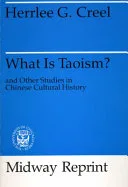
What Is Taoism?
 74
74

What Is Taoism?
Herrlee Glessner Creel's "What Is Taoism?" is a valuable but occasionally dry examination of a multifaceted spiritual tradition. Creel’s strength lies in his meticulous historical tracing and his crucial distinction between what he terms "contemplative," "purposive," and "Hsien" Taoism. This framework is indispensable for understanding the internal divergences within Taoist thought. However, the prose, while aiming for non-technical language, can sometimes feel dense, particularly when detailing the political philosophy of figures like Shen Pu-hai. A more vibrant engagement with the lived experience of these different Taoist expressions would have elevated the work further. Despite this, the book's rigorous scholarship remains a significant contribution to the field, offering a structured approach to a complex subject.
📝 Description
74
Herrlee Glessner Creel's 1982 book argues for at least three distinct, sometimes conflicting, streams of Taoist thought.
Herrlee Glessner Creel's "What Is Taoism?" offers a scholarly examination of a philosophy often seen as obscure. Published in 1982, the book critically analyzes the historical development of Taoist ideas. Creel challenges the idea that there is a single, unified "Taoism." Instead, he proposes that at least three separate, and occasionally opposing, currents shaped its evolution.
This work is suited for students of comparative religion, philosophy enthusiasts, and those interested in Eastern thought who want a clearer understanding beyond simple definitions. It appeals to readers who value historical analysis and appreciate how ancient doctrines change and diverge over time. Those curious about China's intellectual history will find considerable content here.
Creel's book appeared during a period of growing Western fascination with Eastern philosophies, but many introductions lacked depth. "What Is Taoism?" established a rigorous academic basis, setting it apart from more general spiritual guides. By concentrating on the intellectual lineage and internal disagreements within Taoism, it countered a monolithic view. The book's detailed study of figures like Shen Pu-hai places it within academic discussions of early Chinese political and philosophical ideas.
Creel's work enters the study of Taoism, a tradition often associated with esoteric practices and mystical contemplation. Unlike popular introductions that might focus on isolated legends or simplified principles, Creel grounds his analysis in historical and philosophical inquiry. He aims to map the intellectual currents that gave rise to diverse interpretations and applications of Taoist principles, moving beyond a singular, perhaps mythical, understanding of the Tao itself. This approach situates the book within a scholarly engagement with traditions that have complex internal histories and varied manifestations.
💡 Why Read This Book?
• Understand the distinct historical streams of Taoism, including "contemplative Taoism," "purposive Taoism," and "Hsien Taoism," as articulated by Creel, to grasp the philosophy's internal diversity. • Gain insight into the political philosopher Shen Pu-hai from the 4th century B.C., and his connection to specific Taoist doctrines, offering a unique perspective on early Chinese statecraft. • Appreciate the historical development of Taoism beyond a single, monolithic entity, recognizing its evolution through at least three potentially conflicting schools of thought as detailed in the book.
⭐ Reader Reviews
Honest opinions from readers who have explored this book.
❓ Frequently Asked Questions
What is the primary historical argument Herrlee Glessner Creel makes about Taoism?
Creel argues that there isn't one unified "Taoism" but rather at least three distinct, often incompatible, historical developments of the doctrine, which he categorizes.
Who was Shen Pu-hai and why is he discussed in "What Is Taoism?"
Shen Pu-hai was a 4th century B.C. political philosopher whose ideas are explored by Creel as they relate to one of the identified streams of Taoist thought.
What are the three types of Taoism Creel identifies?
Creel identifies "contemplative Taoism," "purposive Taoism," and "Hsien Taoism," each representing different historical manifestations and aims within the broader tradition.
When was "What Is Taoism?" first published?
The book "What Is Taoism?" by Herrlee Glessner Creel was first published on September 15, 1982.
Is "What Is Taoism?" suitable for absolute beginners to Eastern philosophy?
While Creel aims for non-technical language, the book's analytical depth might be best appreciated by those with some foundational interest in philosophy or comparative religion.
What distinguishes Creel's approach to Taoism from other introductions?
Creel's approach is distinguished by its rigorous historical analysis and its explicit categorization of Taoism into distinct, interacting streams, rather than presenting a singular, unified doctrine.
🔮 Key Themes & Symbolism
The Three Streams of Taoism
Creel's central thesis posits that Taoism is not monolithic but comprises at least three distinct historical and philosophical currents: contemplative, purposive, and Hsien. Contemplative Taoism aligns with naturalness and non-action (wu wei), while purposive Taoism might involve strategic action and governance, exemplified by figures like Shen Pu-hai. Hsien Taoism, often focused on longevity and immortality, represents another facet. This categorization is crucial for appreciating the diverse practices and beliefs associated with the Taoist tradition over centuries.
Historical Development and Divergence
The book traces the intellectual lineage of Taoist thought, highlighting how different schools and thinkers interpreted or even contradicted each other. By examining specific historical figures and periods, Creel illustrates the dynamic evolution of Taoist philosophy. This historical perspective is key to understanding the complex relationships between seemingly disparate elements within what is broadly termed 'Taoism,' moving beyond simplistic interpretations.
Philosophical Underpinnings of Governance
A significant aspect explored is the intersection of Taoist principles with political philosophy, particularly through the examination of Shen Pu-hai. This studies how concepts like natural governance, the role of the ruler, and the balance of power were conceived within early Chinese thought, offering a lens on practical applications of philosophical ideas beyond purely spiritual or contemplative pursuits.
The Concept of 'Tao' Itself
While not explicitly defined as a singular entity, the exploration of its varied manifestations implicitly defines the 'Tao' through its effects and interpretations. The book guides readers to understand 'Tao' not as a fixed dogma but as an underlying principle or reality that manifests differently in contemplative detachment, purposeful action, or the pursuit of transcending mortal limits.
💬 Memorable Quotes
Direct passages from the work, attributed to the author.
“there has not been one 'Taoism,' but at least three, in some respects incompatible and often antagonistic.”
— This statement captures Creel's core argument, challenging readers to move beyond a singular understanding and appreciate the historical tensions and divergences within Taoist thought.
“Creel explicates the widely used concepts he originally introduced of 'contemplative Taoism,' 'purposive Taoism,' and 'Hsien Taoism.'”
— This highlights Creel's significant contribution to Taoist scholarship, providing a framework for analyzing its diverse expressions and historical developments.
“He also discusses Shen Pu-hai, a political philosopher of the fourth century B.C.”
— This points to the book's engagement with the practical and political dimensions of early Chinese thought, connecting philosophical ideas to governance and statecraft.
“traces, in nontechnical language, the history of the development of this often baffling doctrine.”
— This emphasizes the book's aim for accessibility, seeking to explain Taoism for a broader audience through historical analysis rather than esoteric jargon.
“in eight closely related papers, Creel explicates the widely used concepts...”
— This detail reveals the structured approach of the book, breaking down complex ideas into manageable sections for systematic understanding.
🌙 Esoteric Significance
Tradition
While not strictly aligned with Western esoteric lineages like Hermeticism or Kabbalah, "What Is Taoism?" engages with a tradition that has profound esoteric dimensions, particularly "Hsien Taoism" (immortalism). It bridges the gap between academic Sinology and esoteric studies by analyzing practices aimed at longevity and transcendence within a historical and philosophical framework, offering insights relevant to those interested in alchemical and spiritual transformation traditions.
Symbolism
The book implicitly explores symbols associated with the Tao, though it focuses more on philosophical streams. Concepts like 'emptiness' (as related to the Tao's unmanifest nature) and the pursuit of immortality (in Hsien Taoism) serve as symbolic representations of ultimate goals within the tradition. The balance between 'contemplative' (yin-like) and 'purposive' (yang-like) approaches also reflects a symbolic understanding of cosmic duality.
Modern Relevance
Contemporary practitioners of mindfulness and contemplative practices often draw on principles associated with "contemplative Taoism," seeking balance and alignment with natural processes. Furthermore, discussions on effective leadership and governance in fields like management and political science can find echoes in Creel's analysis of "purposive Taoism" and figures like Shen Pu-hai, demonstrating the enduring relevance of these ancient philosophical streams.
👥 Who Should Read This Book
• Students of comparative religion and philosophy seeking a structured academic introduction to the complexities of Taoist thought beyond simplistic definitions. • Researchers in Chinese intellectual history interested in the development of ancient Chinese political philosophy and its relation to broader spiritual doctrines. • Individuals drawn to esoteric traditions who wish to understand the historical and philosophical underpinnings of practices related to longevity and spiritual transcendence, particularly within "Hsien Taoism."
📜 Historical Context
Published in 1982, Herrlee Glessner Creel's "What Is Taoism?" arrived during a period of growing Western academic and popular interest in Eastern philosophies. While many contemporary works offered generalized introductions, Creel's book distinguished itself through rigorous scholarly analysis. It directly addressed the burgeoning field of comparative religion and Chinese intellectual history, engaging with scholars who might have previously viewed Taoism as a monolithic entity. Creel's work provided a crucial counterpoint to more syncretic or New Age interpretations that were also gaining traction. By dissecting the divergences within Taoism, particularly through his concepts of 'contemplative,' 'purposive,' and 'Hsien Taoism,' and by discussing figures like the 4th-century B.C. political theorist Shen Pu-hai, Creel offered a nuanced historical perspective that challenged prevailing assumptions and contributed significantly to the scholarly discourse on early Chinese thought.
📔 Journal Prompts
The divergence between contemplative and purposive Taoism as presented by Creel.
Shen Pu-hai's approach to governance and its relation to Taoist principles.
The historical development of Hsien Taoism and its aims.
Understanding the 'Tao' through its varied historical manifestations.
How the concept of 'non-action' (wu wei) contrasts with 'purposive action' in Taoist thought.
🗂️ Glossary
Contemplative Taoism
Creel's term for a stream of Taoism emphasizing passive alignment with the natural order, non-interference (wu wei), and inner peace.
Purposive Taoism
Creel's classification for a strand of Taoism focused on strategic action, governance, and achieving specific aims, often involving political philosophy.
Hsien Taoism
Creel's concept referring to the aspect of Taoism concerned with achieving immortality, longevity, and spiritual transcendence, often through specific practices.
Shen Pu-hai
A 4th-century B.C. Chinese political philosopher whose ideas on statecraft and administration are analyzed by Creel in relation to 'purposive Taoism'.
Wu Wei
A core Taoist concept often translated as 'non-action' or 'effortless action,' signifying action aligned with the natural flow of the Tao.
Tao
The fundamental principle or ultimate reality in Taoism, often described as ineffable, the source and pattern of everything that exists.
Esoteric
Intended for or likely to be understood by only a small number of people with a specialized knowledge or interest; pertaining to inner, hidden meanings.