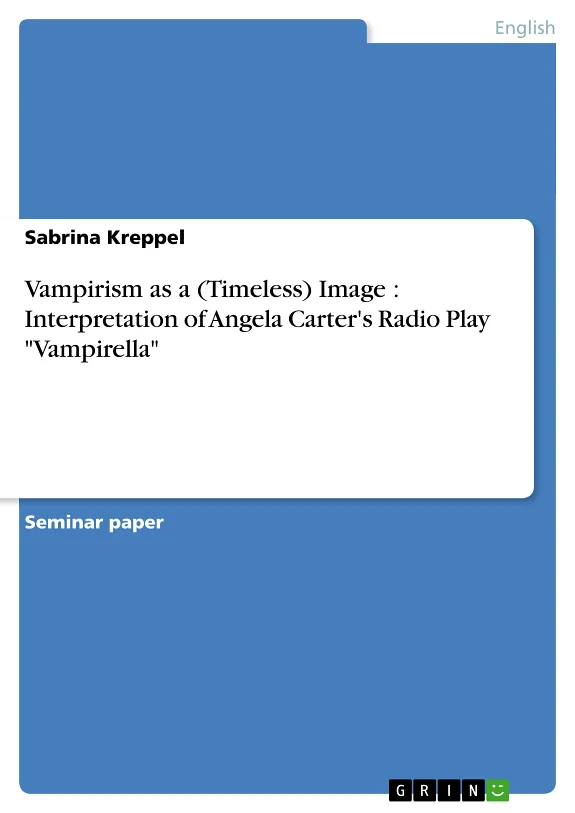
Vampirism as a (Timeless) Image : Interpretation of Angela Carter's Radio Play "Vampirella"
 84
84

Vampirism as a (Timeless) Image : Interpretation of Angela Carter's Radio Play "Vampirella"
Sabrina Kreppel's "Vampirism as a (Timeless) Image" provides a focused academic lens on Angela Carter's "Vampirella," moving beyond superficial horror analysis. The paper's strength lies in its precise dissection of how the vampire archetype functions as a symbolic tool, particularly in Carter's hands, to critique societal norms. Kreppel effectively traces the lineage of vampiric imagery through popular culture, from mid-20th-century cinema to late-20th-century literary adaptations, demonstrating its enduring, albeit shifting, relevance. A limitation, however, is the paper's brevity as a seminar work; while insightful, it leaves one wishing for a more expansive exploration of the psychoanalytic dimensions often associated with vampirism. The interpretation of "Vampirella" as a site where traditional gender roles and power structures are both invoked and subverted is particularly compelling. Ultimately, Kreppel offers a sharp, concise academic argument on the semiotics of the vampire.
📝 Description
84
Sabrina Kreppel's 2002 seminar paper analyzes vampirism as a potent image in Angela Carter's "Vampirella."
Published in 2002, Sabrina Kreppel's seminar paper, "Vampirism as a (Timeless) Image: Interpretation of Angela Carter's Radio Play 'Vampirella'," examines the function of vampiric imagery across different media and historical periods. The study originates from a seminar held at the University of Frankfurt (Main). Kreppel moves beyond conventional horror interpretations to uncover deeper symbolic significance. The paper traces the enduring archetype of the vampire, referencing popular culture from 1950s films to contemporary works like "Interview with the Vampire." This contextualization demonstrates the vampire myth's lasting appeal and its adaptability as a cultural symbol.
Kreppel's central argument posits vampirism not simply as a monstrous figure, but as a flexible image. This image, she contends, represents societal anxieties and desires related to sexuality, power, and the crossing of boundaries. Angela Carter's radio play "Vampirella" serves as a specific case study, illustrating how this traditional lore is reconfigured. The analysis is valuable for scholars of English literature, cultural studies, and esoteric symbolism, particularly those interested in Angela Carter's engagement with mythological themes and the evolution of the vampire figure in Western culture.
This paper situates vampirism within broader cultural mythologies and psychological underpinnings, examining its persistent presence and symbolic adaptability. By analyzing how the vampire figure is reconfigured across various media, Kreppel connects it to enduring human fascinations and anxieties. The focus on vampirism as an "image" suggests an interest in archetypal forms and their manifestation in modern narratives, aligning with traditions that study recurring symbols and their psychological resonance within culture.
💡 Why Read This Book?
• Gain a nuanced understanding of vampirism as a symbolic image, moving beyond horror clichés, by analyzing its specific application in Angela Carter's "Vampirella" through Kreppel's academic framework. • Trace the evolution of the vampire archetype across distinct cultural moments, from 1950s "Dracula" films to contemporary media, to grasp its adaptive power. • Explore how literary and dramatic works, like Carter's radio play, utilize the vampire figure to comment on societal anxieties regarding sexuality and power dynamics, as detailed in the paper's analysis.
⭐ Reader Reviews
Honest opinions from readers who have explored this book.
❓ Frequently Asked Questions
What is the primary focus of Sabrina Kreppel's "Vampirism as a (Timeless) Image"?
The paper primarily focuses on interpreting Angela Carter's radio play "Vampirella" through the lens of vampirism as a symbolic and adaptable image, examining its function beyond simple horror tropes.
When and where was this seminar paper originally presented?
Sabrina Kreppel's seminar paper was presented in 2002 at the University of Frankfurt (Main) in the subject of English Language and Literature Studies.
How does the paper connect "Vampirella" to broader cultural trends?
It connects "Vampirella" by tracing the popularity and evolving representation of the vampire figure in various media, referencing examples from 1950s cinema to 1980s and modern productions.
What academic grade did this paper receive?
The paper received a grade of 2 (B) from the University of Frankfurt (Main).
What is the core argument regarding the 'image' of the vampire?
The core argument is that the vampire serves as a potent, enduring image capable of representing diverse societal anxieties and desires, particularly related to power and transgression, as exemplified in Carter's play.
Is this a full book or a scholarly article?
This is a seminar paper, originally presented as part of academic coursework in 2002, focusing on a specific analysis of Angela Carter's work.
🔮 Key Themes & Symbolism
The Vampire as Symbolic Image
Kreppel's work positions the vampire not as a literal creature but as a potent, malleable image that transcends its horror origins. This image is explored for its capacity to embody complex societal fears and desires, particularly concerning forbidden sexuality, power dynamics, and the transgression of boundaries. The analysis of Carter's "Vampirella" serves to illustrate how this archetypal figure can be reconfigured to critique contemporary social structures and psychological states, demonstrating the enduring symbolic weight of the vampire across different cultural productions.
Evolution of Vampiric Tropes
The paper charts the shifting representation of the vampire across various media and eras, moving from the iconic Dracula figures of 1950s cinema to the more nuanced portrayals in 1980s and contemporary works. This historical perspective reveals how the vampire's image adapts to reflect the specific anxieties and cultural preoccupations of its time. Kreppel uses this evolution to argue for the vampire's persistent relevance as a cultural signifier, capable of being reinterpreted to address new thematic concerns while retaining its core symbolic power.
Carter's "Vampirella" as a Case Study
Angela Carter's radio play "Vampirella" is presented as a crucial text for understanding vampirism as a sophisticated image. Kreppel's interpretation highlights how Carter employs and subverts traditional vampire lore to explore themes of female agency, power exchange, and the uncanny. The analysis focuses on how the play's specific narrative and thematic elements contribute to the broader discourse on the vampire as a symbol, revealing its potential for deconstructing and reconstructing cultural narratives around gender and desire.
Vampirism and Societal Anxieties
The paper explores how the image of the vampire serves as a vehicle for exploring deep-seated societal anxieties. These anxieties often revolve around themes of repressed sexuality, the fear of the 'other,' and the seductive danger of transgression. By examining "Vampirella," Kreppel illustrates how the vampire archetype can be used to confront and articulate these often-unspoken cultural tensions, offering a critical lens through which to view the psychological underpinnings of the myth's enduring appeal.
💬 Memorable Quotes
Direct passages from the work, attributed to the author.
“The enduring success of vampire figures across decades signifies their function as adaptable symbolic images.”
— This highlights the paper's central thesis: that the vampire's power lies not in literal representation but in its symbolic flexibility, allowing it to resonate with changing cultural concerns over time.
“Angela Carter's 'Vampirella' reconfigures traditional vampire lore to address contemporary themes.”
— This points to the specific focus on Carter's work as a primary example, suggesting the play offers a modern interpretation that twists or updates classic vampire tropes for new meanings.
“Popular media from the 1950s to the present demonstrates the vampire's persistent cultural impact.”
— This idea underscores the paper's contextualization, showing how Kreppel draws on a range of cultural examples to build her argument about the vampire's lasting presence and adaptability.
“The paper examines the image of the vampire beyond its function as a simple horror antagonist.”
— This emphasizes the analytical approach taken, indicating that Kreppel moves beyond genre conventions to explore the deeper symbolic and thematic layers of the vampire figure.
💡 Key Ideas
Editorial paraphrase of the work's core concepts — not direct quotes.
Vampirism as an image speaks to anxieties surrounding sexuality and power.
This paraphrase captures a key interpretation of the vampire's symbolic function, linking it to fundamental human psychological and social concerns that make the archetype perpetually relevant.
🌙 Esoteric Significance
Tradition
While not explicitly aligning with a single esoteric lineage, Kreppel's work touches upon themes resonant within Hermetic and Gnostic traditions. The exploration of the vampire as a symbol of repressed desires, primal energies, and the transgression of boundaries can be seen as reflecting certain interpretations of the shadow self or the daemonic in Western esotericism. The focus on symbolic imagery and archetypal figures aligns with methods found in hermeneutic traditions that seek deeper, hidden meanings within cultural artifacts. The paper contributes to an esoteric understanding by analyzing how these ancient symbolic forms persist and are reinterpreted in modern cultural expressions.
Symbolism
The vampire figure itself is a potent symbol, often representing the shadow self, forbidden knowledge, or the seductive allure of forbidden energies in various esoteric traditions. In the context of Carter's "Vampirella," Kreppel's analysis likely explores how this figure can symbolize the subversion of patriarchal power structures or the reclamation of primal feminine energies. The act of 'feeding' or consuming can be interpreted esoterically as the absorption of vital force or psychic energy, a concept present in various occult practices. The nocturnal aspect of the vampire also connects to the hidden, the subconscious, and the lunar mysteries.
Modern Relevance
Contemporary scholars and practitioners interested in feminist interpretations of mythology, psychoanalytic literary criticism, and the semiotics of horror find Kreppel's analysis relevant. Thinkers exploring the evolution of archetypes in popular culture, particularly those examining the enduring power of figures like the vampire, can draw upon this work. Furthermore, artists and writers engaging with gothic themes or seeking to deconstruct traditional narratives might find inspiration in Kreppel's methodical approach to symbolic imagery and its cultural adaptation.
👥 Who Should Read This Book
• Academic researchers and students of English Literature and Cultural Studies interested in the symbolic functions of the vampire archetype across media. • Fans of Angela Carter's work, particularly those seeking in-depth critical analysis of her engagement with mythology and gothic themes in "Vampirella." • Individuals exploring esoteric symbolism and its manifestation in popular culture, seeking to understand how archetypal figures like the vampire carry deeper psychological and societal meanings.
📜 Historical Context
Published in 2002, Sabrina Kreppel's seminar paper emerged during a period of renewed scholarly and popular interest in gothic literature and the figure of the vampire, following the success of films like "Interview with the Vampire" (1994) and television series like "Buffy the Vampire Slayer" (1997). The work situates itself within English Language and Literature Studies, a field increasingly engaged with post-structuralist and feminist critiques of literary archetypes. Kreppel’s analysis of Angela Carter, a prominent figure in late 20th-century postmodern literature known for her reinterpretations of fairy tales and myths, aligns with contemporary critical trends that sought to deconstruct traditional narratives. While the paper doesn't explicitly engage with a competing school of thought by name, its focus on symbolic interpretation and cultural context implicitly positions it against purely formalist or historical approaches to literature. The reception of such papers within academic institutions like the University of Frankfurt (Main) indicates a broader academic interest in exploring the cultural semiotics of persistent mythological figures.
📔 Journal Prompts
The symbolic function of the vampire image in media from the 1950s to modern productions.
Angela Carter's specific reinterpretation of vampire lore in "Vampirella."
The connection between vampirism as an image and anxieties surrounding sexuality and power.
How the vampire archetype adapts to reflect the cultural context of its era.
The significance of the vampire as a symbol beyond its role in horror narratives.
🗂️ Glossary
Vampirism
In this context, not literal blood-drinking, but the symbolic representation and cultural archetype of the vampire, examined for its thematic and psychological resonance.
Archetype
A recurring symbolic image, character type, or motif that is universally understood, often drawn from mythology and folklore, serving as a fundamental element in literature and culture.
Symbolic Image
A representation that carries meaning beyond its literal form, often embodying abstract concepts, emotions, or societal concerns, as explored with the vampire figure.
Semiotics
The study of signs and symbols and their interpretation, used here to analyze the meaning and function of the vampire image in cultural texts.
Gothic Literature
A literary genre characterized by elements of horror, death, and gloom, often featuring supernatural elements, decaying settings, and psychological suspense.
Postmodernism
A broad intellectual and cultural movement that questions grand narratives, emphasizes subjectivity, and often employs irony, pastiche, and deconstruction in its approach to art and literature.
Angela Carter's 'Vampirella'
A specific radio play by author Angela Carter, analyzed in the paper for its unique contribution to the discourse on vampiric imagery and its symbolic applications.
This book appears in 1 collection
🔮 Readers Also Liked
Browse all →








From the “Vampirism” Collection
View all →







More Free Occult Philosophy Books
View all →