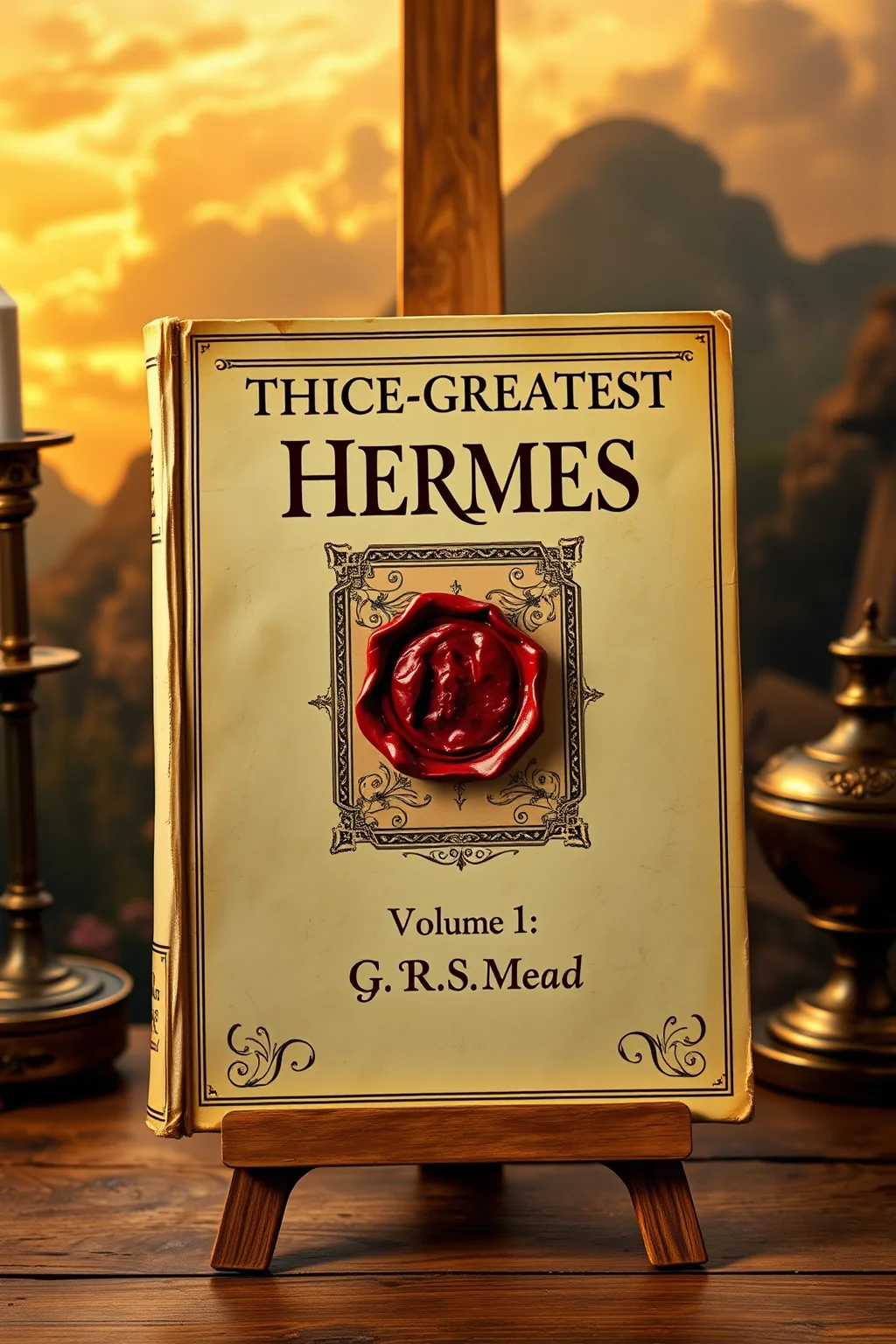
Thrice-Greatest Hermes, Vol. 1
 78
78

Thrice-Greatest Hermes, Vol. 1



G.R.S. Mead's 'Thrice-Greatest Hermes, Vol. 1' stands as a monumental achievement in the study of Hermetic literature. Mead's scholarly rigor and profound spiritual intuition converge to present these sacred texts with unparalleled clarity and depth. This volume is not merely a translation but an initiation into the philosophical underpinnings of Western esotericism, offering profound insights into divine nature, the cosmos, and the human soul. Its strength lies in its comprehensive approach and Mead's ability to render complex ideas accessible without sacrificing their inherent mystery. Essential for scholars, serious students of mysticism, and practitioners seeking to connect with ancient gnosis.
📝 Description
78
G.R.S. Mead published Volume 1 of 'Thrice-Greatest Hermes' in 1893, translating key Hermetic texts.
This first volume of G.R.S. Mead's translation of the Hermetic Corpus presents texts attributed to Hermes Trismegistus. Mead sought to make these ancient writings accessible, accompanying them with substantial commentary. The book includes translations of influential works like the 'Poemandres' and the 'Asclepius.' These texts discuss the creation of the cosmos, the nature of God, and humanity's place within the universe. Mead's annotations aim to clarify the complex philosophical and spiritual ideas within the dialogues. The introduction provides historical context for the Hermetic tradition and Mead's approach to its study. This work offers a direct engagement with the source material that underpinned much of Western esoteric thought.
The Hermetic tradition, originating from texts attributed to the legendary figure Hermes Trismegistus, represents a significant stream in Western esotericism. These writings, compiled primarily in Greco-Roman Egypt, blend Egyptian religious concepts with Greek philosophy. They influenced Neoplatonism, Gnosticism, and later Renaissance Hermeticism. Mead's work in the late 19th century was part of a renewed scholarly and popular interest in these ancient sources, aiming to present them with philological rigor and an understanding of their spiritual significance. The Corpus discusses topics like divine providence, the nature of the Nous (Mind), and the path to spiritual knowledge.
💡 Why Read This Book?
Uncover the foundational wisdom of the Hermetic tradition, explore the origins of Western esoteric thought, and gain profound insights into the nature of divinity, the cosmos, and the human soul. This volume is crucial for scholars, spiritual seekers, and practitioners of alchemy and mysticism who wish to engage with the source texts of profound metaphysical inquiry.
⭐ Reader Reviews
Honest opinions from readers who have explored this book.
❓ Frequently Asked Questions
What is the significance of Hermes Trismegistus?
Hermes Trismegistus is a legendary syncretic figure, revered as the author of the Hermetic Corpus. He embodies divine wisdom, bridging Egyptian and Greek traditions, and is considered the progenitor of alchemy, astrology, and the occult arts.
What is the Hermetic tradition?
The Hermetic tradition is a philosophical and spiritual system based on the teachings attributed to Hermes Trismegistus. It emphasizes divine knowledge, the interconnectedness of all things, and the pursuit of spiritual enlightenment through understanding the cosmos.
What does 'Thrice-Greatest' refer to?
The epithet 'Thrice-Greatest' (Trismegistus) signifies Hermes' mastery over three realms: philosophy, alchemy, and astrology, or alternatively, his possession of divine, cosmic, and psychic knowledge.
Who was G.R.S. Mead?
George Robert Stow Mead (1863-1933) was a prominent scholar and translator of esoteric and Gnostic texts. He dedicated his life to making ancient mystical literature accessible to a modern audience.
Is this book suitable for beginners?
While dense with profound concepts, Mead's scholarly approach and introductory notes make this volume accessible to dedicated beginners eager to delve into the depths of Hermetic philosophy. Prior familiarity with metaphysical concepts is beneficial but not strictly required.
🔮 Key Themes & Symbolism
The Divine Nature and Cosmic Order
This volume explores the profound Hermetic understanding of God as the ultimate source and principle of all existence. It explores the concept of a benevolent, all-encompassing deity and the intricate, divinely ordained structure of the cosmos. Readers will discover how the universe is seen as a manifestation of divine thought and will, governed by immutable laws. The texts elucidate the interconnectedness of all things, from the smallest atom to the grandest celestial bodies, revealing a universe imbued with sacred meaning and purpose, guiding the soul towards an understanding of its own divine spark within the grand cosmic collection.
The Ascent of the Soul and Gnosis
Central to the Hermetic path is the concept of the soul's journey towards spiritual liberation and reunion with the divine. This volume illuminates the process of gnosis – intuitive knowledge of the divine – as the key to transcending the material world and its illusions. It explores the challenges and obstacles encountered on this spiritual path, emphasizing self-purification, contemplation, and the awakening of inner faculties. The texts offer practical guidance and philosophical insights for the soul's upward ascent, encouraging the seeker to recognize their own divinity and achieve a state of enlightened consciousness, free from the limitations of ignorance.
Esoteric Symbolism and Allegory
The Hermetic Corpus is rich with layered symbolism and allegorical narratives designed to convey profound spiritual truths in a veiled manner. This volume provides a crucial entry point into deciphering these sacred symbols, which represent universal principles, cosmic forces, and stages of spiritual development. From the imagery of light and darkness to the alchemical metaphors of transformation, each symbol serves as a key to unlocking deeper layers of meaning. Mead's scholarly annotations aid in navigating this symbolic language, allowing readers to perceive the profound metaphysical concepts encoded within the ancient narratives, fostering a richer understanding of the esoteric worldview.
💬 Memorable Quotes
Direct passages from the work, attributed to the author.
“Know thyself, and thou shalt know the universe and the gods.”
— This aphorism captures the Hermetic principle of microcosm-macrocosm correlation. True self-understanding is the key to comprehending the divine and the universal order, as the divine essence resides within each individual.
“The All is Mind; the All is.”
— A fundamental Hermetic axiom stating the absolute primacy of Mind or Consciousness. The universe is seen as a mental creation, with all reality stemming from a single, universal Mind.
“As above, so below; as below, so above.”
— This principle, known as the Law of Correspondence, highlights the mirroring relationship between the spiritual (above) and the material (below), suggesting that understanding one realm can illuminate the other.
“The eye with which I see God is the same eye with which God sees me.”
— This profound statement points to the unity of the individual soul with the divine. It suggests that our perception of the divine is, in essence, the divine perceiving itself through us.
💡 Key Ideas
Editorial paraphrase of the work's core concepts — not direct quotes.
God is the measure of all things.
This quote emphasizes the divine as the ultimate standard and source of reality. All existence, knowledge, and value are ultimately derived from or measured against the divine principle.
🌙 Esoteric Significance
Tradition
Hermeticism is a core part of Western esoteric traditions, profoundly influencing Gnosticism, alchemy, astrology, Kabbalah, and modern occultism. It provides a philosophical framework for understanding the divine, the cosmos, and the human potential for spiritual transformation through knowledge and inner work.
Symbolism
Hermeticism is rich in symbolism, employing concepts like the Emerald Tablet, the caduceus, and celestial correspondences. These symbols represent cosmic principles, alchemical processes, and the journey of the soul, serving as keys to unlock deeper metaphysical understanding and facilitate spiritual realization.
Modern Relevance
In contemporary times, Hermeticism continues to inspire seekers and scholars interested in ancient wisdom, consciousness studies, and personal transformation. Its emphasis on self-knowledge, the interconnectedness of all things, and the pursuit of inner gnosis remains highly relevant for working through the complexities of modern life and seeking spiritual fulfillment.
👥 Who Should Read This Book
This volume is indispensable for scholars of ancient philosophy, comparative religion, and the history of esotericism. Spiritual seekers and practitioners of occult arts, such as alchemy and ceremonial magic, will find invaluable foundational teachings. Beginners interested in the roots of Western mysticism will benefit from Mead's clear exposition, though a dedicated approach is recommended. Those drawn to Gnosticism, Neoplatonism, or the perennial philosophy will discover a crucial link in the chain of esoteric thought.
📜 Historical Context
Emerging from the Hellenistic period (roughly 3rd century BCE to 3rd century CE), the Hermetic tradition flourished in the multicultural milieu of Egypt, particularly Alexandria. This era was characterized by the fusion of Egyptian religious beliefs, Greek philosophy (Platonism, Stoicism), and nascent Gnostic ideas. The texts attributed to Hermes Trismegistus, though compiled and likely written during this period, claim an ancient Egyptian origin, lending them an aura of primordial wisdom. The Hermetic Corpus influenced Neoplatonism, early Christian thought, and later Renaissance occultism, alchemy, and Rosicrucianism, acting as a vital conduit for mystical and philosophical ideas across centuries and diverse intellectual movements.
📔 Journal Prompts
Reflect on the concept of 'As above, so below' in your daily life. Where do you see correspondences between your inner world and external circumstances?
Meditate on the idea of 'Know thyself.' What aspects of your being do you feel you understand most deeply, and what remains mysterious?
Consider the Hermetic view of the universe as a manifestation of Mind. How does this perspective shift your understanding of reality and your place within it?
Explore the idea of gnosis. What does intuitive knowledge mean to you, and how might you cultivate it in your spiritual practice?
If God is the measure of all things, how does this influence your perception of value, purpose, and the ultimate nature of existence?
🗂️ Glossary
Gnosis
Intuitive or direct spiritual knowledge of divine mysteries, often seen as the key to salvation or enlightenment in Gnostic and Hermetic traditions. It is a knowing that transcends rational understanding.
Hermeticism
A philosophical and religious tradition based on the writings attributed to Hermes Trismegistus, emphasizing divine wisdom, the unity of the cosmos, and the potential for human spiritual ascent.
Cosmology
The study of the origin, structure, and evolution of the universe. In Hermeticism, it refers to the divinely ordered system of heavens, earth, and the spiritual realms.
Metaphysics
A branch of philosophy that deals with the fundamental nature of reality, including the relationship between mind and matter, substance and attribute, and potentiality and actuality.
Theurgy
A system of ritual practice aimed at invoking divine beings or forces to achieve spiritual purification, union with the divine, or other transformative effects.
This book appears in 6 collections
🔮 Readers Also Liked
Browse all →





From the “Transcendental Meditation” Collection
View all →







More Free Sacred Texts & Gnosticism Books
View all →