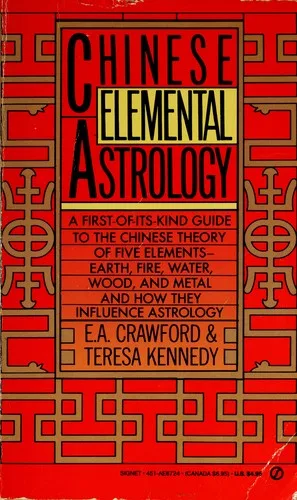
Chinese elemental astrology
 63
63

Chinese elemental astrology


Sophia Crane (Associate Editor) — E. A. Crawford's 'Chinese Elemental Astrology' is an indispensable beacon for serious students of esoteric lore. Crawford illuminates the complex interplay of the Five Elements and the twelve Earthly Branches with remarkable clarity and depth, moving beyond superficial interpretation to reveal profound metaphysical insights. This work is a testament to the enduring power of ancient Chinese cosmology, offering practitioners a robust framework for understanding karmic patterns and energetic influences. It is particularly valuable for its rigorous approach to the subject matter, making it an essential resource for both neophytes venturing into this rich tradition and seasoned practitioners seeking to deepen their understanding of this sacred art.
📝 Description
63
E. A. Crawford's 1990 book unpacks the Five Elements of Chinese astrology.
This book examines the system of Chinese elemental astrology, detailing how the Five Elements—Wood, Fire, Earth, Metal, and Water—interact with the twelve zodiac animals. Crawford explains the symbolism within the lunar calendar and its connection to personal characteristics, life paths, and broader cosmic influences. The text presents the cosmos as a dynamic system, mirroring human experience through celestial patterns.
It provides a framework for understanding how these astrological principles shape personality and destiny. The author aims to reveal the underlying mystical connections that influence human lives. This work serves as a guide for those interested in the esoteric dimensions of Chinese cosmology and its application to personal understanding.
Chinese elemental astrology is part of a broader system of Chinese metaphysics that seeks to understand the relationships between heaven, earth, and humanity. It draws on concepts like Yin and Yang and the Five Elements, which are seen as fundamental forces in the universe. This tradition views astrological configurations not as deterministic fate, but as a map of potentials and tendencies that can be understood and worked with. It is often integrated with practices like Feng Shui and Traditional Chinese Medicine, all aiming for harmony and balance.
💡 Why Read This Book?
Unveil the hidden archetypes of your being and the cosmic blueprint guiding your path. This book offers a profound exploration of the Five Elements and their symbolic resonance, providing practical tools for self-discovery and spiritual growth. Ideal for seekers, astrologers, and scholars interested in the mystical dimensions of Chinese cosmology.
⭐ Reader Reviews
Honest opinions from readers who have explored this book.
❓ Frequently Asked Questions
What are the Five Elements in Chinese astrology?
The Five Elements are Wood, Fire, Earth, Metal, and Water. They represent fundamental cosmic forces that interact, create, and destroy, influencing personality, relationships, and life events within the Chinese astrological system.
How does the Chinese Zodiac differ from Western Astrology?
Chinese astrology is based on a 12-year cycle of animal signs, each imbued with elemental influences, rather than the 12 monthly zodiac signs of Western astrology. It emphasizes cyclical time and elemental interactions.
Can I use this book to understand my personal destiny?
Absolutely. The book provides the foundational knowledge to interpret your birth chart within the Chinese elemental system, revealing key influences on your personality, strengths, challenges, and life path.
Is this book suitable for beginners?
Yes, while rich in detail, Crawford's accessible prose makes the core concepts understandable for those new to Chinese astrology, while offering depth for advanced practitioners.
What is the role of Yin and Yang in Chinese elemental astrology?
Yin and Yang are fundamental principles of duality and balance that underpin the Five Elements. Their interplay dictates the dynamic relationships and energetic flow within the astrological system.
🔮 Key Themes & Symbolism
The Symphony of the Five Elements
Explore the intricate dance of Wood, Fire, Earth, Metal, and Water, the foundational forces that govern the cosmos and human existence. Each element embodies distinct energies, qualities, and cyclical transformations. Understanding their dynamic interplay—creation and destruction, balance and imbalance—is key to deciphering the complex set of Chinese elemental astrology. This section explores the symbolic meanings and energetic signatures of each element, revealing how they manifest in individual personalities, relationships, and the unfolding of destiny, offering a profound lens through which to view the universe.
The Twelve Animal Archetypes
Journey through the vibrant menagerie of the Chinese Zodiac, where each of the twelve animals—Rat, Ox, Tiger, Rabbit, Dragon, Snake, Horse, Goat, Monkey, Rooster, Dog, and Pig—embodies unique archetypal energies and characteristics. These animals are not mere symbols but potent embodiments of cosmic influences that shape our innate nature and life's journey. This theme unravels the symbolic language of each animal, their elemental affiliations, and their inherent strengths and challenges, providing clear insights into personal compatibility, karmic predispositions, and the cyclical ebb and flow of fortune as dictated by the lunar calendar.
Cosmic Cycles and Destiny's Tie
Explore the profound concept of cosmic time and its influence on human destiny within the framework of Chinese elemental astrology. This theme illuminates how the cyclical nature of the heavens, governed by the lunar calendar, the Five Elements, and the twelve animal signs, intricately ties the fabric of our lives. It reveals the esoteric understanding of karma, reincarnation, and the universal patterns that guide our experiences. Understanding these cycles allows for a deeper appreciation of life's unfolding, enabling individuals to navigate challenges with greater wisdom and align themselves with auspicious energies.
💬 Memorable Quotes
Direct passages from the work, attributed to the author.
“Within each element, a universe resides.”
— Highlights the profound depth and complexity contained within each of the Five Elements, suggesting they are not simple categories but intricate systems of energy and meaning.
“Harmony is found in balanced flow.”
— Underscores the central tenet of Eastern philosophies: achieving well-being and success through the cultivation of equilibrium and smooth transitions between energies.
“The beast within reflects the celestial dance.”
— Connects the archetypal energies of the zodiac animals to the grander cosmic movements, suggesting that our inner nature is a microcosm of the universal order.
“Knowledge of the cycles is the key to freedom.”
— Implies that understanding the predictable patterns of time and influence allows one to transcend limitations and make conscious choices.
💡 Key Ideas
Editorial paraphrase of the work's core concepts — not direct quotes.
The stars do not command, they suggest.
This quote emphasizes the guiding, rather than dictating, nature of astrological influence, encouraging active participation in shaping one's destiny.
🌙 Esoteric Significance
Tradition
This work is deeply rooted in the esoteric traditions of ancient China, particularly within the broader umbrella of Taoist cosmology and its philosophical underpinnings. It draws upon concepts like the I Ching, the principles of Yin and Yang, and the cyclical theories of time to interpret the energetic signatures of individuals and events. The system is not merely predictive but a profound map for understanding the flow of Qi (vital energy) and aligning oneself with the natural order of the universe, aiming for spiritual cultivation and harmonious existence.
Symbolism
The symbolism within Chinese elemental astrology is rich and multi-layered. The Five Elements (Wood, Fire, Earth, Metal, Water) represent core energies and their interactions, while the twelve animal signs embody archetypal human characteristics and life stages. The Heavenly Stems and Earthly Branches form a complex matrix of celestial influences. Each combination generates unique energetic profiles, offering symbolic interpretations of personality traits, potential challenges, and auspicious timings for various endeavors, guiding the practitioner toward deeper self-awareness and cosmic connection.
Modern Relevance
In an era often characterized by disconnection and rapid change, Chinese elemental astrology offers a powerful framework for re-establishing a sense of grounding and cosmic interconnectedness. Its emphasis on cyclical time, balance, and understanding inherent energetic patterns provides valuable tools for navigating personal and collective challenges. The wisdom embedded in this ancient system can foster greater self-awareness, improve interpersonal relationships through understanding compatibility, and guide individuals toward a more purposeful and harmonious life, aligning their personal journey with the grander rhythms of the universe.
👥 Who Should Read This Book
This informative text is essential for anyone seeking to deepen their understanding of destiny and the unseen forces that shape human experience. **Beginners** will find a clear and accessible introduction to the foundational principles of Chinese elemental astrology. **Scholars** and **practitioners** of astrology, both Eastern and Western, will discover a wealth of intricate detail and nuanced interpretation. **Spiritual seekers** yearning for a more profound connection to cosmic patterns and a map for personal growth will find this book an invaluable guide on their path to self-discovery and universal harmony.
📜 Historical Context
E. A. Crawford's "Chinese Elemental Astrology" emerges from a rich tradition of cosmological inquiry that spans millennia. Developed within ancient Chinese philosophical and astronomical frameworks, the system of elemental astrology evolved alongside Taoism and Confucianism, deeply integrating concepts of Yin and Yang, Qi (vital energy), and the cyclical nature of time. Its roots lie in the meticulous observation of celestial bodies and their perceived correlation with terrestrial events, from agricultural cycles to imperial governance. This knowledge was not merely academic but a vital tool for understanding the mandate of heaven, guiding rulers, and informing personal life choices. The book stands as a conduit to this ancient wisdom, preserving and informative a practice that has profoundly influenced East Asian culture and continues to offer clear insights into the human condition.
📔 Journal Prompts
Reflect on the element that dominates your birth chart and how its qualities manifest in your daily life.
Consider the relationship between your birth animal sign and your core personality traits. Are there areas of tension or harmony?
How do the cycles of the year, as represented by the animals and elements, influence your mood and energy levels?
Identify a recurring challenge in your life and explore how its elemental or animal correspondences might offer a new perspective.
What are your intentions for aligning yourself more harmoniously with the cosmic energies described in this book?
🗂️ Glossary
Qi (Chi)
The vital life force or energy that flows through all things. In Chinese elemental astrology, Qi is the fundamental substance and dynamic principle that connects the macrocosm (universe) and the microcosm (human being).
Yin and Yang
The fundamental principles of duality and complementary opposites that govern the universe. Yin represents passive, feminine, dark, and receptive qualities, while Yang represents active, masculine, light, and creative qualities. They are interdependent and constantly transform into one another.
Heavenly Stems
A set of ten cyclical characters (often associated with the Five Elements in their Yin and Yang forms) that form the basis of the Chinese calendar and are used in astrological calculations to represent celestial influences.
Earthly Branches
A set of twelve cyclical characters, corresponding to the twelve animals of the Chinese zodiac. They represent terrestrial influences and are paired with the Heavenly Stems to create a sixty-year cycle known as the Sexagenary Cycle.
BaZi (Eight Characters)
Literally 'Eight Characters,' this refers to the four pairs of Heavenly Stems and Earthly Branches that represent the year, month, day, and hour of a person's birth. It is the core of Chinese elemental astrology for individual analysis.
This book appears in 2 collections
🔮 Readers Also Liked
Browse all →









More by E. A. Crawford
All books →
From the “Astrology” Collection
View all →








More Free Astrology & Cosmology Books
View all →