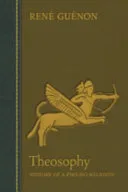
Theosophy
 75
75

Theosophy
Guénon's "Theosophy" offers a bracingly unsentimental look at the movement founded by Helena Blavatsky. Unlike many contemporary analyses that might praise its eclectic reach, Guénon approaches the subject with the sharp scalpel of a traditionalist philosopher. His strength lies in his meticulous dissection of Theosophical doctrines, comparing them against what he posits as orthodox metaphysical principles derived from ancient traditions like Hinduism and Buddhism. He is particularly incisive when discussing the Theosophical Society's claims of possessing secret knowledge and its interpretation of Eastern cosmology. However, the book's limitation for a general reader is its dense, often abstract prose and its assumption of prior familiarity with Guénon's own philosophical system. A passage that particularly illustrates Guénon's critical stance is his examination of the Theosophical concept of "elemental beings," which he argues is a misconstrued interpretation of traditional elemental forces. For those prepared for its intellectual rigor, Guénon's work provides an indispensable, albeit challenging, critique of a foundational modern esoteric movement.
📝 Description
75
René Guénon's "Theosophy" was published in 2001, though written by the author decades earlier.
René Guénon's "Theosophy" scrutinizes the Theosophical Society, a movement that gained traction in the late 19th century. Guénon, a critic of modern Western thought, analyzes the society's claims to ancient wisdom. He examines how the movement presented Eastern traditions and its own esoteric doctrines. This book is not an endorsement of Theosophy. Instead, it offers a critical assessment from a traditionalist viewpoint. Guénon seeks to distinguish authentic spiritual transmission from what he perceived as its modern corruptions.
The work is intended for serious students of esotericism, comparative religion, and intellectual history. Readers interested in the origins and philosophical basis of modern occult movements will find it useful. Those who want a critical, scholarly analysis of Helena Blavatsky's Theosophical Society and its relation to perennial philosophies will appreciate Guénon's methodical approach. It is particularly suited for individuals already familiar with traditionalist thinkers and esoteric concepts.
Guénon's "Theosophy" engages with the Traditionalist School, an intellectual current that posits a universal spiritual tradition underlying all exoteric religions. The book's publication date, 2001, belies its author's lifelong critique of modern spiritual movements. Guénon saw figures like Helena Blavatsky and Annie Besant as deviating from true esoteric principles. His work contrasts their interpretations with what he considered the pure, unbroken transmission of spiritual knowledge from antiquity. This book is situated within a broader critique of how modern Western culture often misunderstands or distorts ancient spiritual teachings.
💡 Why Read This Book?
• Understand Guénon's critique of the Theosophical Society's interpretation of Eastern doctrines, learning how he contrasted it with authentic spiritual transmissions from traditions predating the late 19th century. • Grasp Guénon's distinction between genuine esoteric knowledge and intellectual speculation, a core tenet of his analysis of modern spiritual movements. • Analyze the historical context of the late 19th-century interest in Eastern religions, as examined through Guénon's critical lens on figures like Helena Blavatsky and the Theosophical Society's doctrines.
⭐ Reader Reviews
Honest opinions from readers who have explored this book.
❓ Frequently Asked Questions
What is René Guénon's primary critique of the Theosophical Society?
Guénon's central critique is that the Theosophical Society, despite its claims, fundamentally misunderstands and distorts ancient spiritual traditions. He argues it secularizes sacred doctrines and presents a superficial understanding of concepts like karma and reincarnation, deviating from their original metaphysical context.
When was René Guénon's 'Theosophy' first published in English?
René Guénon's 'Theosophy' was first published in English in 2001.
What are the main traditional philosophies Guénon uses to critique Theosophy?
Guénon primarily draws upon traditional Indian philosophies (like Vedanta and certain schools of Buddhism) and other ancient metaphysical systems to evaluate the doctrines presented by the Theosophical Society, emphasizing their orthodox metaphysical interpretations.
Who were the key figures in the Theosophical Society that Guénon discusses?
Guénon extensively discusses Helena Blavatsky, the principal founder of the Theosophical Society, and often references Annie Besant, another prominent leader, in his critique of the movement's teachings and their purported connection to ancient wisdom.
Is 'Theosophy' a book that supports the Theosophical Society's teachings?
No, this book is a critical analysis, not a supportive one. Guénon, a proponent of the Traditionalist School, viewed the Theosophical Society's teachings as a modern deviation from authentic, perennial spiritual traditions.
What does Guénon mean by 'perennial wisdom'?
By 'perennial wisdom,' Guénon refers to the universal, unchanging metaphysical truths that he believed underlie all authentic spiritual traditions across history and cultures, contrasting this with what he saw as the diluted or corrupted forms presented by modern movements.
🔮 Key Themes & Symbolism
Critique of Modern Esotericism
Guénon posits that modern esoteric movements, including the Theosophical Society, represent a departure from the authentic transmission of spiritual knowledge. He argues that figures like Helena Blavatsky, while claiming access to ancient wisdom, often reinterpreted or diluted these traditions through a modern, Western lens. This theme involves Guénon's meticulous comparison of Theosophical doctrines with what he considered the orthodox metaphysical principles found in traditions like Hinduism and Buddhism, highlighting perceived deviations and misinterpretations.
Perennial Philosophy vs. Modern Interpretations
A central concern is the concept of 'perennial wisdom,' the idea that fundamental spiritual truths are universal and consistent across diverse traditions. Guénon contrasts this with the Theosophical Society's approach, which he believed created a syncretic, often superficial, amalgamation of different beliefs. He emphasizes that true spiritual transmission requires adherence to established metaphysical frameworks, which he felt were compromised by the Theosophical movement's unique synthesis and its claims of novelty.
Metaphysical Principles
Guénon scrutinizes Theosophical concepts such as karma, reincarnation, and the nature of the soul, evaluating their fidelity to traditional metaphysical understandings. He argues that these concepts, when separated from their original cosmological and soteriological contexts, lose their profound meaning and become mere philosophical theories. The work aims to re-establish the integrity of traditional metaphysics against what he perceived as the intellectual and spiritual drift of contemporary movements.
💬 Memorable Quotes
Direct passages from the work, attributed to the author.
“Modern movements often secularize sacred traditions, stripping them of their true spiritual authority.”
— This interpretation reflects Guénon's view that contemporary esoteric groups, including Theosophy, tend to reduce profound spiritual concepts to mere intellectual doctrines or psychological theories, thereby severing them from their original divine or metaphysical origins.
“The Theosophical understanding of karma and reincarnation was a distortion of Eastern principles.”
— This highlights Guénon's specific critique regarding the Theosophical Society's interpretation of fundamental Eastern concepts. He argued that their simplified or altered versions failed to capture the true metaphysical implications of these doctrines as understood in their originating traditions.
“Guénon differentiated between true spiritual authority and intellectual speculation.”
— This interpretation captures Guénon's consistent concern with distinguishing between genuine spiritual realization and mere intellectual theorizing. He believed that the Theosophical Society, despite its extensive writings, often engaged in the latter rather than possessing the former.
💡 Key Ideas
Editorial paraphrase of the work's core concepts — not direct quotes.
The Theosophical Society claimed to possess a secret doctrine, but in reality, it presented a confused synthesis.
This paraphrased concept highlights Guénon's core argument: that the Theosophical Society's "secret doctrine" was not a genuine transmission of ancient wisdom but a fragmented and often misunderstood compilation of various traditions, lacking metaphysical coherence.
Authentic spiritual transmission requires adherence to traditional metaphysical frameworks.
This paraphrased idea underscores Guénon's belief that genuine spiritual knowledge is passed down through unbroken lineages and must conform to established metaphysical principles. He saw deviations from these principles, as found in Theosophy, as a sign of spiritual discontinuity.
🌙 Esoteric Significance
Tradition
Guénon's work operates within the framework of the Traditionalist School, which posits the existence of a universal, perennial wisdom (Sophia Perennis) underlying all major spiritual traditions. "Theosophy" analyzes the Theosophical Society from this perspective, viewing it not as a continuation of ancient esoteric lineages but as a modern construct that deviates from the orthodox principles of these traditions, particularly those of Hinduism and Buddhism.
Symbolism
While "Theosophy" focuses more on doctrinal critique than symbolic interpretation, it implicitly engages with the misuse of symbols. Guénon would argue that concepts like the 'Great White Brotherhood' or the evolutionary schemes presented by Theosophy are modern interpretations that lack the profound, multi-layered metaphysical significance of symbols found in authentic traditions, such as the wheel of dharma or the concept of Brahman.
Modern Relevance
Guénon's critique of Theosophy remains relevant for contemporary esoteric students and scholars examining the history of modern occultism. Thinkers in the Traditionalist vein, as well as those interested in comparative esotericism, continue to draw upon Guénon's rigorous analysis to understand the formation of modern spiritual movements and their relationship to established traditions.
👥 Who Should Read This Book
• Students of comparative religion and esoteric history seeking a critical analysis of the Theosophical Society's origins and doctrines. • Adherents of the Traditionalist School interested in Guénon's assessment of modern spiritual movements and their divergence from perennial wisdom. • Researchers of late 19th and early 20th-century occultism who wish to understand the intellectual landscape and Guénon's counter-perspective on figures like Helena Blavatsky.
📜 Historical Context
René Guénon's "Theosophy," though published in English in 2001, was conceived and written by a thinker whose intellectual activity spanned the first half of the 20th century. The book addresses the Theosophical Society, founded in 1875 by Helena Blavatsky, Annie Besant, and others. This movement arose during a period of intense Western interest in Eastern religions and occultism, often characterized by a Romanticized or syncretic approach. Guénon, a leading figure of the Traditionalist School, viewed movements like Theosophy with deep skepticism, seeing them as products of modernity that distorted rather than preserved ancient spiritual traditions. His critique positioned him in opposition to contemporary esoteric thinkers who might have embraced Theosophy more readily. The Traditionalist School, with which Guénon is associated, emphasized the universality of ancient wisdom and the dangers of its dilution. Guénon's work engaged critically with the intellectual currents that sought to reinterpret traditional doctrines for a modern audience, often through figures like Annie Besant who sought to popularize Theosophical ideas.
📔 Journal Prompts
The Theosophical Society's claim to ancient wisdom versus Guénon's assessment.
Guénon's distinction between authentic spiritual transmission and intellectual speculation.
The concept of perennial wisdom as interpreted by Guénon.
The influence of Eastern traditions on Theosophy as analyzed by Guénon.
Guénon's critique of modern spiritual movements' relationship to traditional metaphysics.
🗂️ Glossary
Theosophical Society
A spiritual organization founded in 1875 by Helena Blavatsky, Annie Besant, and others, promoting the study of comparative religion, philosophy, and science, and seeking to uncover the universal principles of truth underlying all religions.
Perennial Wisdom
A concept, central to the Traditionalist School, referring to the universal and unchanging metaphysical truths believed to be the foundation of all authentic spiritual traditions throughout history.
Traditionalist School
An intellectual movement, associated with René Guénon, Julius Evola, and Frithjof Schuon, that emphasizes the primordial, universal spiritual tradition and criticizes modern secularization and deviation from ancient doctrines.
Metaphysics
The branch of philosophy that investigates the fundamental nature of reality, including the relationship between mind and matter, substance and attribute, potentiality and actuality, and the principles of being.
Orthodox Principles
In Guénon's context, these refer to the fundamental, unchanging doctrines and metaphysical truths that he believed were consistently upheld across authentic spiritual traditions before their modern distortion.
Karma
In Eastern religions, the principle of cause and effect where intent and actions of an individual influence their future existence. Guénon critiques Theosophy's interpretation of this concept.
Reincarnation
The philosophical or religious concept that the non-physical essence of a living being begins a new life in a different physical form or organism after biological death. Guénon analyzes Theosophy's specific view on this.