The Yoga Tradition of the Mysore Palace
 73
73

The Yoga Tradition of the Mysore Palace
N. E. Sjoman's "The Yoga Tradition of the Mysore Palace" offers a scholarly examination of a specific, historically rich yogic lineage. Its primary strength lies in its direct engagement with the Śrītattvanidhi, providing clear reproductions and translations of the asana illustrations. This approach grounds the study in primary source material, a rarity in much yoga literature. The work’s limitation, however, is its academic density; it is less an inspirational guide and more a rigorous historical document, which may deter readers seeking practical instruction. A particularly valuable section details the historical context of the Mysore court's patronage of esoteric arts. Sjoman’s meticulous research illuminates a vital, yet often overlooked, branch of Haṭha Yoga history. This book is an indispensable reference for serious yoga historians.
📝 Description
73
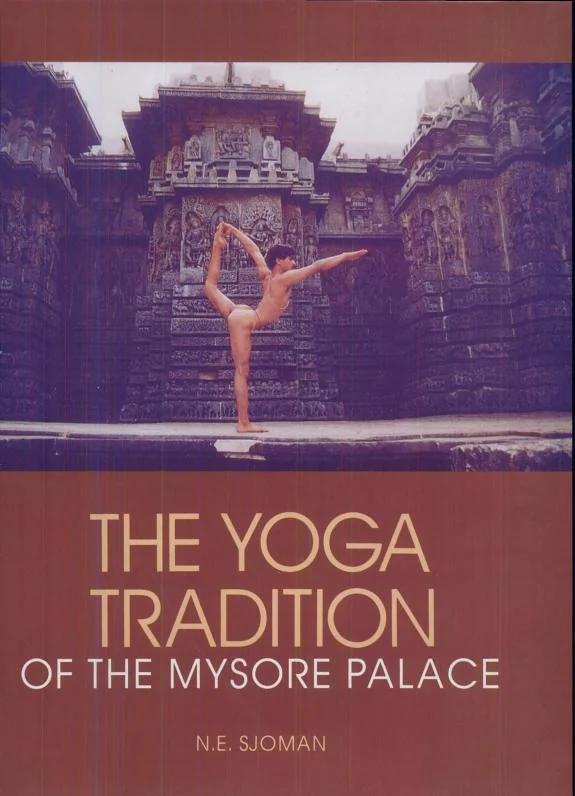
N. E. Sjoman's 1999 book reconstructs the Haṭha Yoga lineage of the Mysore Palace.
This work focuses on the yoga tradition that developed within the royal court of Mysore, drawing heavily from the Śrītattvanidhi manuscript. This illustrated compendium, compiled under Maharaja Kr̥ṣṇarāja Vaḍeyara III, details numerous asanas with accompanying illustrations. Sjoman's research presents the yoga section of this significant manuscript, translating the descriptions and making the visual representations accessible. The book offers a direct look into historical yogic methods as they were understood and practiced within this specific South Indian princely state.
Its value extends to scholars of yoga history, practitioners interested in classical Haṭha Yoga's lineage and textual foundations, and those studying South Indian royal patronage. The book's specific examination of the Mysore tradition provides insight into regional variations in yogic practice and iconography. It serves as a counterpoint to more widely known yoga traditions, highlighting a documented history that existed alongside them.
The book situates Haṭha Yoga practice within a specific South Indian royal context, moving beyond generalized accounts of yogic transmission. By focusing on the Śrītattvanidhi, a compendium created under princely patronage, it reveals how yogic knowledge was documented and codified in a specific historical period. This approach highlights the material and visual culture surrounding yogic practice, demonstrating that traditions were not solely orally transmitted but also preserved in illustrated manuscripts. It offers a view into a particular lineage that contributed to the broader spectrum of yogic development.
💡 Why Read This Book?
• Gain direct access to historical asana illustrations and textual translations from the Śrītattvanidhi, a unique resource not widely available. • Understand the specific yogic practices cultivated within the royal patronage of the Mysore Palace, offering a distinct regional perspective on Haṭha Yoga history. • Examine the historical documentation of yoga under Maharaja Kr̥ṣṇarāja Vaḍeyara III, providing concrete evidence of yogic transmission in 18th- and 19th-century South India.
⭐ Reader Reviews
Honest opinions from readers who have explored this book.
❓ Frequently Asked Questions
What is the Śrītattvanidhi and its significance in this book?
The Śrītattvanidhi is a 19th-century illustrated compendium commissioned by Maharaja Kr̥ṣṇarāja Vaḍeyara III of Mysore. Its yoga section, central to Sjoman's work, provides detailed depictions and descriptions of asanas, serving as a primary source for understanding historical yogic practices.
When was the Yoga Tradition of the Mysore Palace first published?
The book, authored by N. E. Sjoman, was first published in 1999, contributing significantly to the academic study of yoga history during that period.
Does this book offer practical yoga instruction?
No, this book is primarily a historical and scholarly work. It focuses on documenting and analyzing the yoga tradition of the Mysore Palace, using the Śrītattvanidhi as its core source, rather than providing modern instructional guidance.
Who was Maharaja Kr̥ṣṇarāja Vaḍeyara III?
Maharaja Kr̥ṣṇarāja Vaḍeyara III was the ruler of the Kingdom of Mysore whose reign concluded in 1868. He was a patron of arts and sciences, commissioning the Śrītattvanidhi, a significant repository of knowledge including yogic practices.
What makes the Mysore Palace tradition of yoga distinct?
The distinction lies in its codification within the Śrītattvanidhi under royal patronage, offering a specific historical record of asanas and practices prevalent in the Mysore region during the 18th and 19th centuries, as meticulously documented by Sjoman.
Are there illustrations in the book?
Yes, the book features illustrations derived from the Yoga section of the Śrītattvanidhi, showcasing various asanas and providing visual context for the textual descriptions presented.
🔮 Key Themes & Symbolism
Śrītattvanidhi as Primary Source
The core of this work is its direct engagement with the Śrītattvanidhi, a substantial manuscript commissioned by Maharaja Kr̥ṣṇarāja Vaḍeyara III. Sjoman meticulously analyzes the yoga section of this text, which includes detailed illustrations of numerous asanas. This approach elevates the book beyond secondary interpretations, offering readers a direct encounter with historical yogic iconography and its accompanying descriptions from the late 18th and early 19th centuries, a crucial period for the documentation of South Indian esoteric practices.
Royal Patronage of Yoga
The book highlights the significant role of the Mysore royal family, particularly Maharaja Kr̥ṣṇarāja Vaḍeyara III, in preserving and codifying yogic knowledge. This patronage ensured that practices, otherwise potentially ephemeral, were recorded in a formal compendium. It showcases how princely courts acted as vital centers for esoteric scholarship and artistic production, fostering the development and transmission of traditions like Haṭha Yoga within a specific socio-political context during the early 19th century.
Regional Haṭha Yoga Lineage
Sjoman's research focuses on a distinct regional manifestation of Haṭha Yoga, centered in Mysore. By examining the specific asanas and their presentation in the Śrītattvanidhi, the work delineates a particular stylistic and methodological current within the broader Haṭha Yoga tradition. This offers a valuable perspective on the diversity of yogic practices that existed across India, moving beyond more generalized or Northern Indian-centric views that often dominate historical accounts.
Asana Iconography and Practice
A central element is the detailed exploration of the illustrated asanas found in the Śrītattvanidhi. The book provides visual representations alongside English translations of the original Sanskrit text, allowing for a comparative study of historical postures. This focus on iconography is essential for understanding how yogic forms were understood, taught, and practiced within the Mysore court tradition, offering insights into the evolution of asana practice prior to its widespread global popularization.
💬 Memorable Quotes
Direct passages from the work, attributed to the author.
“The yoga section of the Śrītattvanidhi is one of the most comprehensive and artistically rendered compilations of asanas from pre-modern India.”
— This statement emphasizes the unique value of the manuscript. It suggests that the illustrations and accompanying text offer a level of detail and artistic quality that makes it a singularly important historical document for understanding yogic postures.
“Maharaja Kr̥ṣṇarāja Vaḍeyara III's patronage ensured the preservation of these yogic practices for future study.”
— This highlights the critical role of royal support in documenting esoteric traditions. Without the Maharaja's commission, the specific yogic knowledge contained within the Śrītattvanidhi might have been lost or less accessible to contemporary researchers.
“The text provides translations of Sanskrit terms related to the postures, facilitating scholarly analysis.”
— This points to the book's scholarly utility. By translating the original Sanskrit descriptions of the asanas, Sjoman makes the historical text accessible to a wider academic audience, enabling deeper understanding and comparison.
“The visual representations of asanas in the manuscript offer insights into their execution.”
— This underscores the importance of the illustrations. They are not merely decorative but serve as crucial visual aids that inform how the postures were likely performed or understood within the Mysore tradition.
“This work documents a specific regional manifestation of Haṭha Yoga.”
— This statement frames the book's contribution as defining a particular school or lineage of yoga. It suggests that the practices detailed are not universal but are rooted in the cultural and historical context of the Mysore region.
🌙 Esoteric Significance
Tradition
This work engages with the classical Haṭha Yoga tradition, a lineage focused on physical postures (asana) and breath control (pranayama) aimed at spiritual development. While not strictly belonging to Hermetic, Gnostic, or Kabbalistic frameworks, its emphasis on the body as a vehicle for liberation and its detailed postural system align with broader esoteric philosophies that seek transformation through disciplined practice and the manipulation of subtle energies.
Symbolism
The primary symbolism lies within the asana illustrations themselves. Each posture depicted in the Śrītattvanidhi can be seen as a symbolic representation of stability, control, and specific energetic alignments. The act of mastering these forms, as documented in the Mysore tradition, symbolizes the practitioner's journey toward internal equilibrium and the union of physical discipline with mental focus.
Modern Relevance
Contemporary scholars and dedicated practitioners seeking to understand the historical roots of asana practice beyond modern interpretations find immense value in Sjoman's work. It informs discussions on the lineage and authenticity of various yoga styles, offering a historical anchor for those interested in the evolution of Hatha Yoga and its diverse regional expressions.
👥 Who Should Read This Book
• Scholars of South Asian religious history and comparative yoga studies seeking primary source analysis. • Advanced yoga practitioners interested in the historical development and textual origins of asana practice, moving beyond contemporary adaptations. • Researchers of royal patronage and the documentation of esoteric arts in pre-colonial and colonial India.
📜 Historical Context
N. E. Sjoman's "The Yoga Tradition of the Mysore Palace" was published in 1999, a period marked by burgeoning academic inquiry into the historical underpinnings of modern yoga practices. The book emerged as a significant contribution to understanding regional variations in Haṭha Yoga, focusing specifically on the documentation preserved within the Mysore Palace. Its primary source is the Śrītattvanidhi, a Sanskrit compendium compiled under the patronage of Maharaja Kr̥ṣṇarāja Vaḍeyara III, whose reign concluded in 1868. This royal commission ensured the meticulous recording of various arts and sciences, including a substantial section on yoga asanas, dating from the late 18th and early 19th centuries. At a time when many scholars were beginning to critically examine the colonial-era and post-colonial narratives of yoga, Sjoman’s work provided concrete textual and visual evidence from South India, offering a vital counterpoint to traditions more commonly studied. The book's reception was largely within academic circles, appreciated for its rigorous scholarship and direct engagement with primary materials, though its dense nature made it less accessible to a general audience.
📔 Journal Prompts
The asana illustrations from the Śrītattvanidhi: What initial observations arise regarding posture and form?
Maharaja Kr̥ṣṇarāja Vaḍeyara III's commission: Reflect on the motivations behind royal patronage of esoteric texts.
The specific regional Haṭha Yoga tradition documented: How does it compare to generalized concepts of yoga?
N. E. Sjoman's scholarly approach: Consider the impact of primary source engagement on understanding historical practices.
The English translation of the Śrītattvanidhi's yoga section: What insights does direct textual access provide?
🗂️ Glossary
Haṭha Yoga
A branch of yoga that uses physical postures (asana), breathing techniques (pranayama), and other practices to prepare the body and mind for higher states of meditation and spiritual realization.
Asana
Literally meaning 'seat' or 'posture,' asana refers to the physical postures practiced in yoga, intended to promote strength, flexibility, and stability.
Śrītattvanidhi
A significant Sanskrit compendium commissioned by the Maharaja of Mysore, Kr̥ṣṇarāja Vaḍeyara III, containing detailed information on various subjects, including a notable section on yoga asanas.
Kr̥ṣṇarāja Vaḍeyara III
The Maharaja of Mysore whose reign ended in 1868, known for his patronage of arts, literature, and sciences, including the compilation of the Śrītattvanidhi.
Sanskrit
An ancient Indo-Aryan language in which many classical Indian texts, including yogic scriptures, are written.
Manuscript
A book or document written by hand, typically before the invention of printing. The Śrītattvanidhi exists as a historical manuscript.
Iconography
The visual images and symbols used in a work of art or the study or interpretation of these.
This book appears in 1 collection
🔮 Readers Also Liked
Browse all →

![Emanations of Lordly Grace [Al-Fuyudat al-Rabbaniyya]](/img/thumb/emanations-of-lordly-grace-al-fuyudat-al-rabbaniyya-ismail-muhammad-said-al-qadiri-216185.webp)






From the “Hatha Yoga” Collection
View all →






More Free Occult Philosophy Books
View all →