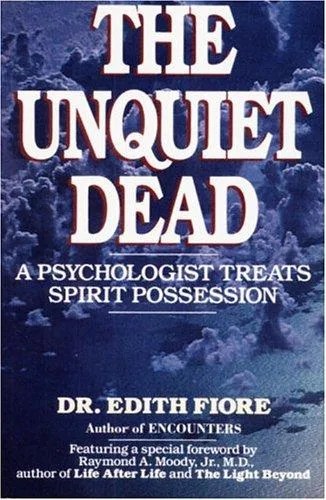
The Unquiet Dead
 78
78

The Unquiet Dead
Edith Fiore's "The Unquiet Dead" presents a bold thesis: many of our deepest troubles, from persistent anxiety to physical malaise, stem from the lingering presence of discarnate entities. Fiore, a psychologist, attempts to bridge the gap between clinical practice and esoteric understanding, arguing in her 1995 work that "spirit attachment" is a tangible phenomenon. Her detailed case studies, though anecdotal, offer compelling narratives of individuals seemingly burdened by external spiritual influences. The strength of the book lies in its directness and its attempt to provide a structured, almost therapeutic, approach to what is often considered purely spiritual or even delusional. However, the work's limitation is its inherent subjectivity. While Fiore presents her interpretations with clinical authority, the absence of empirical, testable evidence leaves the reader reliant on faith in her framework. A particularly striking concept is the "unquiet dead" themselves – spirits not necessarily malevolent but simply lost and seeking solace, often finding it by latching onto the living. Fiore's methodical "clearing" process, aimed at resolving these attachments, provides a practical, if unproven, path forward. It's a work that demands an open mind, offering a unique perspective on human suffering, but one that requires significant critical discernment. It challenges conventional psychology by offering an esoteric explanation for psychological distress.
📝 Description
78
Edith Fiore's 1995 book, The Unquiet Dead, suggests spirits influence human ailments.
The Unquiet Dead, published in 1995, examines how discarnate entities may affect human consciousness and physical health. Edith Fiore, a psychologist with extensive client experience, argues that psychological and physical issues can stem from spirits who have not fully moved on. She proposes a model to understand these spiritual interactions. The book is for those interested in the connections between psychology, spirituality, and the paranormal. It may resonate with individuals experiencing unexplained distress, energy healers, or anyone curious about unseen influences. Readers familiar with esoteric studies or seeking alternative explanations for mental health concerns will find value in Fiore's perspective.
Fiore introduces specific concepts, such as 'spirit attachment' as a cause for various afflictions. She describes the 'unquiet dead' as confused, earthbound spirits. The book details a 'clearing' process designed to help both the client and the spirit achieve peace. It also discusses the energetic and psychological ways these attachments occur.
Published in the mid-1990s, The Unquiet Dead appeared during a time of increasing public interest in New Age philosophies and alternative healing. While the idea of spirit influence is ancient, Fiore's work attempts to integrate these traditions with contemporary psychological thought. The book engaged with broader discussions on consciousness and subtle energies, topics also explored by figures associated with Theosophy and authors like Brian Weiss.
💡 Why Read This Book?
• You will learn about "spirit attachment" as a potential cause for unexplained emotional and physical distress, a concept distinct from conventional psychological diagnoses, as detailed in Fiore's case studies. • You will gain an understanding of the "unquiet dead" – confused, earthbound spirits – and how their energetic presence can manifest in the living, offering a new lens through which to view personal struggles. • You will discover the "clearing" process Fiore outlines, a method for disentangling the energies of discarnate entities from a living person, providing a practical, albeit esoteric, approach to energetic well-being.
⭐ Reader Reviews
Honest opinions from readers who have explored this book.
❓ Frequently Asked Questions
What is the core concept of "The Unquiet Dead"?
The book's central idea is "spirit attachment," suggesting that many human ailments, both psychological and physical, are caused by the lingering presence and influence of discarnate entities, or "unquiet dead."
Who is Edith Fiore and what is her background?
Edith Fiore was a psychologist who, based on her clinical work and personal research, developed theories about spirit attachment and its impact on human well-being, as presented in her 1995 book.
What differentiates "spirit attachment" from psychological disorders?
Fiore suggests that while symptoms may overlap, spirit attachment involves an external energetic influence from a discarnate entity, whereas psychological disorders are typically viewed as originating solely within the individual's psyche.
What is the "clearing" process mentioned in the book?
The "clearing" process is Fiore's proposed method for helping both the living individual and the attached spirit achieve resolution and separation, allowing both to move forward energetically.
When was "The Unquiet Dead" first published?
The book "The Unquiet Dead" by Edith Fiore was first published in 1995.
Does the book claim these "unquiet dead" are always malicious?
No, Fiore often describes the "unquiet dead" as confused or lost spirits who are not necessarily malicious but are simply seeking solace or attention, inadvertently causing distress to the living.
🔮 Key Themes & Symbolism
Spirit Attachment Dynamics
Fiore's work centers on the concept of spirit attachment, detailing how discarnate entities, referred to as the "unquiet dead," can influence the thoughts, emotions, and physical health of living individuals. She posits that these entities are often confused or lost spirits who, lacking other points of connection, attach themselves energetically to humans. The book explores the various ways this attachment can manifest, from subtle energetic drain to overt personality shifts, presenting a view that challenges purely internal explanations for human suffering.
The "Unquiet Dead"
This theme refers to the discarnate entities themselves. Fiore distinguishes them from traditionally conceived "demons" or "possessing spirits," characterizing them more as souls who have not completed their transition after death. They are "unquiet" because they are stuck in a state of confusion or distress, often seeking to experience life vicariously or find resolution through their connection with the living. Understanding their nature is crucial to the "clearing" process described in the book.
Energetic Clearing and Resolution
Central to the practical application of Fiore's theories is the "clearing" process. This is presented as a method to address and resolve spirit attachments, aiming to free both the individual and the attached spirit. It involves recognizing the presence of the "unquiet dead," understanding their situation, and facilitating their transition or release. This theme highlights the book's therapeutic and spiritual healing aspirations, offering a path towards well-being by addressing these energetic interferences.
Psychology Meets the Paranormal
A significant theme is Fiore's attempt to integrate her background as a psychologist with esoteric concepts of spiritual influence. The book bridges the gap between clinical observation and paranormal phenomena, suggesting that spiritual attachments can explain certain conditions that are difficult to treat with conventional psychology alone. This interdisciplinary approach aims to provide a more comprehensive understanding of human experience and distress.
💬 Memorable Quotes
Direct passages from the work, attributed to the author.
“Many of our problems stem not from our own subconscious, but from the subconscious of another.”
— This statement expresses Fiore's core argument: that external influences, specifically from discarnate entities, can be the root cause of personal issues, shifting the locus of problems from purely internal to potentially external energetic attachments.
“The unquiet dead are confused souls who have not moved on.”
— This interpretation of the 'unquiet dead' emphasizes their state of being lost and their lack of malicious intent, framing them as entities in need of assistance rather than entities to be feared, which is key to the clearing process.
“Attachment is a form of energetic vampirism.”
— This powerful metaphor highlights the draining nature of spirit attachment, illustrating how the presence of an "unquiet dead" entity can deplete the living person's vital energy and well-being.
“Clearing is a necessary step for true healing.”
— This interpretation positions the "clearing" of spirit attachments as a foundational element for achieving complete physical and psychological health, implying that until such attachments are resolved, genuine healing remains incomplete.
💡 Key Ideas
Editorial paraphrase of the work's core concepts — not direct quotes.
We must help them move on, not just for their sake, but for ours.
This paraphrase underscores the reciprocal benefit of the clearing process. It suggests that facilitating the transition of discarnate entities not only aids them but is essential for the full recovery and liberation of the living individual.
🌙 Esoteric Significance
Tradition
Fiore's work draws heavily from the broader Western Esoteric tradition, particularly concepts related to mediumship, spiritualism, and subtle energy bodies, which gained prominence in the 19th century. While not strictly adhering to a single lineage like Hermeticism or Gnosticism, it engages with the perennial theme of discarnate entities influencing the living, a concept found across many spiritualistic and occult writings. Her unique contribution lies in framing these phenomena within a psychological context, attempting to make them accessible to a modern, scientifically-minded audience.
Symbolism
The "unquiet dead" themselves function as a potent symbol of unresolved issues, both personal and collective, that linger beyond their apparent time. They represent the unfinished business of life and the potential for residual energies to impact the present. The "clearing" process can be seen as a symbolic act of purification and release, akin to exorcism or spiritual cleansing rituals found in various traditions, aiming to restore energetic balance and integrity to the individual's auric field.
Modern Relevance
Fiore's concepts of spirit attachment and energetic clearing continue to find relevance in contemporary alternative healing modalities and spiritual coaching. Practitioners in fields like energy healing, shamanism, and even some forms of transpersonal psychology may reference her work. The idea that energetic blockages or external influences can cause illness appeals to modern discussions on psychosomatic illness and the mind-body connection, albeit through an esoteric lens. Her work provides a foundation for understanding subtle energy dynamics in health and well-being.
👥 Who Should Read This Book
• Individuals experiencing persistent, unexplained emotional or physical symptoms that have not responded to conventional treatments, who are open to exploring energetic and spiritual causes. • Students of comparative spirituality and esoteric psychology, seeking to understand how concepts of discarnate entities are integrated into modern therapeutic frameworks. • Practitioners of energy healing or spiritual counseling, looking for additional perspectives and methodologies to address client issues related to perceived external spiritual influences.
📜 Historical Context
Edith Fiore's "The Unquiet Dead," published in 1995, emerged during a period of heightened interest in New Age spirituality and alternative healing. The 1990s saw a surge in popular literature exploring consciousness, psychic phenomena, and spiritual growth, influenced by earlier movements like Theosophy and figures such as Helena Blavatsky and Alice Bailey. Fiore's work offered a unique synthesis, attempting to bridge the concepts of spirit attachment, prevalent in various occult traditions, with the language and framework of clinical psychology. This approach stood in contrast to purely psychological or psychiatric models that dominated mainstream discourse. While authors like Brian Weiss were popularizing past-life regression, Fiore focused more directly on the energetic interference of discarnate entities. The book's reception was primarily within alternative spiritual and self-help circles, appealing to those seeking explanations beyond conventional medical or psychological paradigms, and it contributed to the broader conversation about non-physical influences on human health.
📔 Journal Prompts
Reflection on the concept of the "unquiet dead" and personal encounters with unexplained energies.
Analysis of personal experiences that could be interpreted as "spirit attachment" according to Fiore's framework.
Consideration of the "clearing" process as a potential path to personal energetic liberation.
Exploration of the boundary between psychological distress and external energetic influence.
Mapping potential sources of "unquiet dead" influence in one's own life or environment.
🗂️ Glossary
Unquiet Dead
Discarnate entities or spirits who have not transitioned fully after death and remain earthbound, often confused or distressed, potentially influencing the living.
Spirit Attachment
The phenomenon where an "unquiet dead" entity attaches itself energetically to a living person, influencing their thoughts, emotions, physical health, or behavior.
Clearing
A process outlined by Fiore to help release or resolve "spirit attachments," aiming to liberate both the living individual and the attached "unquiet dead" entity.
Discarnate Entity
A being or consciousness that exists without a physical body; a spirit or soul no longer inhabiting a physical form.
Energetic Influence
The subtle impact or effect that one entity's or being's energy field has on another, as described in the context of "spirit attachment" in the book.
Residual Energy
Lingering energetic imprints or patterns left behind in a place or on an object, sometimes associated with strong emotional events or the presence of "unquiet dead."
Auric Field
The subtle energy field or 'aura' that is believed to surround and emanate from a living being, which can be affected by "spirit attachments."
🔮 Readers Also Liked
Browse all →









More by Edith Fiore
All books →
More Free Occult Philosophy Books
View all →