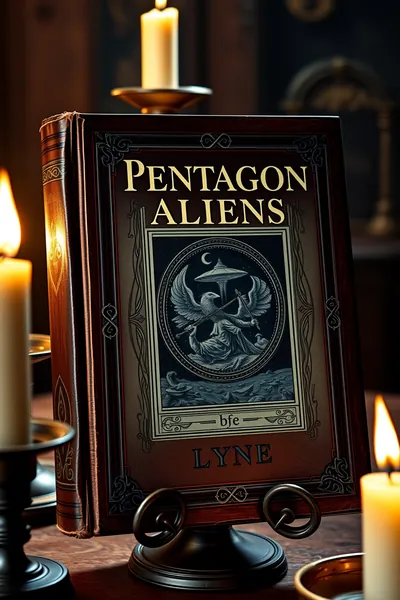
The Truth about UFOs: Ancient Astronauts from Outer Space
 71
71

The Truth about UFOs: Ancient Astronauts from Outer Space
Donald Keyhoe’s "The Truth about UFOs" reads less like a scholarly treatise and more like a manifesto, penned with the urgency of someone revealing a monumental secret. His direct confrontation with the U.S. Air Force and intelligence agencies, particularly concerning their handling of the 1952 Washington D.C. UFO incident, forms the book’s core. Keyhoe marshals testimony and alleged internal documents, painting a picture of systematic obfuscation. While his conviction is palpable, the narrative occasionally strains under the weight of its own certainty, sometimes presenting conjecture as established fact. A notable strength lies in its persistent questioning of authority, a stance that remains relevant. However, the absence of rigorous, independently verifiable proof for every claim leaves room for doubt. It’s a vital historical document for understanding early UFOlogy's confrontational stance.
📝 Description
71
Donald Keyhoe's 1953 book claimed governments knew UFOs were extraterrestrial and hid the truth.
Donald Keyhoe's 1953 book, 'The Truth about UFOs: Ancient Astronauts from Outer Space,' presents a controversial thesis about unidentified flying objects. Keyhoe asserted that governmental bodies, including the U.S. Air Force and intelligence agencies, possessed evidence of extraterrestrial visitation but deliberately concealed this information from the public. The book details alleged instances of cover-ups, witness intimidation, and propaganda campaigns designed to discredit reports of UFO phenomena.
This work appeals to readers interested in the history of UFOlogy and the Cold War era's influence on public discourse regarding unexplained aerial phenomena. It is for those who question official explanations and seek to understand the arguments for a perceived governmental conspiracy to hide evidence of alien presence. Keyhoe's arguments and cited evidence aim to spark debate among both skeptics and believers.
Published during a period of heightened Cold War anxieties and widespread reports of aerial anomalies, Keyhoe's work taps into a burgeoning fascination with the unknown. It aligns with a tradition of questioning official narratives and positing hidden truths about humanity's place in the cosmos. The book's focus on suppressed evidence and secret agencies resonates with esoteric thought that often explores clandestine knowledge and alternative realities beyond mainstream acceptance, framing UFOs not merely as technological curiosities but as indicators of a larger, concealed cosmic drama.
💡 Why Read This Book?
• Understand the historical roots of government UFO cover-up theories, specifically Keyhoe's confrontation with the U.S. Air Force in the 1950s, which challenged official dismissals of UFO sightings. • Examine the documented efforts by agencies like the CIA to influence public perception, as detailed in the book's critique of official pronouncements. • Gain insight into the early arguments for an extraterrestrial hypothesis, focusing on Keyhoe's interpretation of pilot testimonies and photographic evidence from the era.
⭐ Reader Reviews
Honest opinions from readers who have explored this book.
❓ Frequently Asked Questions
What specific government agencies did Donald Keyhoe accuse of suppressing UFO information?
Donald Keyhoe explicitly named the U.S. Air Force, the CIA, and the NSA in his work as agencies actively involved in investigating and subsequently concealing evidence of UFOs and potential alien visitors.
What was the primary motivation Keyhoe attributed to government agencies for UFO secrecy?
Keyhoe suggested that these agencies had their own undisclosed reasons for suppressing information, implying a deliberate effort to prevent the public from learning about findings related to alien visitors.
Did Keyhoe provide evidence of witnesses being silenced?
Yes, the book details allegations of witnesses, including capable Air Force pilots, being gagged or discredited to maintain the official narrative and prevent public awareness of UFO phenomena.
When was Donald Keyhoe's work on UFOs first published?
While this edition is listed with a 2016 publication date, Donald Keyhoe's influential writings and activism regarding UFOs, particularly his confrontations with the Air Force, began much earlier, gaining significant traction in the 1950s.
What does the book suggest about the nature of UFO sightings?
The book presents UFO sightings not as misidentifications or natural phenomena, but as concrete proof of alien visitors from outer space, a conclusion supposedly reached by government investigators but deliberately hidden.
What is the historical significance of Donald Keyhoe's approach to UFO research?
Keyhoe is significant for his direct, confrontational approach, challenging official government stances and military secrecy surrounding UFOs, thereby energizing the ufological community and public interest in the subject.
🔮 Key Themes & Symbolism
Governmental Secrecy and UFOs
This theme scrutinizes the alleged conspiracy by governmental bodies, including the U.S. Air Force and CIA, to withhold evidence of extraterrestrial visitation. Keyhoe argues that official investigations into UFO sightings are not aimed at discovery but at containment and disinformation. The book posits that a deliberate wall of silence has been erected, utilizing public relations campaigns and witness intimidation to prevent public knowledge of alien presence. This secrecy is presented as a fundamental obstacle to understanding a critical aspect of reality, driven by unspecified but significant agency motives.
Ancient Astronaut Hypothesis
The concept of 'Ancient Astronauts' suggests that extraterrestrial beings have visited Earth in the past, influencing human civilization and history. Keyhoe's work implicitly supports this by framing modern UFO phenomena as part of a continuum of alien presence. The book implies that the advanced technology observed in UFOs is not a recent development but potentially evidence of long-term observation or interaction by off-world entities. This perspective positions UFOs as a continuation of historical visitations, challenging conventional historical and anthropological narratives.
Witness Testimony and Credibility
A significant focus is placed on the testimonies of credible witnesses, particularly military pilots and personnel, who have allegedly observed UFOs. Keyhoe highlights how these firsthand accounts are often dismissed, suppressed, or discredited by official channels. The book champions the importance of these witnesses, arguing that their experiences provide crucial, albeit suppressed, evidence of the reality of UFOs and their extraterrestrial origin. The silencing or discrediting of these individuals is presented as a key tactic in the alleged cover-up.
Public Relations and Disinformation
The book critiques the role of public relations campaigns and disinformation strategies employed by government agencies to manage public perception of UFOs. Keyhoe suggests that large-scale efforts are made to promote mundane explanations for sightings, sow confusion, and discredit genuine evidence. This theme addresses how information is controlled and manipulated, creating a public narrative that deviates from the alleged truth held within classified government files. The goal, according to Keyhoe, is to maintain public ignorance and prevent widespread panic or inquiry.
💬 Memorable Quotes
Direct passages from the work, attributed to the author.
“This book was written in defiance of the U.S. Air Force, the CIA, the NSA...”
— This opening statement immediately establishes the confrontational stance of the work, positioning it as an act of rebellion against powerful government entities accused of suppressing crucial information about UFOs.
“These agencies do not want the public to learn of their findings.”
— This phrase captures the core accusation: a deliberate, organized effort by intelligence and military bodies to keep the public in the dark regarding evidence of extraterrestrial visitation.
“Despite the official wall of silence, the gagging of many witnesses...”
— This highlights the perceived methods of suppression: a combination of outright denial and active silencing of individuals who have experienced or investigated UFO phenomena firsthand.
“...and gigantic public relations blitzes to discredit genuine evidence.”
— This points to a sophisticated strategy of disinformation, suggesting that coordinated media efforts are employed to confuse the public and undermine credible UFO sightings and evidence.
“Proof of alien visitors from outer space.”
— This direct assertion frames the central thesis: UFOs are not merely unexplained phenomena but tangible evidence of non-human intelligence visiting Earth.
🌙 Esoteric Significance
Tradition
While not strictly within a single esoteric lineage like Hermeticism or Kabbalah, Keyhoe's work aligns with the broader tradition of challenging orthodox scientific and governmental explanations for phenomena that hint at hidden realities. It speaks to Gnostic impulses to uncover suppressed knowledge and with theosophical ideas of hidden hierarchies and non-human intelligences influencing terrestrial affairs. His direct confrontation with authority echoes prophetic figures who reveal inconvenient truths, positioning him as a secular prophet of the extraterrestrial.
Symbolism
The primary symbol is the "flying saucer" itself, representing the unknown, advanced technology, and the 'Other' from beyond Earth. The "wall of silence" symbolizes institutional obfuscation and the deliberate withholding of truth, akin to the veils of ignorance in Platonic philosophy. "Witnesses" become symbolic of pure, unadulterated perception, their silencing representing the suppression of direct experience in favor of manufactured consensus.
Modern Relevance
Keyhoe's legacy continues to influence modern ufology and conspiracy theories. Thinkers and researchers exploring the 'deep state' and government transparency often cite his early work as foundational. Contemporary movements advocating for full disclosure of UFO information, such as those inspired by figures like Jacques Vallée (who evolved from Keyhoe's foundational ideas), draw upon his precedent of challenging official narratives and demanding accountability from powerful institutions regarding unexplained aerial phenomena.
👥 Who Should Read This Book
• Amateur investigators of unexplained aerial phenomena seeking historical context for modern UFO disclosure movements. • Researchers of Cold War history interested in the intersection of national security, public perception, and fringe topics. • Skeptics and critical thinkers who wish to understand the arguments and evidence presented by early UFOlogists challenging official narratives.
📜 Historical Context
Donald Keyhoe's work emerged in the mid-20th century, a period marked by intense Cold War paranoia and a surge in public fascination with unidentified flying objects. Following the widespread reports of flying saucers in 1947 and the U.S. Air Force's Project Blue Book investigations, public skepticism and government secrecy became intertwined. Keyhoe, a decorated naval aviator and journalist, became a prominent critic, directly challenging the official narratives. His confrontational approach, detailed in works like this, contrasted sharply with more speculative or philosophical approaches to the UFO phenomenon prevalent in other circles. He directly engaged with figures like Major Donald H. Menzel, a Harvard astronomer who offered conventional explanations for UFO sightings, positioning Keyhoe as a proponent of the extraterrestrial hypothesis against scientific and governmental dismissal. The era’s climate of secrecy, amplified by national security concerns, provided fertile ground for Keyhoe’s claims of a cover-up.
📔 Journal Prompts
The "official wall of silence" described by Keyhoe: How might psychological defense mechanisms operate on a national scale?
Consider the implications of "gagging of many witnesses." What ethical considerations arise when powerful entities control information flow?
Analyze the concept of "ancient astronauts" as presented through the lens of modern UFO claims.
Reflect on the role of "public relations blitzes" in shaping public understanding of controversial topics.
Evaluate the evidence Keyhoe presents for the U.S. Air Force's involvement in UFO investigation and potential cover-up.
🗂️ Glossary
Unidentified Flying Objects (UFOs)
Aerial phenomena observed but not immediately identifiable. Keyhoe argues these are reliably indicative of extraterrestrial craft, contrary to official explanations.
Ancient Astronauts
The hypothesis that extraterrestrial beings visited Earth in antiquity, influencing human civilization. Keyhoe links modern UFO sightings to this historical presence.
Official Silence
A term used by Keyhoe to describe the alleged coordinated effort by government agencies to conceal information about UFOs and alien visitors from the public.
Witness Gagging
The practice, alleged by Keyhoe, of intimidating or silencing individuals, particularly military personnel, who have reported UFO sightings to prevent disclosure.
Public Relations Blitz
A concerted effort, often involving media manipulation, to influence public opinion. Keyhoe claims this tactic is used to discredit UFO evidence.
Extraterrestrial Visitation
The concept that beings from other planets have traveled to Earth. Keyhoe posits this as the definitive explanation for UFO phenomena.
Project Blue Book
The U.S. Air Force's official investigation into UFOs (1952-1969). Keyhoe criticizes its findings and methodology as part of the cover-up.