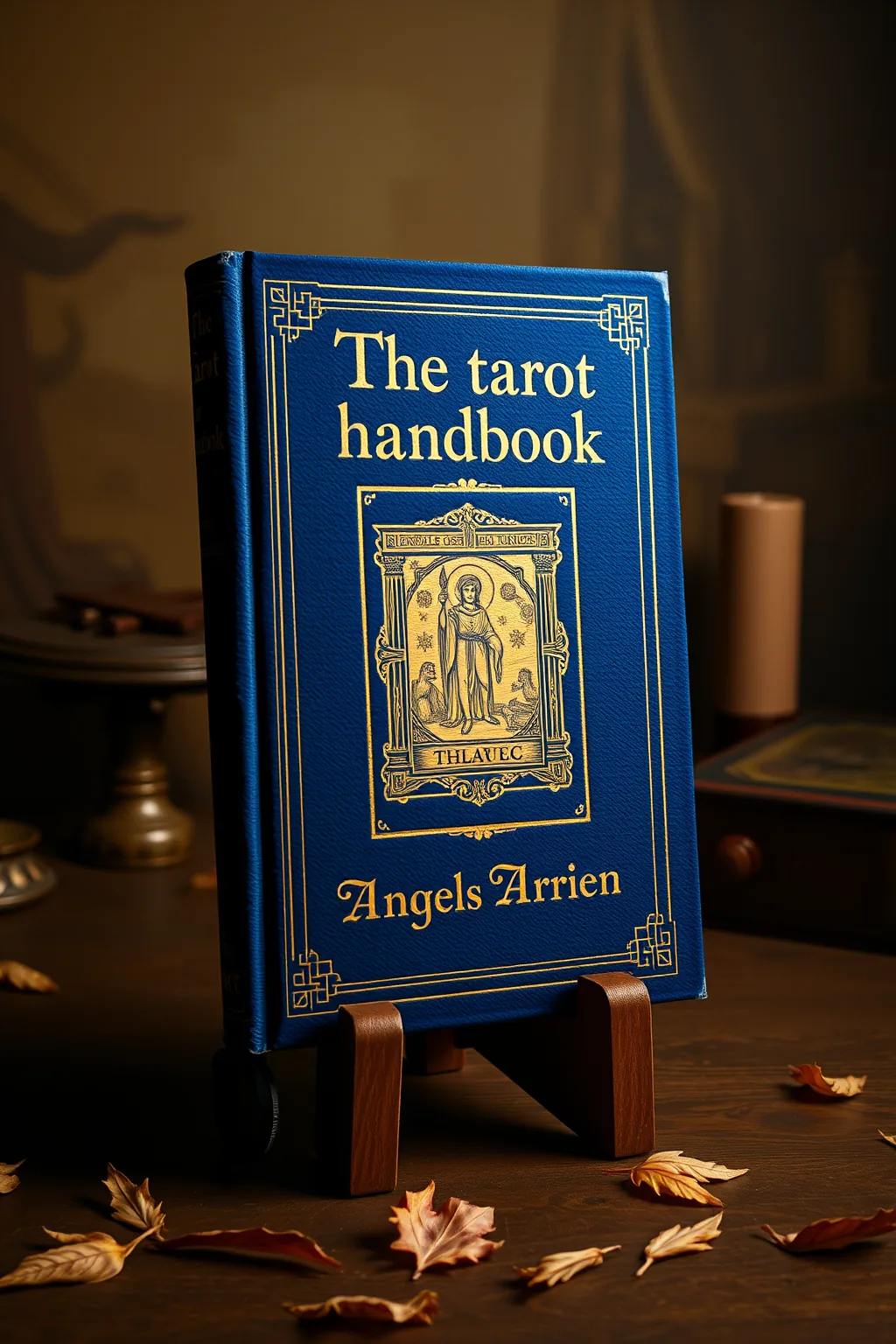
The tarot handbook
 71
71

The tarot handbook
Angeles Arrien’s "The Tarot Handbook" provides a solid foundation, particularly in its 1994 debut, for understanding the Rider-Waite-Smith tarot system. Arrien’s strength lies in her ability to connect the archetypal imagery of the cards to psychological states and life's developmental stages, moving beyond mere fortune-telling. The way she elucidates the journey of the Fool through the Major Arcana offers a compelling narrative arc for personal growth. However, the book occasionally feels more like a textbook than an intuitive guide. While comprehensive, its structure, though logical, can sometimes lack the spontaneous spark that makes tarot readings feel alive. A specific passage detailing the numerological progression within the suit of Pentacles demonstrates this methodical approach, offering clarity but perhaps less evocative inspiration. It remains a valuable reference for those seeking a structured, psychologically informed introduction to the tarot.
📝 Description
71
Angeles Arrien published "The Tarot Handbook" in 1994, framing the tarot as a psychological map.
This handbook approaches the 78 tarot cards, the 22 Major Arcana and 56 Minor Arcana, as a symbolic language for understanding the human experience. Arrien moves past simple fortune telling, presenting the cards as tools for psychological insight and personal growth. The book details the correspondences and narrative potential within the deck. It is written for anyone interested in tarot, whether they are new to it or have practiced for years. Students of symbolism, psychology, and esoteric traditions who see tarot as a path to self-discovery will find value. Readers who prefer a structured method for learning card meanings and applying them in readings will benefit from its approach.
Arrien's work emerged when interest in esoteric studies and the psychological analysis of ancient systems was growing. Following a surge in tarot's popularity in the mid-20th century, particularly with the Rider-Waite deck, Arrien's book contributed to understanding tarot within psychological frameworks. The 1990s were a time when spiritual traditions and modern psychological theories were often synthesized. This book is part of that trend, blending ancient symbols with contemporary thought.
Arrien's "The Tarot Handbook" connects with traditions that view tarot not just as a divinatory tool but as a psychological and spiritual map. It aligns with hermetic and alchemical thought that sees correspondences between the macrocosm and microcosm, using the cards to reflect inner states and life's patterns. This approach grew in prominence during the late 20th century, as esoteric studies increasingly intersected with depth psychology, seeking to integrate ancient symbolic systems with modern understandings of the psyche and personal development.
💡 Why Read This Book?
• Gain a structured understanding of the 78 tarot cards, including the archetypes of the Major Arcana and the elemental correspondences of the Minor Arcana suits, as presented in Arrien's 1994 handbook. • Learn a methodical approach to card interpretation, focusing on how the cards form a narrative for personal growth, a technique detailed throughout the book. • Explore the tarot as a psychological tool for self-discovery and understanding life's transitions, a core theme Arrien emphasizes from the book's introduction.
⭐ Reader Reviews
Honest opinions from readers who have explored this book.
❓ Frequently Asked Questions
When was "The Tarot Handbook" by Angeles Arrien first published?
"The Tarot Handbook" by Angeles Arrien was first published in 1994, positioning it as a significant work during a period of renewed interest in esoteric studies and psychological interpretations of tarot.
What tarot deck does "The Tarot Handbook" primarily focus on?
The handbook primarily focuses on the Rider-Waite-Smith tarot deck, which has become a standard for many practitioners and features the archetypal imagery discussed in Arrien's work.
Does Angeles Arrien use the Rider-Waite deck in her book?
Yes, Angeles Arrien's "The Tarot Handbook" extensively uses the symbolism and structure of the Rider-Waite-Smith tarot deck, which was first published in 1909.
What is the main purpose of "The Tarot Handbook"?
The book's main purpose is to serve as a comprehensive guide to understanding the archetypal meanings and symbolic language of the tarot, emphasizing its use for psychological insight and personal growth.
Who is Angeles Arrien?
Angeles Arrien was an anthropologist, educator, and author known for her work integrating psychology, symbolism, and spiritual traditions, particularly through her writings on the tarot.
What are the 78 cards of the tarot deck?
The tarot deck consists of 78 cards, divided into 22 Major Arcana, representing significant life lessons and archetypes, and 56 Minor Arcana, often seen as reflecting daily life events and challenges.
🔮 Key Themes & Symbolism
Archetypal Journey
The book frames the 22 Major Arcana cards as representing the Fool's Journey, an archetypal path of self-discovery and transformation. Each card symbolizes distinct stages, challenges, and lessons encountered in human life. Arrien interprets these cards as powerful symbols of psychological states and developmental milestones, offering readers a map for navigating their own inner and outer worlds. The concept is central to understanding the tarot's narrative potential beyond simple divination.
Symbolic Language of Suits
Arrien elucidates the distinct energies and correspondences of the four Minor Arcana suits: Wands (action, creativity), Cups (emotions, relationships), Swords (intellect, conflict), and Pentacles (material world, security). The work details how these suits, particularly as depicted in the Rider-Waite-Smith deck first popularised in 1909, represent different facets of human experience and interaction. Understanding these elemental associations is crucial for interpreting the nuances of any tarot reading.
Tarot as a Psychological Tool
A significant theme is the application of tarot as a tool for introspection and psychological exploration. Arrien moves past purely predictive interpretations to focus on how the cards can reveal subconscious patterns, clarify motivations, and illuminate decision-making processes. This perspective aligns with psychological theories popular in the late 20th century, positioning the tarot as a mirror for the psyche and a guide for personal development.
Card Correspondences and Meanings
The handbook provides detailed interpretations for each of the 78 cards, including numerological and astrological correspondences where applicable. Arrien emphasizes understanding the core meaning of each card within the context of the deck's overall structure. This systematic approach, evident since its 1994 publication, aims to equip readers with a robust framework for both personal study and practical application in readings.
💬 Memorable Quotes
Direct passages from the work, attributed to the author.
“The tarot is a mirror of the soul.”
— This statement expresses Arrien's view of the tarot not as a predictive oracle, but as a reflective tool. It suggests that the cards reveal inner truths, subconscious patterns, and the user's own psyche when approached with intention and introspection.
“Each card is an archetypal energy.”
— This highlights the book's focus on the profound, universal symbols represented by the tarot figures. It frames the cards as embodying fundamental aspects of the human experience, accessible through symbolic interpretation.
“The Fool's Journey is the map of our lives.”
— This interpretation emphasizes the narrative structure of the Major Arcana, portraying the progression through life's stages and lessons as a journey initiated by the Fool, a concept central to Arrien's psychological approach.
“Understanding the suits is key to the Minor Arcana.”
— This points to the fundamental importance of grasping the elemental associations (Wands, Cups, Swords, Pentacles) to unlock the meaning and context of the 56 Minor Arcana cards.
💡 Key Ideas
Editorial paraphrase of the work's core concepts — not direct quotes.
The tarot offers guidance, not destiny.
This paraphrased concept reflects the book's emphasis on the tarot as a tool for empowerment and awareness, suggesting it illuminates possibilities and informs choices rather than dictating a fixed future.
🌙 Esoteric Significance
Tradition
Arrien's work draws heavily from the Western Esoteric tradition, particularly its psychological and archetypal interpretations of symbolism. While not strictly adhering to a single lineage like Kabbalah or Hermeticism, it synthesizes elements that resonate with modern psychological applications of ancient symbolic systems. It builds upon the foundation laid by the Rider-Waite-Smith deck, which itself incorporated esoteric symbolism, and positions the tarot as a tool for self-knowledge aligned with Jungian psychology's exploration of the collective unconscious.
Symbolism
Key symbols explored include the Fool, representing new beginnings and innocence; the archetypal figures of the Major Arcana, which embody universal human experiences and stages of growth; and the four suits of the Minor Arcana (Wands, Cups, Swords, Pentacles), each representing distinct elemental energies and life domains. Arrien interprets these symbols as a visual language for understanding the psyche and navigating life's journey.
Modern Relevance
Contemporary practitioners of tarot, particularly those focused on psychological and archetypal readings, continue to draw from Arrien's structured approach. Her work informs modern tarot courses and literature that emphasize self-exploration and personal growth over simple prediction. Thinkers and educators in fields like transpersonal psychology and consciousness studies may also find value in her integration of symbolism with psychological frameworks.
👥 Who Should Read This Book
• Aspiring tarot readers seeking a foundational, psychologically informed understanding of the 78 cards and their archetypal meanings. • Students of symbolism and comparative mythology interested in how ancient systems like the tarot can map human experience. • Individuals engaged in personal growth and self-reflection who are looking for a structured tool to explore their inner world and life challenges.
📜 Historical Context
Angeles Arrien's "The Tarot Handbook," first published in 1994, arrived during a vibrant period for esoteric and psychological literature. The late 20th century saw a significant synthesis of ancient symbolic systems with modern psychological theories, a trend Arrien actively participated in. This era followed the foundational work on tarot symbolism by figures like A.E. Waite and the influential art of Pamela Colman Smith, whose Rider-Waite deck (1909) remained a benchmark. Arrien's approach contributed to a growing field that sought to integrate tarot into frameworks of personal development and archetypal psychology, distinct from earlier purely divinatory or occultist interpretations. While figures like Carl Jung had already explored archetypes, Arrien specifically applied these concepts to the tarot in a widely accessible manner. Her work was part of a broader intellectual current that explored mythology, symbolism, and consciousness, often engaging with Jungian psychology. The book's reception was generally positive within the burgeoning self-help and esoteric communities, validating its place alongside other popular tarot guides of the time.
📔 Journal Prompts
Reflect on the archetypal energy of the Fool as depicted in the Major Arcana.
Consider the elemental correspondences of the Suit of Swords and their relation to intellectual challenges.
Map the stages of the Fool's Journey as presented in the book onto a significant personal transition.
Analyze how the symbolism of the Pentacles might manifest in your material or professional life.
Explore the emotional landscape represented by the Suit of Cups in your own experiences.
🗂️ Glossary
Major Arcana
The 22 trump cards of the tarot deck, representing significant life lessons, archetypal figures, and spiritual journeys. They are often seen as depicting the major events and transformations in a person's life.
Minor Arcana
The 56 cards of the tarot deck divided into four suits (Wands, Cups, Swords, Pentacles), typically reflecting daily events, challenges, and circumstances. They provide context and detail to the broader themes of the Major Arcana.
Archetype
A universal, archaic pattern or image that is part of the collective unconscious, derived from early experiences of humankind. In tarot, the Major Arcana cards are often seen as embodying powerful archetypes.
The Fool's Journey
A symbolic narrative representing the progression through the Major Arcana cards, viewed as a metaphor for the human journey of growth, learning, and spiritual development, starting with the Fool.
Wands
One of the four suits in the Minor Arcana, associated with the element of Fire. It typically represents creativity, passion, action, energy, and inspiration.
Cups
One of the four suits in the Minor Arcana, associated with the element of Water. It typically represents emotions, relationships, intuition, love, and feelings.
Swords
One of the four suits in the Minor Arcana, associated with the element of Air. It typically represents intellect, thoughts, challenges, conflict, and truth.
Pentacles
One of the four suits in the Minor Arcana, associated with the element of Earth. It typically represents the material world, finances, work, health, and security.
🔮 Readers Also Liked
Browse all →








More by Angeles Arrien
All books →

More Free Divination & Tarot Books
View all →