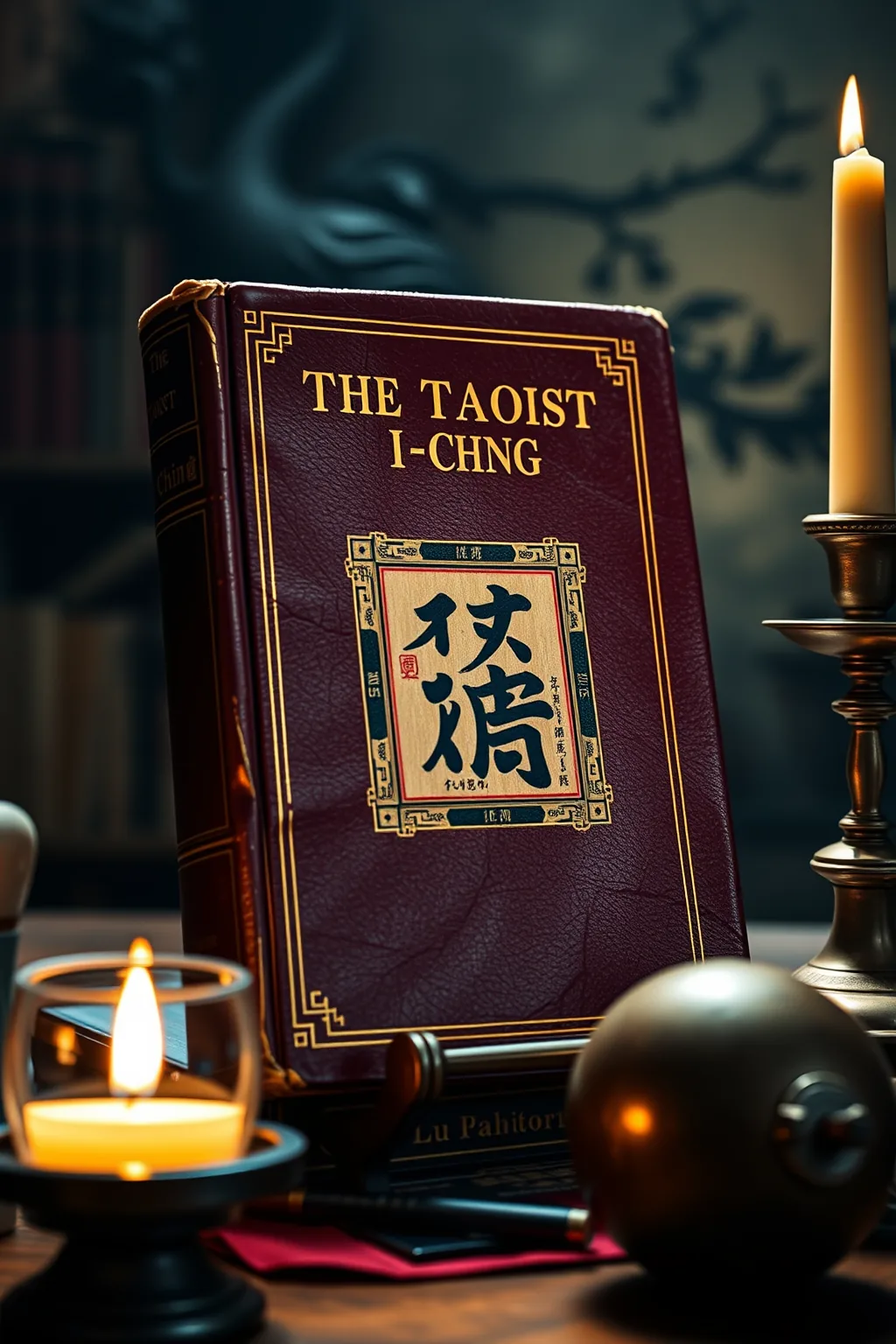
The Taoist I Ching
 74
74

The Taoist I Ching
Lui I-ming’s "The Taoist I Ching" offers a welcome, less-trafficked path through the labyrinthine interpretations of the ancient Chinese classic. Moving beyond the common focus on divination, I-ming grounds the hexagrams firmly within the Taoist cosmological framework, presenting the text as a profound map of universal flux. The clarity with which the interplay of Yin, Yang, and the Five Elements is explained in relation to the hexagrams is a significant strength. One particular passage discussing the transformation of hexagrams as analogous to the body's energetic meridians felt especially insightful, bridging the text's abstract principles with tangible practice. However, the book occasionally assumes a prior familiarity with complex Taoist concepts, which may leave absolute beginners adrift. The author’s dedication to presenting the *I Ching* as a living, breathing system of universal principles, rather than a static oracle, is its most compelling aspect. It is a valuable addition for those seeking a more philosophically integrated understanding of this foundational text.
📝 Description
74
Lui I-ming's The Taoist I Ching connects the ancient text to Taoist cosmology and practice.
This book reinterprets the I Ching, the classic Chinese 'Book of Change,' by grounding it firmly in Taoist philosophy. Instead of seeing it solely as a tool for divination or a philosophical treatise, the author presents the I Ching as a living cosmology that reflects the universe's dynamic processes and the human mind. The text examines core Taoist principles, including the interplay of yin and yang and the five elements, as they are expressed through the I Ching's hexagrams and their associated imagery.
It is intended for serious students of Taoism and those interested in comparative mythology and esoteric traditions. Practitioners of Taoist arts like meditation and qigong will find connections between their physical practices and the symbolic language of the I Ching. The work moves beyond simple fortune-telling to offer a deeper understanding of this ancient Chinese text, making it accessible to readers seeking scholarly insight.
The I Ching, with origins over 2,500 years ago, has long been a subject of esoteric study. While often associated with Confucianism, its deep connections to Taoist principles of natural cycles, balance, and transformation are central to this interpretation. Lui I-ming's work places the I Ching within the lineage of Taoist practice, viewing its hexagrams not just as symbolic representations but as keys to understanding the energetic and philosophical underpinnings of reality as understood by Taoist mystics.
💡 Why Read This Book?
• Gain a Taoist-centric understanding of the *I Ching*, moving beyond simple prognostication to grasp its philosophical depth, as illuminated by the discussion of the Tao as the fundamental principle. • Learn to see the 64 hexagrams not as isolated symbols, but as dynamic expressions of Yin and Yang, reflecting the universe's constant transformation, as detailed in the analysis of these core energies. • Connect the *I Ching*'s symbolic language to practical esoteric disciplines by understanding the Five Elements and their cycles, as applied to both natural phenomena and human experience.
⭐ Reader Reviews
Honest opinions from readers who have explored this book.
❓ Frequently Asked Questions
What is the Taoist perspective on the I Ching presented in this book?
This book frames the *I Ching* through the lens of Taoist philosophy, viewing it as a dynamic cosmology that illustrates the workings of the Tao, the fundamental principle of existence, and the interplay of Yin and Yang.
How does Lui I-ming's interpretation differ from other I Ching books?
It emphasizes the *I Ching*'s roots in Taoist practice and cosmology, focusing on universal principles and dynamic change rather than solely on divination or predictive fortune-telling.
What are the key esoteric concepts explored in relation to the I Ching?
The book explores the Tao, the fundamental unity and source of all, and the dynamic balance of Yin and Yang, as well as the cyclical relationships of the Five Elements (Wu Xing).
Is this book suitable for beginners to the I Ching?
While accessible, it assumes some familiarity with basic Taoist concepts. Beginners may benefit from reading introductory material on Taoism alongside this text for a richer understanding.
When was The Taoist I Ching first published?
The original publication date for 'The Taoist I Ching' by Lui I-ming was May 3, 2005.
What is the significance of the hexagrams in this interpretation?
The hexagrams are presented as representations of the countless transformations and manifestations arising from the Tao, illustrating the continuous cycles of change in the universe.
🔮 Key Themes & Symbolism
The Tao as Dynamic Principle
This work posits the Tao not as a static entity but as the fundamental, ineffable force driving all change and manifestation. The *I Ching*'s hexagrams are presented as a symbolic language describing the infinite ways the Tao expresses itself, from the subtle origins of creation to the complex patterns of the cosmos. The book illustrates how understanding the Tao allows one to perceive the underlying unity in apparent diversity and the constant flow of becoming and unbecoming.
Yin and Yang Polarity
Central to the text is the concept of Yin and Yang, not as dualistic opposites but as interdependent, complementary energies. The book meticulously details how the interplay of these forces generates the phenomena of the universe, from the cycles of nature to the dynamics within the human psyche. Each hexagram is analyzed through the lens of its Yin and Yang components, revealing the balance, tension, and transformation inherent in all situations.
The Five Elements Cycle
Lui I-ming integrates the Five Elements (Wood, Fire, Earth, Metal, Water) as a crucial framework for understanding the generative and destructive cycles that govern existence. This section explores how these elements interact within the hexagrammatic system, providing a practical means to analyze the energetic qualities of situations and the potential for transformation. The cyclical nature of the elements offers insights into natural processes and personal development.
Hexagrammatic Transformation
The book emphasizes the dynamic nature of the *I Ching*, focusing on how hexagrams transform into one another. This process is depicted as mirroring the constant flux of reality. Understanding these transformations allows the reader to perceive the underlying currents of change and to anticipate shifts in circumstances, aligning personal actions with the natural unfolding of events. It moves the interpretation from static meaning to dynamic process.
💬 Memorable Quotes
Direct passages from the work, attributed to the author.
“The Tao is the unnamable source from which all things arise.”
— This highlights the foundational Taoist concept of the Tao as the ultimate, ineffable origin of the cosmos, emphasizing its mysterious and beyond-description nature.
“Yin and Yang are not enemies, but partners in the dance of creation.”
— This interprets the relationship between Yin and Yang as one of essential cooperation and mutual generation, crucial for understanding the dynamic processes described in the *I Ching*.
“Each hexagram is a snapshot of the universe in motion.”
— This metaphor captures the book's emphasis on the *I Ching* as a system representing continuous change and the ever-evolving state of reality.
“The Five Elements reveal the rhythms of growth and decay.”
— This points to the cyclical interactions of Wood, Fire, Earth, Metal, and Water as a key to understanding the natural patterns of development and decline.
“Wisdom lies in aligning with the flow of the Tao.”
— This suggests that true understanding and effective action come from harmonizing oneself with the fundamental principles and natural currents of existence.
🌙 Esoteric Significance
Tradition
This work firmly situates the *I Ching* within the Taoist tradition, emphasizing its roots in classical Taoist cosmology and philosophy. It aligns with the Taoist pursuit of understanding the fundamental nature of reality (the Tao) and living in harmony with its principles. Unlike purely divinatory or Western Hermetic interpretations, it focuses on the text as a map of universal processes and the energetic dynamics described by Yin, Yang, and the Five Elements, integral to Taoist internal arts and philosophy.
Symbolism
Key symbols explored include the Tao, representing the ultimate, ineffable source of all; Yin and Yang, the complementary forces of creation and transformation; and the Five Elements (Wood, Fire, Earth, Metal, Water), illustrating the cyclical patterns of nature and existence. The 64 hexagrams themselves are seen as symbolic representations of the myriad states and transformations that arise from the interplay of these fundamental principles, offering a symbolic language for universal dynamics.
Modern Relevance
Contemporary practitioners of internal arts like Tai Chi and Qigong, as well as scholars of comparative religion and philosophy, draw upon this work. It provides a bridge between ancient wisdom and modern understanding, offering insights into concepts like systems thinking, dynamic balance, and the interconnectedness of all phenomena, relevant to fields ranging from psychology to ecological studies and personal development practices.
👥 Who Should Read This Book
• Students of Taoism seeking a foundational text that integrates philosophical principles with symbolic interpretation. • Practitioners of esoteric arts who wish to deepen their understanding of the energetic dynamics (Yin/Yang, Five Elements) underpinning their practices. • Scholars of comparative mythology and religion interested in the diverse interpretations of ancient Chinese classics.
📜 Historical Context
The *I Ching*, or "Book of Change," has a lineage stretching back over 2,500 years, originating from early divination practices in the Western Zhou dynasty (c. 1046–771 BCE). By the time of Confucius (551–479 BCE), it had evolved into a foundational text for Chinese philosophy, with Confucius himself credited with compiling commentaries known as the Ten Wings. These commentaries significantly shaped its interpretation, moving it beyond mere divination to a profound philosophical and cosmological treatise. Throughout subsequent dynasties, it remained central to scholarly discourse, influencing Confucianism, Taoism, and Legalism. Its influence spread across East Asia and, in the 20th century, gained attention in the West, notably through Carl Jung’s work on synchronicity. Lui I-ming’s 2005 work emerges in an era where Western interest in Eastern esoteric traditions was burgeoning, offering a specific Taoist interpretation against a backdrop of diverse global scholarly engagement with the classic.
📔 Journal Prompts
The Tao as the unnamable source: reflect on moments where reality felt fundamentally unified.
Yin and Yang balance: explore a recent personal conflict through the lens of complementary energies.
The Five Elements' cycles: map a personal project's progression using the generative and control cycles.
Hexagrammatic transformation: consider how one significant change in your life led to another.
Alignment with the Tao: identify one aspect of your routine that could better reflect natural flow.
🗂️ Glossary
Tao (Dao)
The fundamental, ineffable principle underlying all reality in Taoist philosophy; the ultimate source and force of all existence.
Yin
The passive, receptive, dark, and feminine principle in Taoist cosmology, often associated with earth, moon, and stillness.
Yang
The active, creative, light, and masculine principle in Taoist cosmology, often associated with heaven, sun, and movement.
Hexagram
A symbol composed of six stacked horizontal lines, each line being either solid (Yang) or broken (Yin), used in the *I Ching*.
Trigram (Ba Gua)
A symbol composed of three stacked lines, each either solid or broken, representing fundamental cosmic forces or elements; eight such trigrams form the basis of the *I Ching*'s hexagrams.
Five Elements (Wu Xing)
A Chinese philosophical concept describing the dynamic relationships and cycles between five fundamental elements: Wood, Fire, Earth, Metal, and Water.
I Ching (Yijing)
An ancient Chinese divination text and one of the oldest of the Chinese classics, also known as the 'Book of Changes'.