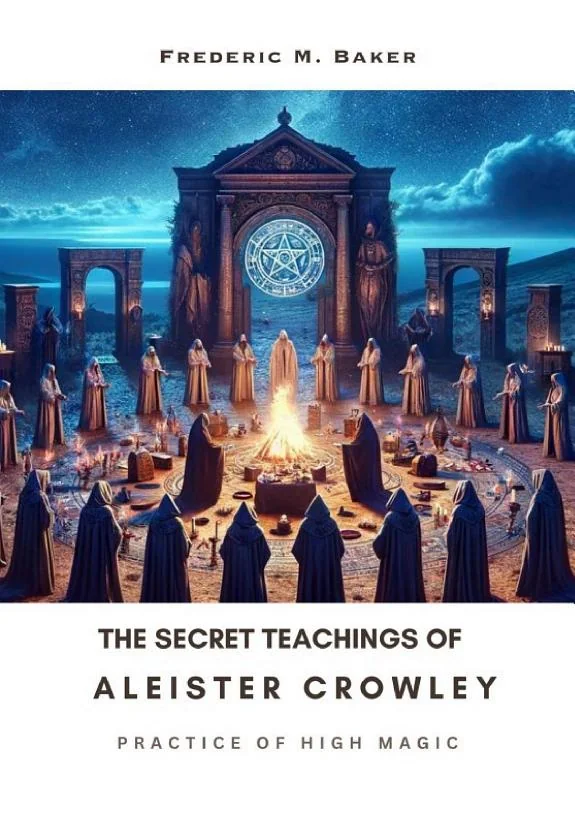
The Secret Teachings of Aleister Crowley
 82
82

The Secret Teachings of Aleister Crowley
Baker's "The Secret Teachings of Aleister Crowley" attempts to distill the voluminous and often contradictory output of its subject into a digestible format. The author commendably focuses on the philosophical underpinnings of Crowley's system, particularly the concept of the True Will, and its practical application through ceremonial magic. A notable strength is the book's clear exposition of the Gnostic Mass, a ritual often overlooked in popular accounts. However, the work occasionally struggles with the sheer density of Crowley's thought, sometimes presenting complex ideas with an abruptness that may leave readers seeking further clarification. The analysis of Crowley's engagement with Kabbalah, while present, could benefit from more detailed textual exegesis. Ultimately, Baker provides a valuable, if somewhat dry, scholarly overview for those prepared to grapple with the intricacies of Crowley's magical philosophy.
📝 Description
82
Frederic M. Baker's 2016 book examines Aleister Crowley's occult system.
Frederic M. Baker's "The Secret Teachings of Aleister Crowley" provides a structured look at the occultist's philosophical and practical system. The book moves past sensationalism to dissect the core ideas of Crowley's magical and spiritual practices. It constructs a coherent, though demanding, framework for understanding his contributions to Western esotericism, using his extensive writings.
This work is for those with a basic knowledge of esoteric concepts and a real interest in how modern occultism developed. It suits practitioners wanting to know more about specific magical systems, students of religious and mystical traditions, and anyone interested in the intellectual forces that influenced 20th-century magical thought. This is not an introduction for beginners but an academic study of complex ideas.
Published in 2016, this book situates Aleister Crowley's work within the context of late 19th and early 20th-century spiritual and intellectual movements. It acknowledges influences from figures like Helena Blavatsky and the Hermetic Order of the Golden Dawn, periods marked by spiritualism and a reaction against Victorian materialism. Baker's analysis traces Crowley's development and his articulation of the "Law of Thelema," presenting a synthesis that sought to transcend contemporary thought.
💡 Why Read This Book?
• Gain a structured understanding of Aleister Crowley's philosophical system, particularly the concept of the "True Will," as presented in Chapter 3, allowing for a more organized approach to his complex ideas. • Explore the practical applications of ceremonial magick as detailed in sections on ritual, offering concrete methods for spiritual development beyond theoretical study. • Understand the historical context of Crowley's work within the Hermetic Order of the Golden Dawn, providing specific connections to the intellectual currents of the late 19th and early 20th centuries.
⭐ Reader Reviews
Honest opinions from readers who have explored this book.
❓ Frequently Asked Questions
What is the "Law of Thelema" as explained in "The Secret Teachings of Aleister Crowley"?
The Law of Thelema, as outlined by Aleister Crowley and explored in this book, posits "Do what thou wilt shall be the whole of the Law." This principle emphasizes discovering and enacting one's unique purpose or "True Will" as the ultimate spiritual goal.
Does "The Secret Teachings of Aleister Crowley" cover specific magical rituals?
Yes, the book details various aspects of ceremonial magick as practiced by Crowley. It discusses specific rituals and their theoretical underpinnings, providing insight into his methods for spiritual and magical attainment.
Who was Aleister Crowley?
Aleister Crowley (1875-1947) was a highly influential British occultist, ceremonial magician, and poet who founded the religious philosophy of Thelema. He is a central figure in modern Western esotericism, known for his extensive writings and magical system.
Is "The Secret Teachings of Aleister Crowley" suitable for beginners in occult studies?
While it offers a comprehensive overview, the book delves into complex philosophical and magical concepts. It is best suited for those with some prior exposure to esoteric traditions or a strong academic interest in occultism.
What is the significance of the Gnostic Mass in Crowley's teachings?
The Gnostic Mass is a central eucharistic ritual in the Thelemic tradition, designed by Crowley to be an adaptable and potent expression of Thelemic principles. The book examines its structure and esoteric meaning.
When was "The Secret Teachings of Aleister Crowley" first published?
Frederic M. Baker's "The Secret Teachings of Aleister Crowley" was first published on February 25, 2024, making it a recent scholarly contribution to the study of Crowley's work.
🔮 Key Themes & Symbolism
Thelema and the True Will
Central to Crowley's philosophy is the concept of Thelema, meaning 'Will,' and its primary tenet: 'Do what thou wilt shall be the whole of the Law.' Baker's work elaborates on the "True Will," distinguishing it from mere caprice. It's presented not as selfish desire but as an individual's unique, divinely ordained purpose. The book explores how identifying and executing this True Will becomes the ultimate path to spiritual liberation and self-realization within Crowley's system.
Ceremonial Magick and Ritual Practice
This book dissects the practical applications of Crowley's magical theories, focusing on ceremonial magick. It moves beyond a simple definition to explore the structure and purpose of specific rituals, including the Gnostic Mass. Baker examines the symbolic language, invocations, and operations designed to effect change in consciousness and the external world, offering a glimpse into the operational side of Crowley's occultism.
Kabbalistic and Enochian Systems
Crowley's magical system is deeply interwoven with esoteric traditions, notably the Kabbalah and the angelic language of Enochian magic. "The Secret Teachings" illustrates how Crowley adapted and integrated these frameworks, particularly the Tree of Life, into his own evolving doctrines. It highlights his unique interpretations and applications of these ancient systems as tools for spiritual ascent and magical attainment.
Crowley's Place in Esoteric History
Baker situates Aleister Crowley within the broader range of Western esotericism, acknowledging his influences from earlier magical orders and thinkers while emphasizing his radical departures. The book addresses Crowley's controversial legacy and his significant impact on subsequent occult movements, presenting him as a key, albeit polarizing, figure in the development of modern magical thought.
💬 Memorable Quotes
Direct passages from the work, attributed to the author.
“Do what thou wilt shall be the whole of the Law.”
— This is the central axiom of Thelema, Crowley's religious philosophy. It signifies the importance of discovering and aligning with one's authentic purpose or "True Will" as the guiding principle for life and spiritual practice.
“Every man and every woman is a star.”
— This poetic declaration underscores the inherent divinity and autonomy of the individual within Thelemic thought. It suggests that each person possesses a unique essence and destiny, akin to a celestial body.
“The key of the ritual is in the symbolism.”
— This highlights Crowley's emphasis on the symbolic nature of magic. Rituals are not mere actions but are laden with meaning, intended to communicate profound truths and effect transformations through symbolic correspondence.
“The Gnostic Mass is the centre of the Church of Thelema.”
— This statement by Crowley emphasizes the crucial role of the Gnostic Mass as the primary religious sacrament and unifying ritual within the Thelemic tradition he established.
“Magick is the Science and Art of causing Change to occur in conformity with Will.”
— This is Crowley's famous definition of magick, defining it as a disciplined practice focused on achieving specific outcomes through focused intention and deliberate action aligned with one's purpose.
🌙 Esoteric Significance
Tradition
Crowley's work is primarily situated within the Western Esoteric Tradition, drawing heavily from Hermeticism, Kabbalah, Gnosticism, and ceremonial magic. He synthesized these elements into a unique system known as Thelema. While building upon existing structures like the Hermetic Order of the Golden Dawn, Crowley departed significantly by emphasizing individual spiritual authority and the concept of the "True Will," positioning his work as a radical evolution rather than mere continuation of earlier magical lineages.
Symbolism
Key symbols in Crowley's teachings include the pentagram, often used in invocation and banishing rituals; the Ouroboros, representing cyclical time, unity, and the infinite; and the Stele of Revealing, the artifact associated with the reception of the Book of the Law. These symbols are not merely decorative but are integral components of his magical system, serving as focal points for consciousness and conduits for spiritual energy.
Modern Relevance
Crowley's influence persists strongly in contemporary occult circles. Modern practitioners of ceremonial magick, Neopaganism, and Chaos Magick often engage with his writings and techniques. Thinkers and authors exploring Western esotericism continue to analyze his complex legacy, and his concepts, particularly the "True Will," are frequently discussed in philosophical and spiritual discourse, demonstrating his enduring impact on esoteric thought.
👥 Who Should Read This Book
• Students of Western Esotericism: Those seeking to understand the development of occult traditions in the 20th century will find Baker's analysis of Crowley's foundational role invaluable. • Practitioners of Ceremonial Magick: Individuals engaged in magical practices can gain deeper theoretical insights into the principles and rituals popularized by Aleister Crowley. • Comparative Religion Scholars: Researchers interested in new religious movements and the evolution of spiritual thought will benefit from a structured examination of Thelemic philosophy.
📜 Historical Context
Aleister Crowley’s work emerged from a fertile ground of late Victorian and Edwardian occultism, a period marked by a reaction against scientific materialism and a surge of interest in spiritualism, Theosophy, and Western esotericism. He was deeply influenced by his early involvement with the Hermetic Order of the Golden Dawn, a key magical organization whose members included figures like W. B. Yeats. While the Golden Dawn focused on Kabbalistic and Hermetic magic, Crowley, after his departure around 1900, sought to forge a more radical and personal path. His proclamation of the "Law of Thelema" in 1904, following his reception of the Book of the Law, set him apart from contemporaries like Annie Besant and Rudolf Steiner, who were developing different spiritual systems. Crowley's reception was often fraught with controversy and public scandal, leading to censorship and vilification, yet his prolific writings and organizational efforts profoundly shaped the trajectory of modern occultism.
📔 Journal Prompts
The concept of the "True Will" as presented in Chapter 3.
Crowley's definition of "Magick" and its implications for personal change.
The symbolic meaning of the Ouroboros within Crowley's framework.
The structure and purpose of the Gnostic Mass.
The historical context of the Hermetic Order of the Golden Dawn.
🗂️ Glossary
Thelema
The Greek word for 'Will,' central to Aleister Crowley's religious philosophy. It posits that the sole purpose of life is to discover and enact one's unique, divinely ordained "True Will."
True Will
In Thelemic philosophy, this refers to an individual's authentic, predetermined purpose or destiny. It is distinct from personal desires and is considered the guiding principle for spiritual attainment.
Ceremonial Magick
A structured system of ritual magic that employs symbolism, invocation, and specific procedures to effect change in consciousness or the external world, often drawing on Kabbalistic and Hermetic principles.
Kabbalah
A system of Jewish mysticism and esoteric interpretation that uses symbolic analysis, particularly of the Hebrew Bible and the Sefer Yetzirah, to understand divine nature and the structure of the universe.
Enochian Magic
A complex magical system supposedly revealed by angels to John Dee and Edward Kelley in the 16th century. It involves a unique language and cosmology, adopted and adapted by Crowley.
Gnostic Mass
A eucharistic ritual developed by Aleister Crowley, serving as a central ceremony for the religion of Thelema. It incorporates elements of Gnosticism and aims to enact spiritual principles.
Book of the Law (Liber AL vel Legis)
The foundational text of Thelema, purportedly dictated to Aleister Crowley in Cairo in 1904. It contains the core philosophical and religious tenets of the movement.
This book appears in 1 collection
🔮 Readers Also Liked
Browse all →







From the “High Magic” Collection
View all →







More Free Magic & Ritual Books
View all →