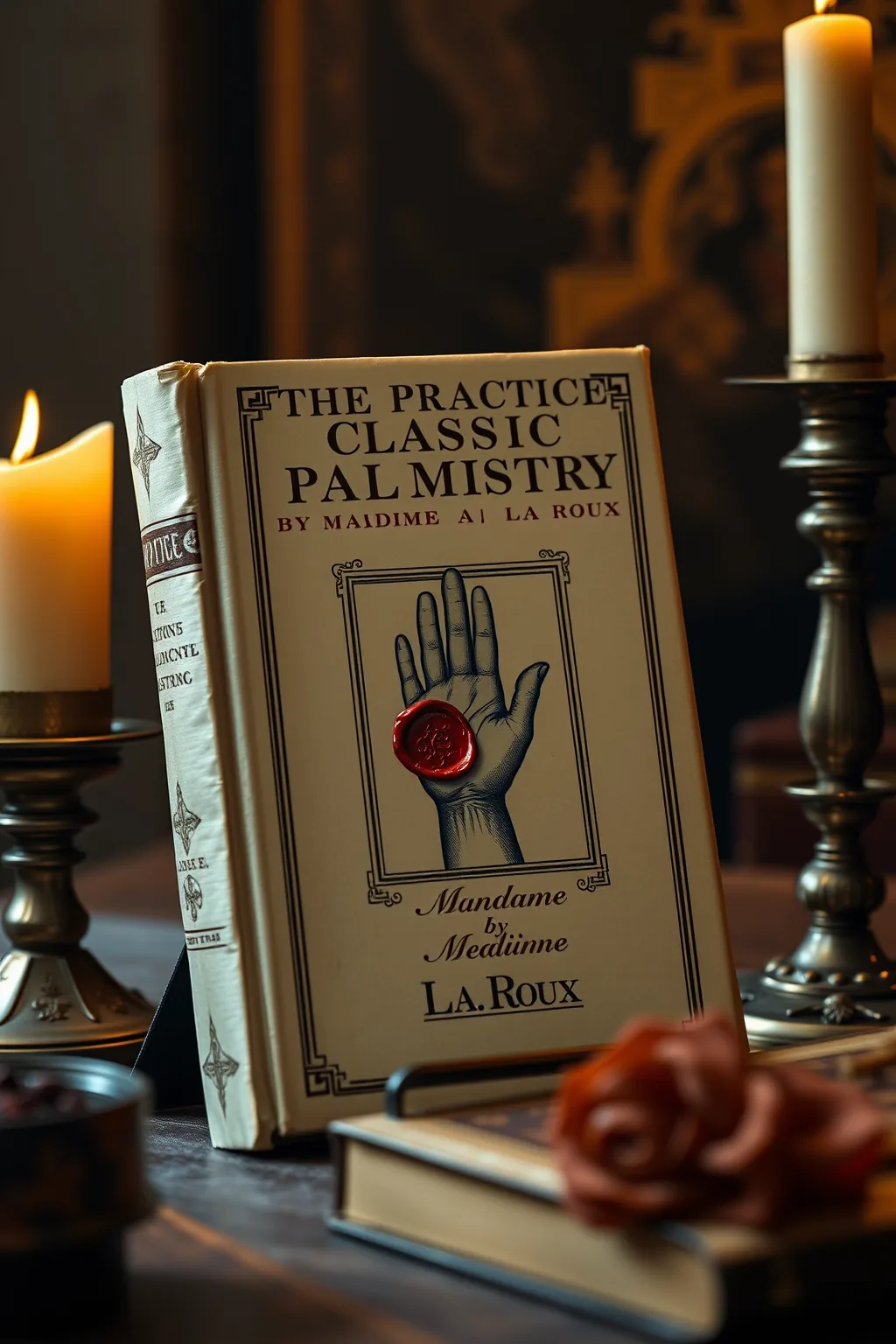
The Practice of Classical Palmistry
 78
78

The Practice of Classical Palmistry
Madame la Roux’s *The Practice of Classical Palmistry* distinguishes itself by its methodical deconstruction of the hand. Rather than presenting a sweeping overview, it insists on understanding the lines and fingers as discrete markers of personality before attempting a full palm reading. This approach is exceptionally valuable for beginners, offering clarity where other texts might overwhelm. The inclusion of case studies, illustrating the application of principles, is a particular strength, grounding theory in practice. However, the book's focus on classical interpretation means it offers less on the more fluid, intuitive, or modern psychological approaches to palmistry that have gained traction. For instance, the discussion on the Head Line, while detailed, might not fully encompass contemporary understandings of cognitive styles. Nevertheless, for those seeking a rigorous foundation in traditional chiromancy, this book provides an accessible and well-organized entry point.
📝 Description
78
Madame la Roux's *The Practice of Classical Palmistry* was first published on January 15, 1993.
This 1993 text approaches palmistry through a structured analysis of the hand's features. Madame la Roux organizes the material to first examine individual lines and fingers separately. Only after this detailed breakdown does the book move toward synthesizing these elements for a complete interpretation of the palm. The author includes guidance on how to conduct readings, covering client interaction and providing case studies. The book is intended for those interested in a methodical introduction to chiromancy. It features a self-study format with questions at the end of each chapter, suitable for independent learners who wish to apply the techniques directly.
*The Practice of Classical Palmistry* appeared during a period of growing interest in esoteric subjects, following the New Age trends of the late 20th century. It sought to re-center palmistry on classical methods, differentiating itself from earlier Theosophical approaches and more speculative contemporary interpretations. The author's aim was to present a practical system for reading the hand.
Published in 1993, *The Practice of Classical Palmistry* emerged as a practical guide during a resurgence of interest in divination. It consciously stepped away from the spiritual interpretations common in the New Age movement and earlier Theosophical writings. Instead, Madame la Roux focused on the systematic analysis of hand features, aiming to revive what she saw as more classical methods of chiromancy. The book provides a structured alternative for those seeking a less mystical, more observational approach to reading the palm.
💡 Why Read This Book?
• Gain a systematic method for interpreting palm lines, starting with individual expressions of personality before integrating them, as detailed in Madame la Roux's chapter-by-chapter analysis. • Learn practical client interaction techniques and how to conduct a reading, directly from the author’s experience presented through case studies. • Develop self-assessment skills by using the integrated self-study questions that prompt you to examine your own hand in relation to each concept introduced.
⭐ Reader Reviews
Honest opinions from readers who have explored this book.
❓ Frequently Asked Questions
What is the primary focus of *The Practice of Classical Palmistry*?
The book's primary focus is on teaching classical palmistry by first analyzing individual lines and fingers before integrating them into a holistic reading, emphasizing a structured, step-by-step approach.
Who is Madame la Roux?
Madame la Roux is the author of *The Practice of Classical Palmistry*, a well-regarded guide to traditional palm reading techniques first published in 1993.
Does the book include illustrations?
Yes, *The Practice of Classical Palmistry* features illustrations to aid readers in understanding the various lines, mounts, and finger formations discussed within its pages.
What makes this book suitable for self-study?
Its suitability for self-study stems from its clear chapter organization and the inclusion of self-study questions that allow readers to apply the learned material directly to their own hands.
When was *The Practice of Classical Palmistry* first published?
The book was first published on January 15, 1993.
How does this book approach palm reading differently?
It emphasizes reading lines as singular expressions of personality before considering the palm as a whole, offering a more granular and systematic method than some broader introductions.
🔮 Key Themes & Symbolism
Line Analysis Primacy
The core tenet of this work is the rigorous examination of individual palm lines – Life, Head, Heart, and Fate – as distinct indicators of personality traits and life potentials. Before the palm is considered as a unified whole, each line is presented as a singular expression. This method allows for a detailed understanding of specific facets of the self, building a comprehensive picture from granular components. The text provides specific interpretive frameworks for each line's variations and features.
Finger and Mount Significance
Beyond the major lines, Madame la Roux dedicates attention to the interpretation of finger shapes, lengths, and the various mounts on the palm (e.g., Mount of Venus, Mount of Jupiter). These elements are presented not merely as decorative features but as crucial modifiers and amplifications of the information conveyed by the lines. Understanding the interplay between finger characteristics and palm mounts is vital for a nuanced and accurate reading, offering further layers to personality assessment.
Practical Reading Methodology
The book moves beyond theoretical interpretation to offer practical guidance on conducting a palmistry reading. This includes advice on client interaction, ethical considerations, and the process of synthesizing diverse palm features into a coherent narrative. The inclusion of case studies serves as a vital pedagogical tool, demonstrating how the principles are applied in real-world scenarios, bridging the gap between study and practice.
Self-Study and Application
A distinctive feature is the integration of self-study questions at the end of each chapter. These prompts encourage readers to actively engage with the material by examining their own hands, reinforcing learning through direct application. This interactive approach transforms the book from a passive read into an active learning tool, fostering personal insight and practical skill development in chiromancy.
💬 Memorable Quotes
Direct passages from the work, attributed to the author.
“The lines are singular expressions of the personality before the palm as a whole is integrated into a reading.”
— This central thesis emphasizes a foundational approach to palmistry, advocating for a detailed analysis of individual palm lines before attempting a synthesis of the entire hand's meaning.
“Focus on the meaning of each line individually.”
— This highlights the book's pedagogical strategy: to build a comprehensive understanding of palmistry by first mastering the interpretation of each distinct line before moving to more complex integrations.
“Self-study questions are given to allow the student to examine his or her own hand.”
— This points to the interactive nature of the text, designed to facilitate practical learning and personal application of palmistry principles through direct examination of one's own hand.
“The author discusses how to do a reading and work with clients.”
— This indicates the book's practical orientation, extending beyond pure theory to cover the essential interpersonal skills and procedural knowledge required for performing actual palm readings.
“Illustrations are provided to aid understanding.”
— This highlights the visual learning aids within the book, crucial for a subject like palmistry where visual recognition of lines, mounts, and shapes is fundamental to interpretation.
🌙 Esoteric Significance
Tradition
This work fits within the Western esoteric tradition of chiromancy, which has roots stretching back to ancient Greece and Rome, and was further developed through medieval and Renaissance occult studies. It departs from purely fortune-telling interpretations by emphasizing psychological profiling and personality analysis, aligning with a more modern, Hermetic-influenced understanding of correspondences between the microcosm (human) and macrocosm. It seeks a practical, almost alchemical, refinement of self-knowledge through the symbolic language of the hand.
Symbolism
Key symbols include the major palm lines (Life, Head, Heart) representing vitality, intellect, and emotion, respectively. The mounts, such as the Mount of Venus (love, passion) and Mount of Jupiter (ambition, leadership), act as amplifiers or indicators of specific energies. Finger shapes and lengths further refine these interpretations, symbolizing different modes of expression and interaction with the world. Together, these elements form a symbolic language for understanding individual destiny and character.
Modern Relevance
Contemporary practitioners of psychological astrology, human design, and even certain branches of mindfulness coaching may find resonance with the book's detailed mapping of personality traits. The emphasis on self-reflection and understanding inherent patterns echoes modern therapeutic approaches. While classical palmistry isn't a mainstream academic pursuit, works like this continue to inform individuals seeking non-traditional methods for self-discovery and personal development.
👥 Who Should Read This Book
• Aspiring palmists seeking a methodical, foundational education in classical chiromancy, who appreciate a structured, step-by-step learning process. • Individuals interested in personality analysis and self-discovery through esoteric means, looking for practical tools to understand themselves and others. • Students of Western esoteric traditions interested in practical divination systems beyond astrology or tarot, seeking a tangible system of symbolic interpretation.
📜 Historical Context
Published in 1993, *The Practice of Classical Palmistry* arrived during a period when esoteric interests were resurfacing following the more generalized New Age movement of the preceding decades. While not directly tied to the Theosophical Society’s revival of interest in palmistry earlier in the 20th century, it aimed to provide a structured, classical approach. This work offered a counterpoint to the more eclectic or psychologically-oriented interpretations that had become popular. Unlike authors such as Cheiro (William John Warner), who focused on dramatic pronouncements and celebrity readings, Madame la Roux’s method was more pedagogical and analytical. The book’s focus on foundational principles and self-study questions resonated with a growing audience seeking practical skills rather than purely spiritual or prophetic claims, situating it within a broader trend of explaining esoteric arts for wider accessibility.
📔 Journal Prompts
The significance of the Head Line's length and clarity in your own hand.
How the shape of your Jupiter finger influences your ambitions, based on Chapter 3.
Comparing the interpretations of the Heart Line across different chapters.
The role of the mounts, particularly the Mount of Venus, in expressing affection.
Synthesizing the individual line readings into a cohesive self-portrait.
🗂️ Glossary
Chiromancy
The practice of fortune-telling or discerning character through the study of the palm, including its lines, mounts, and finger shapes. It is synonymous with palmistry.
Life Line
A major line on the palm, typically curving around the base of the thumb, often interpreted as relating to physical vitality, well-being, and significant life events.
Head Line
A prominent horizontal line on the palm, usually running across the middle, associated with intellectual capacity, communication style, and mental processes.
Heart Line
A horizontal line across the upper palm, below the fingers, traditionally linked to emotional nature, romantic relationships, and heart health.
Fate Line
A vertical line running up the center of the palm, often associated with career, life path, and external influences impacting one's destiny.
Mounts
The fleshy, raised areas on the palm, named after classical deities (e.g., Venus, Jupiter, Apollo), believed to signify specific character traits and potentials.
Singular Expressions
Referring to the interpretation of individual palm features (like a single line or finger) in isolation before integrating them into a complete reading.