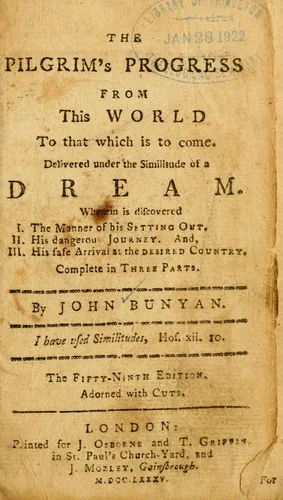
The Pilgrim's Progress
 75
75

The Pilgrim's Progress
Bunyan's narrative, while rooted in a specific theological framework, possesses a stark, almost visceral power that transcends its didactic purpose. The depiction of the Slough of Despond, for instance, is not merely a literary device but a potent image of spiritual despair made tangible. However, the relentless allegorical mapping can, at times, feel overly schematic, reducing complex human experience to easily categorized virtues and vices. The character of Christian, while a compelling everyman for his time, sometimes lacks the nuanced interiority that modern readers might expect. Still, the work's enduring impact on literary and religious thought is undeniable, offering a compelling portrayal of spiritual perseverance. It remains a significant artifact of English devotional literature.
📝 Description
75
John Bunyan published The Pilgrim's Progress in 1678, an allegory of Christian life.
This allegorical novel follows Christian's journey from the City of Destruction toward the Celestial City. Bunyan structures the narrative as a dream, where characters and locations represent theological concepts and moral conditions. The protagonist faces various obstacles and temptations on his path to salvation.
The book was written during a time of religious and political unrest in England. Bunyan, imprisoned for his preaching, produced this work clandestinely. It resonated with believers through its vivid storytelling and accessible theological ideas, standing apart from other devotional literature of the era.
Its central themes include the nature of faith, the fight against temptation, and the concept of predestination. The narrative contrasts the earthly world, filled with sin, with the divine kingdom of salvation. The journey serves as a metaphor for the Christian life, filled with hardship and the pursuit of virtue.
While not strictly esoteric in the modern sense, Bunyan's work draws from a deep vein of Christian mysticism and devotional practice common in 17th-century England. The allegorical framework, with its hidden meanings and spiritual topography, invites a contemplative reading. It reflects a tradition of inward spiritual struggle and the quest for divine grace, understood through a lens shaped by Puritan theology and the experience of religious persecution.
💡 Why Read This Book?
• You will gain an understanding of the allegorical techniques employed in 17th-century religious literature, exemplified by the journey from the City of Destruction to the Celestial City. • You will explore the specific challenges faced by religious nonconformists in post-Restoration England, as reflected in Christian's persecution and imprisonment allegories. • You will encounter early representations of concepts like the Slough of Despond and Vanity Fair, which have influenced subsequent theological and literary discourse.
⭐ Reader Reviews
Honest opinions from readers who have explored this book.
❓ Frequently Asked Questions
What is the main allegory in The Pilgrim's Progress?
The primary allegory is Christian's journey from the City of Destruction to the Celestial City, representing the soul's path from sin and worldly temptation towards salvation and eternal life.
Why was John Bunyan imprisoned when he wrote The Pilgrim's Progress?
Bunyan was imprisoned in 1660 for unlicensed preaching, a consequence of the stringent religious laws enacted after the English Restoration. He wrote much of *The Pilgrim's Progress* during this incarceration.
Who are some key characters or locations in the book besides Christian?
Key figures include Faithful, Hopeful, and Mr. Worldly Wiseman, while significant locations include the Slough of Despond, Vanity Fair, and the Palace Beautiful, each representing spiritual states or trials.
Is The Pilgrim's Progress considered a religious or literary work?
It is both. It functions as a foundational text in Christian literature due to its theological themes and allegorical structure, while also being a significant work in the development of the English novel.
What is the significance of Vanity Fair in the book?
Vanity Fair represents the allure of worldly possessions, status, and pleasures, symbolizing the temptations Christians must resist. Its depiction highlights the conflict between spiritual values and secular materialism.
When was The Pilgrim's Progress first published?
The first part of *The Pilgrim's Progress* was first published in 1678, with the second part following in 1684.
🔮 Key Themes & Symbolism
The Spiritual Warfare
The narrative frames the Christian life as an active conflict against spiritual forces and internal weaknesses. Characters like Apollyon and the inhabitants of the Valley of Humiliation embody these adversarial elements. The journey requires constant vigilance, prayer, and reliance on divine aid to overcome the 'wiles of the devil.' This is not a passive faith but one engaged in a continuous struggle for the soul's purity and salvation, reflecting a common theme in devotional literature of the period.
The Perils of Worldliness
Vanity Fair serves as a potent symbol for the seductive distractions of the material world. Bunyan critiques the pursuit of wealth, fame, and pleasure, portraying them as obstacles to spiritual progress. Characters like Ignorance and Mr. Worldly Wiseman exemplify those who prioritize earthly comforts over eternal truths. The book suggests that true spiritual advancement necessitates detachment from these worldly enticements, a core tenet for many ascetic traditions.
The Nature of Faith and Doubt
Doubt is personified in characters and situations, such as the Slough of Despond, where Christian momentarily succumbs to despair. The narrative emphasizes that faith is not a static state but a dynamic force requiring constant cultivation and reinforcement. The presence of companions like Faithful and Hopeful illustrates the importance of community and mutual encouragement in maintaining spiritual resolve against the constant barrage of discouragement and temptation.
The Goal of Salvation
The Celestial City represents the ultimate spiritual destination—a state of divine union and eternal peace. The entire pilgrimage is oriented towards this goal, providing the motivation for enduring hardships and resisting temptations. The book details the criteria for entry, emphasizing adherence to divine law and a life lived in accordance with Christian doctrine, presenting salvation as the culmination of a righteous, tested life.
💬 Memorable Quotes
Direct passages from the work, attributed to the author.
“I saw a Man was coming from his House and all of his back was Loaden with Books.”
— This opening image, though slightly different in some editions, captures the burden of unapplied knowledge or perhaps the weight of worldly concerns that often impede spiritual journeys, setting a tone of personal trial.
“The Soul of Religion is the practical part.”
— This statement highlights Bunyan's emphasis on lived faith and action over mere intellectual assent or ritual. True spirituality, for Bunyan, is demonstrated through one's conduct and choices in the face of life's challenges.
“This Hill, though high, I count my gain.”
— Spoken by Christian after a difficult ascent, this reflects the perspective that spiritual trials and hardships, though arduous, ultimately contribute to one's growth and ultimate reward in the Celestial City.
“I saw then in my Dream, that the Highway to Heaven is so narrow in Possibilities of Enjoyment, and so difficult in the Passage, that it is hardly to be trodden by any, save those who are of the greatest Courage and Resolution.”
— This highlights the demanding nature of the spiritual path. It suggests that achieving salvation requires not just belief but significant fortitude, unwavering commitment, and the courage to face immense obstacles.
“I saw a Man stand with his Finger in his Ear, and his Book in his Hand.”
— This image suggests the need for selective attention—focusing on spiritual texts and teachings while consciously blocking out distracting or harmful external influences.
🌙 Esoteric Significance
Tradition
While overtly Christian and rooted in Puritan theology, *The Pilgrim's Progress* contains elements that resonate with broader esoteric traditions, particularly in its depiction of the spiritual journey as an arduous quest. The allegorical structure, where mundane settings conceal profound spiritual truths, echoes Gnostic and Hermetic methods of veiled teaching. The emphasis on an internal, subjective transformation mirrored in outward trials aligns with mystical paths across various traditions that focus on the purification of the soul.
Symbolism
The Slough of Despond is a powerful symbol of spiritual despair and the inertia of doubt, representing the challenges of overcoming negative mental states. Vanity Fair symbolizes the overwhelming allure of materialism and worldly distraction, a common theme in ascetic and contemplative traditions warning against attachment. The Wicket Gate, representing entry into the path of salvation, signifies the often narrow and challenging first step toward spiritual commitment, requiring intentionality and a turning away from the broader, easier path.
Modern Relevance
Contemporary spiritual seekers, particularly those in the Christian contemplative and evangelical traditions, continue to draw inspiration from Bunyan's depiction of spiritual perseverance. Its archetypal journey structure also finds echoes in modern self-help and personal development literature that emphasizes overcoming obstacles. Furthermore, scholars of literature and religious history analyze its enduring influence on narrative forms and the portrayal of the individual's relationship with societal and divine structures.
👥 Who Should Read This Book
• Aspiring authors of allegorical fiction seeking models for character and plot development grounded in symbolic meaning. • Students of 17th-century English history and religion interested in the lived experience and theological perspectives of Puritan dissenters. • Individuals undertaking personal spiritual journeys who seek a narrative framework for understanding trials, temptations, and the pursuit of ultimate purpose.
📜 Historical Context
When *The Pilgrim's Progress* emerged in 1678, England was working through the turbulent waters of the post-Restoration period. The monarchy had been re-established, and religious nonconformists like John Bunyan faced significant persecution. Bunyan himself spent approximately 12 years imprisoned in Bedford, during which time he penned this enduring allegory. The work appeared amidst a flourishing of devotional literature, yet its vivid narrative and direct engagement with the common person's spiritual anxieties set it apart. It offered solace and guidance to Protestant dissenters chafing under the established Church of England and royal authority. Contemporaries like John Milton, though writing in a different vein, also explored grand theological narratives, but Bunyan's accessible prose and allegorical framework achieved a far wider readership, becoming one of the most printed books in the English language.
📔 Journal Prompts
The burden of Christian's load: What are the metaphorical 'loads' hindering your own spiritual progress?
Reflect on the temptations encountered at Vanity Fair and their modern equivalents.
Consider the role of companions like Faithful and Hopeful in sustaining spiritual resolve.
Analyze the allegorical representation of the Slough of Despond in your own moments of doubt.
Contemplate the narrowness of the path to the Celestial City and its implications for daily choices.
🗂️ Glossary
City of Destruction
The allegorical starting point of Christian's journey, representing the fallen world steeped in sin and destined for judgment.
Celestial City
The ultimate spiritual destination, symbolizing heaven and eternal salvation, the goal of the pilgrim's arduous journey.
Slough of Despond
A miry bog representing deep spiritual despair, doubt, and discouragement that pilgrims must traverse or overcome.
Vanity Fair
An allegorical marketplace symbolizing the temptations of the material world, including wealth, pleasure, and worldly status.
Wicket Gate
The narrow entrance to the path leading toward the Celestial City, representing the initial commitment and entry into the Christian life.
Apollyon
A demonic figure representing Satan or a powerful spiritual adversary, encountered by Christian in the Valley of Humiliation.
Faithful
A companion of Christian who exemplifies steadfast belief and ultimately suffers martyrdom at Vanity Fair, representing unwavering spiritual integrity.
🔮 Readers Also Liked
Browse all →









More by John Bunyan
All books →



More Free Spiritual Development Books
View all →