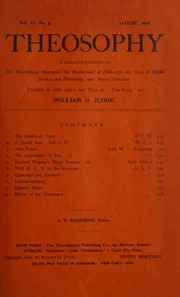
The Occult World

 83
83

The Occult World
Alfred Percy Sinnett's The Occult World presents a candid and earnest defense of spiritualist phenomena and Theosophical tenets. Its strength lies in Sinnett's determined effort to articulate these concepts within a logical, if speculative, framework, particularly his engagement with the notion of 'adepts' as distinct from common mediums. He attempts to present a rational basis for beliefs that were often dismissed outright by the scientific establishment of his day. However, the book's limitation is its inherent bias; it is less an objective analysis and more a polemic designed to persuade readers of the reality of the unseen. The passages discussing the nature of thought-forms and their potential influence on the material plane, while intriguing, are presented with an uncritical acceptance that may alienate modern skeptical readers. Ultimately, The Occult World remains a significant historical document for understanding the early Theosophical movement's philosophical underpinnings.
📝 Description
83
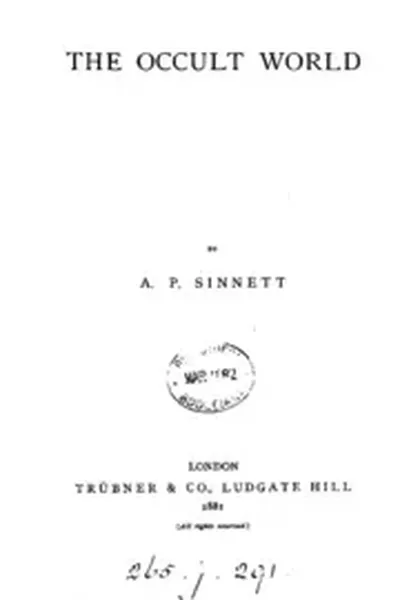
Alfred Percy Sinnett's The Occult World, published in 1969, argued for the validity of occult doctrines.
Alfred Percy Sinnett wrote The Occult World to present and defend the spiritualist and theosophical viewpoints of the late 19th and early 20th centuries. He sought a rational framework for psychic and spiritual occurrences, moving beyond anecdotal evidence to discuss underlying principles. Sinnett was an important figure in the early Theosophical Society, which Helena Blavatsky co-founded in 1875. His book addresses a period when scientific materialism was strong, but spiritualism also held public fascination. Sinnett aimed to connect the physical world with subtler, unseen dimensions of existence. The work engaged with debates about psychic phenomena and the growing influence of Eastern philosophies in the West. It is relevant for students of Western esotericism, particularly those studying Theosophy's origins and its relation to Spiritualism. Researchers of late Victorian and Edwardian intellectual history will find value in Sinnett's arguments and his description of the era's societal context. The book also serves as an introduction to texts that shaped modern occult philosophy.
Sinnett's arguments centered on 'Occultism' as a legitimate field of study. He discussed concepts such as spiritualism, psychic phenomena, and the potential for human consciousness to interact with unseen forces. The book also touched upon the influence of Eastern thought on Western esoteric traditions. It was written during a time of significant questioning of established religious and scientific ideas, providing an alternative perspective. The work appealed to those within the Theosophical Society and beyond who were looking for explanations for experiences not covered by conventional science or religion.
The Occult World emerged from the late 19th-century milieu where scientific materialism was ascendant, yet a strong interest in spiritualism and esoteric ideas also existed. Sinnett's work was a direct engagement with this climate, seeking to legitimize occultism as a field of study. It aligns with the broader Theosophical movement's aim to synthesize Eastern and Western spiritual traditions and provide a rational basis for phenomena considered paranormal. The book addressed a growing Western awareness of Eastern philosophies and their potential integration into a modern spiritual worldview.
💡 Why Read This Book?
• Understand the early Theosophical perspective on unseen forces and spiritual evolution, as articulated by Alfred Percy Sinnett, a key proponent of Helena Blavatsky's work. • Grasp the concept of 'adepts' and the proposed hierarchical structure of spiritual development explored within the book, which influenced subsequent occult traditions. • Examine Sinnett's arguments for the existence of subtle bodies and astral phenomena, providing a historical lens on late 19th-century spiritualist discourse.
⭐ Reader Reviews
Honest opinions from readers who have explored this book.
❓ Frequently Asked Questions
What is the primary focus of The Occult World by Alfred Percy Sinnett?
The book primarily focuses on presenting and defending spiritualist phenomena and Theosophical doctrines, arguing for the existence of advanced spiritual beings ('adepts') and exploring concepts like karma and reincarnation.
When was Alfred Percy Sinnett's The Occult World first published?
Alfred Percy Sinnett's The Occult World was first published in 1969, though its original conceptualization and writing stem from the late 19th century.
Who was Alfred Percy Sinnett and what was his role in the Theosophical Society?
Sinnett was a prominent English writer and journalist who became a leading figure in the early Theosophical Society, serving as editor of its journal 'The Theosophist' and a close associate of Helena Blavatsky.
Does The Occult World discuss Eastern philosophies?
Yes, the work incorporates and interprets concepts from Eastern philosophies, particularly Hinduism and Buddhism, such as karma and reincarnation, as integral to its presentation of occult science.
What is the book's stance on scientific understanding of the time?
Sinnett's work implicitly challenges the limitations of contemporary scientific materialism, suggesting that occult phenomena represent a broader reality that science had yet to acknowledge or explain.
Is The Occult World a primary source for Theosophical beliefs?
It is considered a significant early text that helped popularize and systematize Theosophical ideas, making it a valuable primary source for understanding the movement's foundational period.
🔮 Key Themes & Symbolism
The Nature of Adepts
Sinnett dedicates significant attention to the concept of 'adepts' or 'Masters,' presenting them not as mythical figures but as individuals possessing advanced spiritual and psychic faculties, attainable through rigorous discipline and evolution. He argues for their existence as a tangible reality, capable of intervening in human affairs and guiding spiritual progress. This theme positions the book as a defense of a hidden spiritual hierarchy, central to the Theosophical worldview, and challenges the purely materialistic interpretations of consciousness prevalent in the late 19th century.
Spiritual Science and Subtle Bodies
The work posits a 'spiritual science' that operates on principles beyond conventional physics, focusing on the existence of subtle bodies (e.g., astral, mental) that interact with the physical form. Sinnett attempts to explain phenomena such as clairvoyance, telepathy, and mediumship as manifestations of these subtler energies and planes of existence. This theme offers an alternative cosmology, suggesting that human consciousness is not confined to the brain but extends through these non-physical vehicles, impacting perception and interaction with the environment.
Karma and Reincarnation as Cosmic Law
Sinnett integrates the Indian concepts of karma and reincarnation into a Western esoteric framework, presenting them as fundamental laws governing the universe and individual destiny. Karma is depicted as the principle of cause and effect, ensuring moral accountability across lifetimes, while reincarnation provides the mechanism for spiritual evolution and the working out of karmic consequences. This theme grounds the occult worldview in a seemingly just and ordered system, explaining disparities in human experience and offering a path for eventual spiritual perfection.
The Theosophical Movement's Foundation
As a foundational text for early Theosophy, the book implicitly outlines the movement's core tenets and its mission to synthesize ancient wisdom with modern understanding. Sinnett's writing reflects the intellectual ferment of the late 19th century, attempting to reconcile esoteric traditions with scientific inquiry. The work serves as an apologia for Theosophy, aiming to establish its legitimacy and appeal to a public increasingly disillusioned with traditional religious and scientific dogma, positioning it as a vital spiritual alternative.
💬 Memorable Quotes
Direct passages from the work, attributed to the author.
“The existence of Masters of Wisdom is not a matter of faith but of evidence.”
— This statement underscores Sinnett's intent to present occult realities as demonstrable phenomena, rather than purely spiritual beliefs. It reflects his effort to ground Theosophy in verifiable occurrences, challenging skepticism by appealing to evidence accessible to the earnest seeker.
“Thought-forms possess a definite though fluctuating existence.”
— This interpretation highlights the book's exploration of the objective reality of mental constructs. It suggests that thoughts are not merely ephemeral mental events but can manifest as energetic entities with a degree of independent existence and influence.
“The astral body is the vehicle for experiences beyond the physical.”
— This interpretation points to the book's description of the astral body as a functional entity separate from the physical form. It suggests this subtle vehicle is responsible for phenomena like dreams, out-of-body experiences, and perceptions on non-physical planes.
“Spiritual development is an evolutionary process, not a sudden gift.”
— This reflects Sinnett's view that spiritual attainment is achieved through gradual progress and effort over potentially many lifetimes. It contrasts with notions of divine grace or sudden enlightenment, emphasizing a path of consistent, disciplined growth.
💡 Key Ideas
Editorial paraphrase of the work's core concepts — not direct quotes.
The Law of Karma ensures a balance of justice throughout the cosmos.
This paraphrased concept emphasizes the deterministic and ethical dimension of karma as presented by Sinnett. It frames the principle not as arbitrary fate but as an inherent cosmic mechanism ensuring that actions have precise, equitable consequences across time.
🌙 Esoteric Significance
Tradition
The Occult World is deeply rooted in the Theosophical tradition, which itself synthesizes elements of Hermeticism, Neoplatonism, Gnosticism, and Eastern philosophies (primarily Hinduism and Buddhism). Sinnett's work endeavors to present Theosophy as a 'universal brotherhood' and a rediscovered ancient wisdom, distinct from sectarian religions. It fits within this lineage by positing a spiritual hierarchy, subtle planes of existence, and a cosmic law of karma and reincarnation, aiming to offer a comprehensive spiritual philosophy that transcends Western materialism.
Symbolism
While not heavily symbolic in its prose, the work's core concepts function symbolically. The 'adept' or 'Master' symbolizes the perfected human potential and the existence of higher guidance accessible through spiritual evolution. The concept of 'subtle bodies' (astral, mental) symbolizes the multi-dimensional nature of consciousness and reality, extending beyond the limitations of the physical form. The cyclical nature of 'karma' and 'reincarnation' symbolizes cosmic justice and the continuous, purposeful journey of the soul towards ultimate enlightenment.
Modern Relevance
Contemporary esoteric practitioners and scholars of Western Esotericism frequently reference Sinnett's work. New Age movements and various forms of modern Theosophy continue to draw upon his explanations of karma, reincarnation, and the Masters. Thinkers in consciousness studies and alternative spirituality often engage with his ideas on subtle bodies and psychic phenomena as early attempts to articulate concepts that are now explored through different lenses, making 'The Occult World' a touchstone for understanding the historical development of these fields.
👥 Who Should Read This Book
• Students of early Theosophy and Western Esotericism seeking primary source material on the foundational beliefs articulated by Alfred Percy Sinnett. • Researchers of late 19th-century intellectual history interested in the intersection of spiritualism, science, and alternative philosophies of the era. • Individuals exploring concepts of karma, reincarnation, and the nature of consciousness beyond the physical form, looking for historical perspectives on these ideas.
📜 Historical Context
The Occult World emerged in 1881, a period ripe with intellectual and spiritual upheaval. The late Victorian era witnessed a widespread fascination with Spiritualism, the séance phenomenon, and the potential for communication with the deceased, often fueled by the perceived limitations of orthodox science. Simultaneously, a nascent interest in Eastern religions and philosophies, particularly Hinduism and Buddhism, began to filter into Western consciousness. Alfred Percy Sinnett, a key figure in the burgeoning Theosophical Society (founded 1875), wrote this work as an earnest attempt to provide a coherent, rational framework for these phenomena, arguing for the existence of 'adepts' and a subtle spiritual hierarchy. His work was contemporary with and influenced by Helena Blavatsky's more extensive writings, such as 'Isis Unveiled' (1877). While figures like Madame Blavatsky were central, Sinnett's role was crucial in popularizing and articulating Theosophical ideas for a broader, educated audience. The book's reception was polarized; it was embraced by occultists and spiritualists while facing significant skepticism and criticism from the scientific establishment, which often dismissed such claims as delusion or fraud.
📔 Journal Prompts
The concept of 'adepts' as presented by Sinnett: Reflect on the idea of attainable spiritual mastery.
Sinnett's explanation of 'subtle bodies': Consider how consciousness might extend beyond the physical.
The principle of 'karma' in 'The Occult World': Analyze its role in structuring moral and spiritual order.
The historical context of spiritualism in the late 19th century: How did this milieu shape Sinnett's arguments?
The 'Theosophical Society' as a 'universal brotherhood': Reflect on its aims and Sinnett's contribution.
🗂️ Glossary
Adepts
Individuals believed to have achieved a high degree of spiritual and psychic development, possessing advanced knowledge and abilities beyond ordinary humans. Often referred to as 'Masters' within Theosophy.
Subtle Bodies
Non-physical vehicles or sheaths of consciousness, such as the astral body and mental body, believed to function alongside or independently of the physical body, enabling experiences on different planes of existence.
Karma
The universal principle of cause and effect, where actions (karma) inevitably lead to corresponding consequences, influencing an individual's present and future lives.
Reincarnation
The process by which a soul or consciousness is reborn into a new physical body after death, typically understood as a mechanism for spiritual evolution and the working out of karma.
Astral Plane
A non-physical dimension of existence, often associated with emotions, desires, and the experiences of the astral body during sleep or out-of-body states.
Spiritualism
A religious movement and belief system that asserts the possibility of communication between the living and the spirits of the dead, often through mediums.
Theosophy
A spiritual philosophy originating in the late 19th century, seeking to synthesize religious, philosophical, and scientific teachings, emphasizing universal brotherhood and the study of comparative religion and esoteric doctrines.
🔮 Readers Also Liked
Browse all →






More by Alfred Percy Sinnett
All books →
More Free Theosophy & Anthroposophy Books
View all →