The Modern Witchcraft Book of Tarot
 79
79

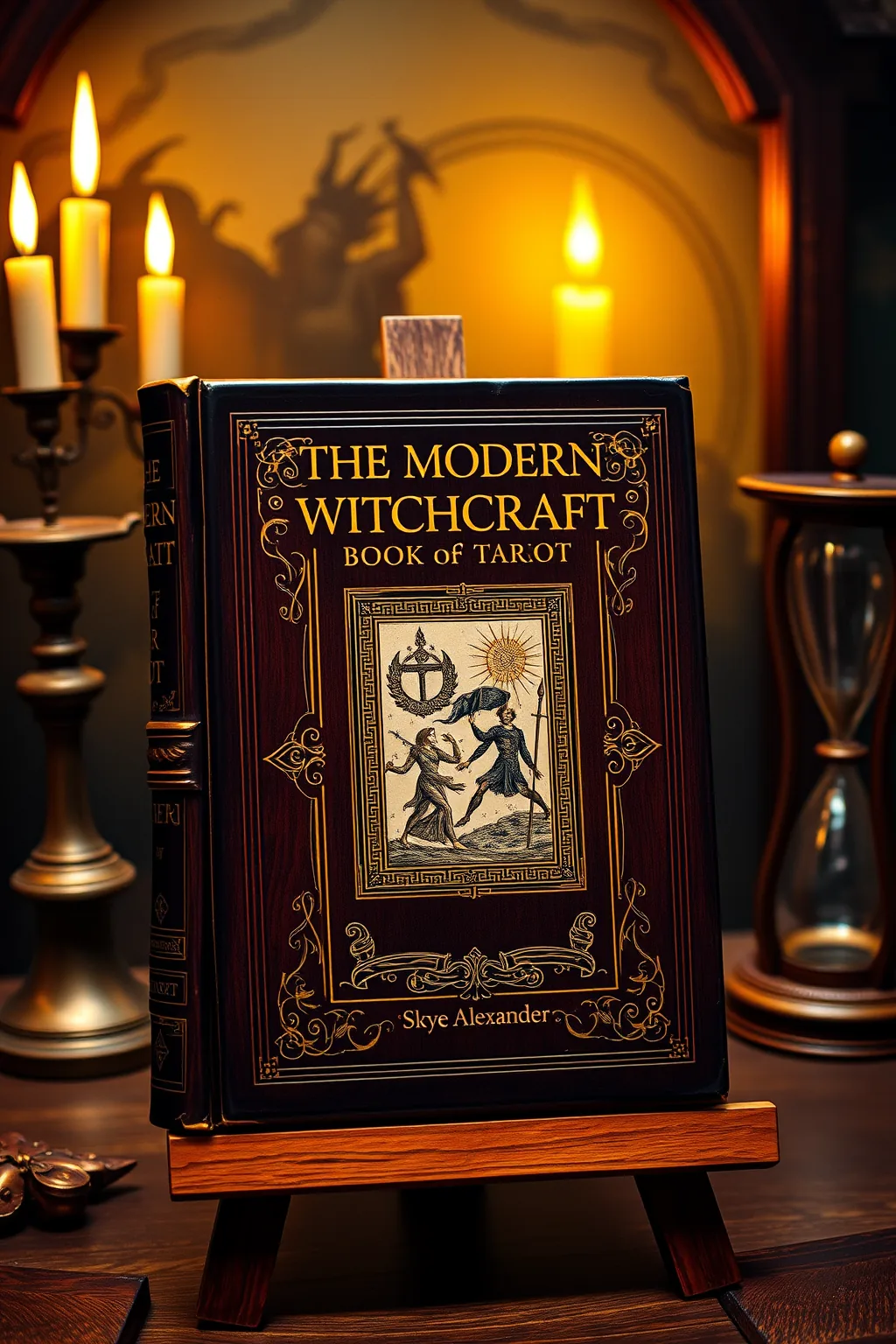
The Modern Witchcraft Book of Tarot
Skye Alexander's "The Modern Witchcraft Book of Tarot" arrives as a practical, accessible entry point for those drawn to the cards through a contemporary pagan lens. The strength of this work lies in its straightforward presentation of complex material. Alexander avoids overly academic jargon, making the Rider-Waite-Smith system and its archetypal meanings digestible for newcomers. A particularly effective section details the symbolism of the Minor Arcana suits, linking them concretely to the elements of fire, water, air, and earth. However, the book’s primary limitation is its generality; while comprehensive, it sometimes sacrifices depth for breadth. For instance, discussions on the historical development of Tarot, while present, could benefit from more specific engagement with earlier decks or distinct interpretive traditions beyond the Waite lineage. The author’s interpretation of the Hanged Man card, for example, focuses heavily on surrender and new perspectives, which is a valid modern take but could be further enriched by acknowledging its older associations with sacrifice or liminality. Ultimately, "The Modern Witchcraft Book of Tarot" serves as a functional, if not revolutionary, guide for aspiring Tarot practitioners within a witchcraft context.
📝 Description
79
Skye Alexander's 2017 book connects Tarot to modern witchcraft for personal insight.
Published in 2017, The Modern Witchcraft Book of Tarot by Skye Alexander presents the Tarot as a system for self-discovery and empowerment within contemporary witchcraft. The book covers the history of Tarot, its ties to occult traditions, and practical card reading methods for personal use and for others. Alexander's work is aimed at those interested in modern witchcraft and integrating Tarot into their spiritual or magical practices. It serves beginners with no prior Tarot knowledge and intermediate practitioners seeking to enhance their understanding and reading skills. Readers curious about the links between Tarot, mythology, and psychological archetypes will find the book valuable.
Alexander places the Tarot within a history of esoteric thought, noting its origins in 15th-century Italy. The influence of figures like Arthur Edward Waite and Pamela Colman Smith, creators of the Rider-Waite-Smith deck, is acknowledged. The book traces how Tarot interpretation evolved from divination to its use in psychological and witchcraft circles during the 20th century. Central to Alexander's approach is viewing the Tarot as a 'mirror of the soul,' reflecting inner states and potential future paths. The archetypal nature of the Major Arcana is emphasized, presented as universal stages of the human journey.
This book connects the Tarot to a lineage of esoteric thought, tracing its roots to 15th-century Italian decks. It acknowledges the significant impact of occultists like A.E. Waite and P.C. Smith, whose Rider-Waite-Smith deck became a standard. Alexander discusses the Tarot's progression from a divinatory tool to its integration into psychological study and modern witchcraft practices. The work frames the Major Arcana as archetypal stages of human experience, aligning with concepts like the monomyth.
💡 Why Read This Book?
• Learn to interpret the Tarot as a tool for personal empowerment and magical practice, distinct from purely divinatory approaches, by understanding Alexander's emphasis on archetypes within the Major Arcana. • Gain practical skills for reading the cards by studying the detailed explanations of each card's symbolism and elemental associations, particularly the structure of the Minor Arcana suits as presented in the book. • Connect with a lineage of modern witchcraft by exploring how Alexander integrates Tarot into contemporary spiritual practices, offering insights not commonly found in older, more traditional Tarot guides.
⭐ Reader Reviews
Honest opinions from readers who have explored this book.
❓ Frequently Asked Questions
What is the historical origin of the Tarot decks discussed in "The Modern Witchcraft Book of Tarot"?
Skye Alexander notes that Tarot decks originated in 15th-century Italy. The book heavily references the Rider-Waite-Smith deck, first published in 1909, which became a significant model for modern interpretations.
How does "The Modern Witchcraft Book of Tarot" connect Tarot to witchcraft?
The book frames Tarot as a tool for self-discovery and magical practice within modern witchcraft. It emphasizes using the cards for insight, empowerment, and aligning with elemental forces, rather than solely for fortune-telling.
What are the Major Arcana in "The Modern Witchcraft Book of Tarot"?
Alexander presents the Major Arcana as archetypal symbols representing significant life lessons and stages of the human journey, often compared to universal spiritual quests or Campbell's monomyth.
Are there practical exercises for learning Tarot in this book?
Yes, the book includes guidance on how to perform Tarot spreads and offers interpretations for various card combinations, encouraging readers to practice reading for themselves and others.
What is the significance of the Minor Arcana according to Skye Alexander?
Alexander explains the Minor Arcana's four suits (Wands, Cups, Swords, Pentacles) as representing different aspects of life and personality, deeply connected to the four classical elements and their inherent energies.
When was "The Modern Witchcraft Book of Tarot" first published?
The book was first published in 2017, positioning it as a contemporary guide to Tarot within the witchcraft tradition.
🔮 Key Themes & Symbolism
Archetypal Journey of the Major Arcana
Alexander posits the Major Arcana as a symbolic map of human experience, echoing Joseph Campbell's concept of the monomyth. Each card, from the Fool's innocent beginnings to the World's completion, represents a stage or challenge on the path to self-realization. This perspective shifts Tarot from simple prediction to a framework for understanding personal growth and spiritual evolution within a witchcraft context. The book details the archetypal characters and situations encountered, offering a visual and narrative structure for introspection and magical intent.
Elemental Symbolism of the Minor Arcana
The work meticulously breaks down the Minor Arcana into their four suits: Wands (Fire), Cups (Water), Swords (Air), and Pentacles (Earth). Alexander explains how each suit corresponds to a classical element, influencing its interpretation in relation to actions, emotions, intellect, and material concerns. This elemental association is crucial for understanding the nuances of daily life and magical workings as depicted in the numbered cards and court figures, providing a practical language for reading the subtle energies at play.
Tarot as a Tool for Empowerment
Beyond divination, Alexander presents Tarot as a means of personal empowerment and self-discovery. The book encourages readers to use the cards to identify strengths, confront challenges, and gain clarity on their spiritual path. By understanding the symbolic language of the Tarot, practitioners can engage in conscious creation and manifestation, aligning their will with the energies depicted in the cards. This active engagement transforms the Tarot from a passive oracle into a dynamic partner in magical practice.
Integration with Modern Witchcraft
This book explicitly bridges the ancient practice of Tarot with contemporary witchcraft traditions. It provides context for how witches utilize Tarot for spellcraft, ritual planning, and understanding energetic influences. Alexander highlights the compatibility of Tarot's symbolic system with pagan and Wiccan beliefs, offering a resource for those seeking to deepen their witchcraft practice through card work and intuitive development.
💬 Memorable Quotes
Direct passages from the work, attributed to the author.
“The Tarot is a mirror reflecting your inner world and potential futures.”
— This core idea suggests that the cards don't dictate fate but rather illuminate the user's internal landscape and the likely outcomes of their current trajectory, emphasizing self-awareness.
“The Major Arcana represent significant life lessons and archetypal energies.”
— This highlights the book's focus on the profound, transformative stages of life as depicted by the 22 trump cards, framing them as universal experiences rather than isolated events.
“Each suit in the Minor Arcana is connected to one of the four classical elements.”
— This principle is fundamental to Alexander's method, grounding the interpretation of the numbered cards and court figures in elemental symbolism for practical application.
“Tarot reading is a dialogue between the querent, the cards, and the reader.”
— This emphasizes the interactive and interpretive nature of Tarot, suggesting that meaning arises through the engagement and intuition of all parties involved in a reading.
💡 Key Ideas
Editorial paraphrase of the work's core concepts — not direct quotes.
Use the cards to empower yourself and understand your spiritual path.
This paraphrased concept underscores the book's aim to equip readers with Tarot skills for personal growth and conscious magical work, promoting agency.
🌙 Esoteric Significance
Tradition
This work fits within the modern Western Esoteric tradition, specifically its branch focused on witchcraft and neo-paganism. It draws heavily on the symbolism and interpretive frameworks popularized by early 20th-century occultists like Arthur Edward Waite, who himself was steeped in Hermeticism and the Kabbalah. Alexander adapts these established esoteric systems, particularly the Rider-Waite-Smith deck's iconography, to align with contemporary witchcraft practices, emphasizing personal empowerment and intuitive development rather than solely predictive divination.
Symbolism
Key symbols include the archetypal figures of the Major Arcana, representing universal stages of the human journey (e.g., The Fool, The Magician, The World), and the elemental correspondences of the Minor Arcana's suits: Wands (Fire), Cups (Water), Swords (Air), and Pentacles (Earth). Alexander interprets these not just as abstract concepts but as practical tools for understanding life's energies and directing magical intent within witchcraft rituals.
Modern Relevance
Contemporary practitioners of modern witchcraft, tarot readers seeking to deepen their practice beyond basic meanings, and individuals exploring archetypal psychology find value in Alexander's accessible approach. Thinkers and communities focused on intuitive development, personal sovereignty, and the integration of magical tools into daily life often reference guides like this one for practical application and foundational understanding.
👥 Who Should Read This Book
• Aspiring witches and modern pagans seeking to incorporate Tarot into their spiritual toolkit, offering a clear path to understanding card meanings and their application in ritual. • Beginners interested in learning Tarot who prefer an approach grounded in witchcraft principles and archetypal symbolism, providing a less intimidating entry point than purely academic texts. • Individuals exploring personal development and self-discovery through symbolic systems, who can utilize the book's framework to gain insight into their own life path and challenges.
📜 Historical Context
Published in 2017, "The Modern Witchcraft Book of Tarot" emerged during a period of renewed interest in esoteric practices, particularly within neo-pagan and witchcraft communities. This era saw a proliferation of books aimed at making occult traditions accessible, often building upon foundational works from the early 20th century. The book's lineage clearly traces back to figures like Arthur Edward Waite, whose influential Rider-Waite-Smith deck, created with artist Pamela Colman Smith in 1909, redefined Tarot for many. Waite's own esoteric explorations, particularly his involvement with the Hermetic Order of the Golden Dawn, provided a rich symbolic framework that Alexander draws upon. While Waite sought to systematize Tarot interpretation within a Western Esoteric tradition, Alexander adapts these concepts for a modern, witchcraft-focused audience. This contrasts with earlier, more purely divinatory or psychological interpretations that gained traction throughout the 20th century, such as those influenced by Carl Jung's archetypal psychology, though Alexander certainly incorporates archetypal concepts. The book's reception is part of a broader trend where esoteric knowledge, once confined to secret societies, became widely available, largely bypassing the kind of academic scrutiny or censorship that marked earlier periods.
📔 Journal Prompts
Reflect on the Fool's journey and how it mirrors your own initial steps into new spiritual paths.
Consider the elemental associations of the Cups suit and how they manifest in your emotional life.
Analyze the archetypal energies of The Magician card in relation to your personal power and manifestation abilities.
Explore the symbolism of the Swords suit and its connection to your intellectual processes and decision-making.
Meditate on the Pentacles suit's representation of the material world and your relationship with abundance.
🗂️ Glossary
Major Arcana
The 22 trump cards in a Tarot deck that represent significant life lessons, spiritual stages, and archetypal energies, often seen as a map of the soul's journey.
Minor Arcana
The 56 cards of a Tarot deck divided into four suits (Wands, Cups, Swords, Pentacles), representing everyday events, situations, and challenges.
Rider-Waite-Smith Deck
A highly influential Tarot deck first published in 1909, created by Arthur Edward Waite and illustrated by Pamela Colman Smith, known for its detailed symbolic imagery.
Archetype
A universal, archaic pattern or image that derives from the collective unconscious and is believed to influence human behavior and perception, as represented in the Major Arcana.
Elemental Correspondences
The association of Tarot suits (Wands, Cups, Swords, Pentacles) with the classical elements of Fire, Water, Air, and Earth, respectively, used for interpretation.
Tarot Spread
A specific arrangement of Tarot cards laid out in a pattern, designed to answer a particular question or explore a specific situation, each position having a defined meaning.
Querent
The person for whom a Tarot reading is being conducted; the individual seeking insight or answers from the cards.
🔮 Readers Also Liked
Browse all →
More by Skye Alexander
All books →
More Free Divination & Tarot Books
View all →