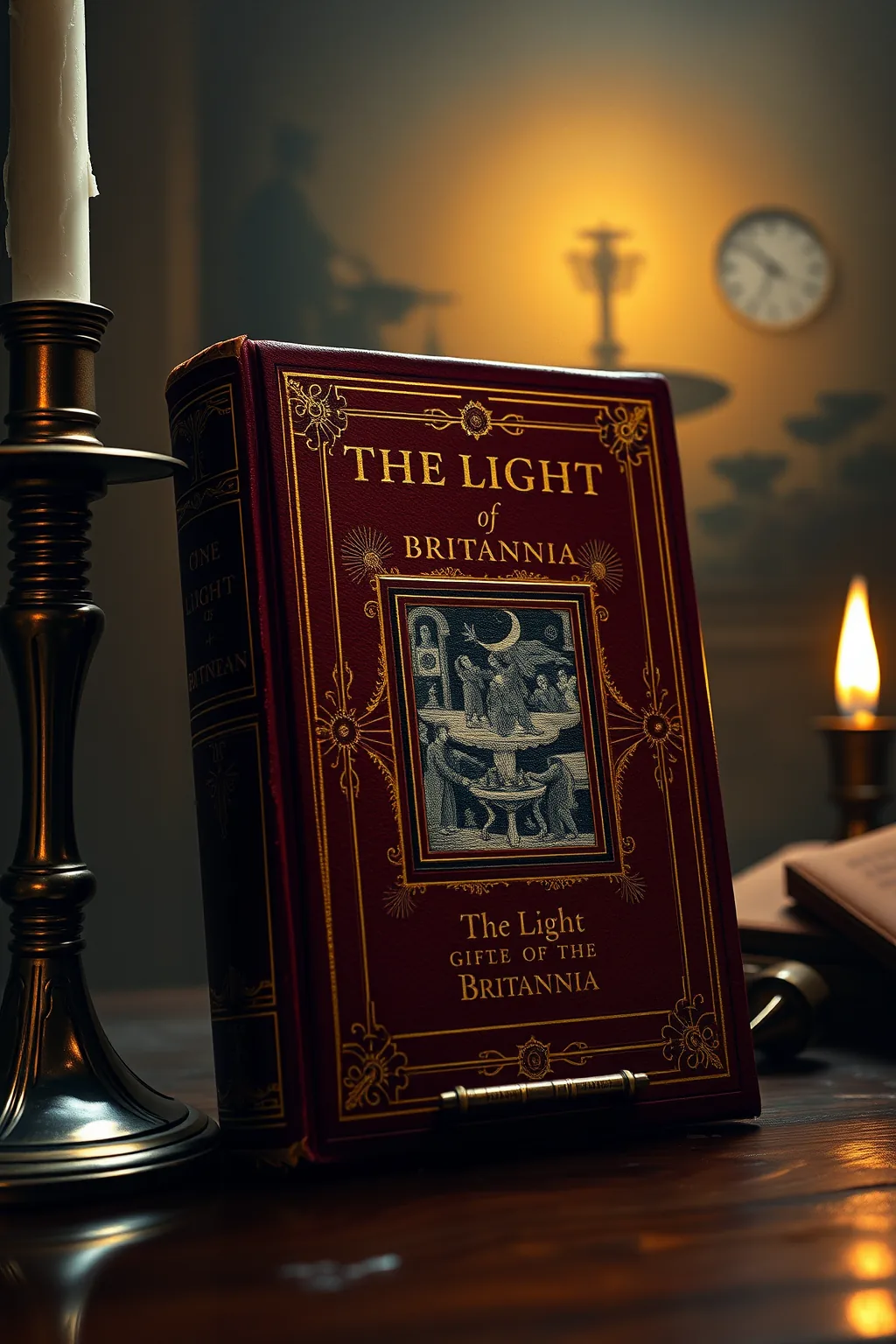
The Light of Britannia
 81
81

The Light of Britannia
Owen Morgan's "The Light of Britannia" is a fascinating, if occasionally problematic, window into late 19th-century occult scholarship. The book's strength lies in its direct, unvarnished presentation of theories linking ancient British Druidism to phallic worship. Morgan doesn't shy away from controversial interpretations, offering a bold, if speculative, reconstruction of early religious practices. One passage that stands out is his detailed analysis of certain ancient stones and earthworks, which he interprets as explicit representations of generative forces, a perspective that certainly challenges conventional archaeological views.
However, the work's primary limitation is its inherent bias and the lack of rigorous academic methodology by modern standards. The interpretations are deeply rooted in the author's specific esoteric framework, often presenting conjecture as established fact. The reprint, while preserving the original text, does little to contextualize its more extreme claims for a contemporary audience. Despite these reservations, "The Light of Britannia" remains a significant artifact of esoteric history, offering a unique, albeit biased, perspective on ancient British spirituality.
📝 Description
81
Owen Morgan's 1893 book claims to unveil the original source of phallic worship within ancient British Druidism.
Originally published in 1893, "The Light of Britannia" by Owen Morgan presents a view of ancient British Druidism. Morgan connects these practices to what he calls "phallic worship," suggesting a lineage from pre-Christian beliefs to later religious developments. The book aims to illuminate these aspects of Britain's past, focusing on symbols and rituals.
This work is suited for those interested in the historical roots of Western esotericism and Celtic traditions. It offers primary source material on Druidic practices, viewed through a 19th-century lens. Readers engaged in comparative religion or studies of ancient symbolism will find it a reference point, acknowledging its historical perspective.
Published in 1893, "The Light of Britannia" emerged during the late Victorian era's fascination with ancient religions and the occult. This period saw figures like Helena Blavatsky and the Theosophical Society popularizing Eastern and Western traditions, alongside revivals of Hermetic and Rosicrucian orders by figures such as William Wynn Westcott and Samuel Liddell MacGregor Mathers. Morgan's book fits into a broader late 19th-century scholarly effort to reinterpret pre-Christian European spiritualities, often filtered through contemporary scientific and moral viewpoints.
💡 Why Read This Book?
• Gain insight into 19th-century esoteric interpretations of Druidism, specifically Owen Morgan's theories on ancient British fertility cults as presented in "The Light of Britannia." • Understand the historical context of occult research during the Victorian era, noting how authors like Morgan engaged with ancient mythologies and religious practices. • Explore specific symbolic interpretations, such as Morgan's views on ancient stones and earthworks as representations of generative forces, offering a unique lens on historical artifacts.
⭐ Reader Reviews
Honest opinions from readers who have explored this book.
❓ Frequently Asked Questions
What is the original publication date of 'The Light of Britannia'?
The original edition of 'The Light of Britannia' by Owen Morgan was first published on July 25, 2017, though it is a reprint of an 1893 work. This reprint aims to preserve the historical text.
What is the main focus of 'The Light of Britannia'?
The book's primary focus is on unveiling the mysteries of ancient British Druidism, with a particular emphasis on its connection to what the author terms 'phallic worship' and fertility cults.
Is 'The Light of Britannia' based on archaeological evidence?
While the book discusses ancient British sites and symbols, its interpretations are heavily influenced by the author's esoteric beliefs and late 19th-century speculative frameworks rather than strict modern archaeological consensus.
Who published the reprint of 'The Light of Britannia'?
The reprint of 'The Light of Britannia' is published by Hansebooks, a company that focuses on preserving historical literature across various academic and cultural topics.
Does the book offer a modern perspective on Druidism?
No, 'The Light of Britannia' offers a perspective from 1893. While valuable for historical context, its views on Druidism and phallic worship should be considered through the lens of its original publication era.
What does the subtitle 'The Original Source of Phallic Worship' imply?
This subtitle suggests that Owen Morgan believed ancient British Druidism was the foundational source for later practices and beliefs related to fertility and generative worship across various cultures.
🔮 Key Themes & Symbolism
Druidic Fertility Rites
The work posits that ancient British Druidism was fundamentally a religion centered on fertility and generative forces. Morgan analyzes supposed rituals and symbolism, linking them directly to the worship of the phallus as a representation of life and creation. This interpretation aims to reveal a core aspect of pre-Christian British spirituality that he believes has been obscured or forgotten, connecting it to universal themes of nature's cycles and human procreation.
Symbolism of Ancient Sites
Morgan interprets various ancient British megaliths, standing stones, and earthworks not merely as astronomical markers or burial sites, but as deliberate representations of sexual organs and fertility symbols. He suggests these structures were integral to religious ceremonies designed to invoke the powers of nature for bountiful harvests and lineage continuation. This approach treats the landscape itself as a sacred text imbued with esoteric meaning.
Origins of Religious Practices
A central argument is that the practices and beliefs associated with ancient Druidism, particularly those related to fertility and the phallus, represent the original source from which many later religious traditions evolved. The book seeks to trace an unbroken lineage of esoteric knowledge, suggesting that understanding these ancient British roots is key to comprehending the development of religious expression across Western cultures.
Esoteric Interpretation of History
The book employs an esoteric methodology to reinterpret historical and archaeological evidence, moving beyond conventional scholarly interpretations. It aligns with a broader late 19th-century trend of seeking hidden spiritual meanings in ancient cultures. Morgan's work frames Druidism not just as a historical religion but as a repository of profound, mystical knowledge concerning life, death, and regeneration.
💬 Memorable Quotes
Direct passages from the work, attributed to the author.
“The original source of Phallic Worship.”
— This subtitle captures Morgan's central thesis: that ancient British Druidism is the foundational origin point for the widespread practice of worshipping the phallus, seen here as a symbol of life and fertility.
“The Mysteries of Ancient British Druidism Unveiled.”
— This phrase highlights the book's declared purpose: to expose hidden or secret aspects of Druidic belief and practice that the author believes have been misunderstood or deliberately concealed.
“An unchanged, high-quality reprint of the original edition of 1893.”
— This statement from the publisher, Hansebooks, emphasizes the fidelity of the current edition to the 1893 original, assuring readers they are engaging with the author's precise wording and perspective from that era.
“Many works of historical writers and scientists are available today as an”
— This unfinished sentence from the publisher's note suggests their mission is to make historical texts accessible, implying 'The Light of Britannia' is part of a larger effort to preserve and disseminate foundational writings.
💡 Key Ideas
Editorial paraphrase of the work's core concepts — not direct quotes.
The work explores the original source of Phallic Worship.
This is a paraphrased concept emphasizing the book's core argument that ancient British Druidism served as the primary origin for later forms of phallic worship, focusing on fertility and generative symbolism.
🌙 Esoteric Significance
Tradition
This work falls within the broad category of Western Esotericism, specifically engaging with the reconstruction and interpretation of ancient European pagan traditions. It aligns with the late 19th and early 20th-century fascination with Druidry, often seeking to identify it as a source of ancient wisdom akin to Hermeticism or Kabbalah. Morgan's approach is less about a direct lineage from established esoteric orders and more about uncovering what he perceives as foundational, universal spiritual truths embedded in ancient British culture.
Symbolism
The book places significant emphasis on the phallus as a primary symbol, interpreting it not merely as a sexual organ but as a potent representation of generative power, life force, and cosmic creation. Additionally, it likely interprets natural formations, ancient stones, and perhaps certain Celtic knotwork or artistic motifs as symbolic expressions of fertility, cyclical renewal, and the union of divine and earthly energies.
Modern Relevance
Contemporary Neo-Druidic movements and scholars of Western Esotericism occasionally reference or engage with works like Morgan's, though often critically, to understand the historical evolution of Druidic interpretation. Thinkers exploring the history of sexuality in religion, or those interested in the Victorian occult revival's engagement with paganism, find value in its perspective. It serves as a case study in how esoteric traditions are constructed and how ancient cultures are reinterpreted through contemporary lenses.
👥 Who Should Read This Book
• Students of Western Esotericism interested in the historical development of Neo-Druidism and its 19th-century interpretations. • Researchers of comparative religion focusing on fertility cults and the symbolic use of the phallus in ancient cultures. • Occult historians and collectors seeking primary source materials from the Victorian era that explore fringe theories on ancient British spirituality.
📜 Historical Context
Published in the late Victorian era, "The Light of Britannia" emerged during a fervent period of antiquarianism and occult revivalism. This was an age when scholars and mystics alike sought to unearth the spiritual roots of Western civilization, often finding them in pre-Christian traditions like Druidism. Contemporaries like Madame Blavatsky were popularizing esoteric philosophies through Theosophy, and figures like Sir Richard Burton were publishing translations of ancient erotic texts. Morgan's work fits into this milieu by attempting to reconstruct a primal religion, albeit through a lens heavily influenced by 19th-century notions of sexuality and spirituality, and a desire to find ancient British origins for universal concepts. While not directly engaging with specific academic debates of the time, its focus on fertility cults would have been considered radical, potentially aligning with or diverging from the more conservative anthropological views prevalent then.
📔 Journal Prompts
The interpretation of ancient stones as fertility symbols in 'The Light of Britannia'.
The concept of Druidism as the 'original source of Phallic Worship'.
Connecting Morgan's analysis of generative forces to modern ecological spirituality.
Comparing Victorian esoteric interpretations of Druidism with contemporary scholarship.
The unveiling of 'Mysteries of Ancient British Druidism' as presented by Owen Morgan.
🗂️ Glossary
Druidism
An ancient Celtic religious tradition practiced by priests, sorcerers, and judges in ancient Britain, Gaul, and Ireland. Its exact beliefs and practices are largely reconstructed from historical accounts and later interpretations.
Phallic Worship
Religious practices centered on the veneration of the phallus, typically as a symbol of fertility, generative power, and life itself, found in various ancient cultures worldwide.
Generative Forces
In an esoteric context, refers to the fundamental powers of creation, reproduction, and renewal inherent in nature and the cosmos, often symbolized by masculine or fertility principles.
Esotericism
Belief systems and spiritual practices characterized by esoteric knowledge, often hidden or revealed only to initiates, focusing on spiritual transformation and mystical understanding.
Megaliths
Large stone structures, such as standing stones or dolmens, built in prehistoric times, often associated with ancient religious or ceremonial purposes.
Victorian Era
The period of Queen Victoria's reign in the United Kingdom, from 1837 to 1901, characterized by significant industrial, cultural, political, scientific, and military change.
Fertility Cults
Religious practices focused on ensuring the fertility of land, livestock, and humans, often involving rituals, symbols, and deities associated with nature's cycles of growth and reproduction.