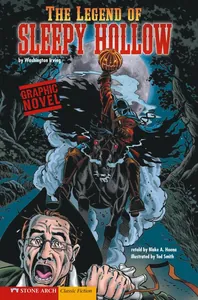
The Legend of Sleepy Hollow(Action Classics Level 1)

 82
82

The Legend of Sleepy Hollow(Action Classics Level 1)
Adam Grant's "Action Classics Level 1" adaptation of "The Legend of Sleepy Hollow" successfully distills Washington Irving's iconic tale into a digestible format for younger or less experienced readers. The simplification of language and sentence structure makes the narrative accessible without entirely sacrificing its eerie atmosphere. The core elements—Ichabod Crane, the rivalry with Brom Bones, and the chilling encounter on the bridge—remain intact. A notable strength is its ability to maintain a sense of suspense despite the reduced complexity. However, the adaptation necessarily omits the richer descriptive prose and nuanced characterizations present in Irving's 1820 original. The spectral intensity of the Headless Horseman's chase, while present, feels somewhat muted. The verdict is that this version serves its purpose as a gateway to a classic, offering a clear, albeit less textured, rendition of a foundational American ghost story.
📝 Description
82
Adam Grant adapted Washington Irving's 1820 ghost story for emergent readers in 2023.
This adaptation of "The Legend of Sleepy Hollow" by Adam Grant presents Irving's tale for new readers. The story follows Ichabod Crane, a superstitious schoolmaster in the isolated New York hamlet of Sleepy Hollow. He encounters the spectral Headless Horseman, a figure steeped in local folklore. The narrative captures colonial life and the beliefs of the time.
Written for "Action Classics Level 1," Grant's version uses accessible language and sentence structure. It targets emergent readers wanting an introduction to classic American literature. Those interested in ghost stories, historical settings, and American folklore will find this accessible. It offers a starting point for understanding the impact of Irving's original work.
Washington Irving's "The Legend of Sleepy Hollow" taps into anxieties about the unknown and lingering colonial beliefs. The story's focus on the spectral Headless Horseman and Ichabod Crane's superstitious nature draws from oral traditions and European ghost lore. It reflects a period in early American literature where writers explored local legends and integrated supernatural elements into narratives, often reflecting a fascination with the uncanny and the darker aspects of rural life. This tradition connects to broader European gothic literature and the American fascination with its own developing folklore.
💡 Why Read This Book?
• You will learn how to recognize the core elements of a classic ghost story by tracing the simplified plot of Ichabod Crane's encounter with the Headless Horseman, understanding the narrative's roots in the early 19th century. • You will feel the distinct atmosphere of colonial New York through descriptions of Sleepy Hollow, grasping how setting influences fear and folklore without complex vocabulary. • You will gain insight into the power of local legends by observing how Ichabod Crane's belief in the Headless Horseman shapes his fate, a concept central to Washington Irving's 1820 work.
⭐ Reader Reviews
Honest opinions from readers who have explored this book.
❓ Frequently Asked Questions
What is the "Action Classics Level 1" designation for this book?
The "Action Classics Level 1" designation indicates this is a simplified adaptation of a classic story, designed for emerging readers. Level 1 typically means very basic vocabulary and sentence structure, making it accessible for those new to reading.
Who is the author of the original "The Legend of Sleepy Hollow"?
The original "The Legend of Sleepy Hollow" was written by Washington Irving and first published in 1820 as part of his collection "The Sketch Book of Geoffrey Crayon, Gent."
What is the main conflict in "The Legend of Sleepy Hollow"?
The main conflict involves Ichabod Crane, a superstitious schoolmaster, who becomes entangled in local folklore and experiences a terrifying encounter with the legendary Headless Horseman while riding home.
What historical period does "The Legend of Sleepy Hollow" depict?
The story depicts rural life in the Hudson Valley of New York during the early American republic, likely shortly after the American Revolution, reflecting the era's folklore and superstitions.
What is the significance of the Headless Horseman in the story?
The Headless Horseman is a legendary ghost, purportedly the head of a Hessian trooper from the Revolutionary War, whose spectral ride through Sleepy Hollow terrifies residents and plays a pivotal role in Ichabod Crane's fate.
Is Adam Grant the original author of this story?
No, Adam Grant is the adapter of "The Legend of Sleepy Hollow" for the "Action Classics Level 1" series. The original story was written by Washington Irving.
🔮 Key Themes & Symbolism
Superstition and Belief
The narrative deeply explores the power of superstition, particularly through Ichabod Crane's fearful belief in local legends, most notably the spectral Headless Horseman. His susceptibility to folklore shapes his perception of events in Sleepy Hollow. This theme highlights how deeply ingrained beliefs, even if unfounded, can dictate an individual's experience and actions, leading to terror and ultimately, disappearance. The story suggests that in isolated communities, folklore can take on a life of its own, influencing the collective consciousness.
The Supernatural Encounter
Central to the tale is the terrifying encounter with the Headless Horseman, a figure drawn from Hessian folklore. This spectral apparition represents the unknown and the primal fears that lurk beneath the surface of everyday colonial life. The ambiguity surrounding the Horseman—whether a genuine ghost or a human deception—underscores the story's exploration of perception versus reality. This encounter serves as the climax, irrevocably altering Ichabod Crane's destiny and cementing the legend of Sleepy Hollow.
Rural Isolation and Folklore
Sleepy Hollow itself is portrayed as an isolated, tranquil hamlet where folklore and local legends thrive. This insular environment fosters a unique cultural landscape where tales of ghosts and spectral riders are readily accepted and passed down. Washington Irving uses this setting to illustrate how isolated communities can develop their own distinct mythologies, often blending historical remnants with imaginative storytelling. The pastoral descriptions contrast sharply with the supernatural terror that pervades the area.
Rivalry and Courtship
The narrative includes a secondary plotline involving Ichabod Crane's rivalry with Brom Bones for the affections of Katrina Van Tassel. This element grounds the supernatural tale in relatable human desires and social dynamics of the time. The competition for Katrina's hand provides Ichabod with a motive for his late-night ride and adds a layer of social commentary to the story, illustrating the often-humorous, sometimes serious, consequences of romantic pursuits in a close-knit community.
💬 Memorable Quotes
Direct passages from the work, attributed to the author.
“Ichabod Crane... was tall, but exceedingly lank, with short, drooping yellow hair, and a whole host of freckles... his nose was long and bony...”
— This descriptive passage immediately establishes Ichabod Crane's distinct physical appearance, emphasizing his gaunt and somewhat unappealing features. It sets him apart from the more robust Brom Bones and hints at his outsider status and perhaps his susceptibility to the superstitions of Sleepy Hollow.
“The schoolhouse stood in a sequestered glen...”
— This phrase paints a picture of the school's isolated location, emphasizing the remoteness and perhaps the unsettling atmosphere of Ichabod Crane's workplace. The word 'sequestered' suggests a place set apart, contributing to the story's overall mood of seclusion and potential danger.
“He was tall of them, and broad all over, but he was nowise delicate.”
— This description refers to Brom Bones, contrasting his hearty, robust physique with Ichabod Crane's lankiness. It establishes Brom as a formidable presence in the community and a direct rival for Katrina Van Tassel's attention, highlighting the physical contrast between the two suitors.
“The neighborhood abounded with tales, ghosts, and goblins.”
— This statement directly addresses the pervasive nature of folklore and superstition in Sleepy Hollow. It sets the stage for Ichabod Crane's fear and explains why the legend of the Headless Horseman would be so potent in this particular locale.
💡 Key Ideas
Editorial paraphrase of the work's core concepts — not direct quotes.
He fancied that he beheld some great naked creature, in a buck’s skin, rapidly advancing toward him...
This quote captures Ichabod's heightened fear and imaginative state as he encounters what he perceives as a monstrous figure. It illustrates his tendency to interpret ordinary events through a lens of supernatural terror, a key aspect of his character.
🌙 Esoteric Significance
Tradition
While "The Legend of Sleepy Hollow" is not overtly part of a specific esoteric lineage like Hermeticism or Theosophy, it taps into a deep vein of Western folk magic and animistic beliefs. The story speaks to pre-Christian European folklore concerning spirits of place and spectral entities that inhabit liminal spaces, particularly during twilight or night. It reflects a broader cultural undercurrent where the veil between the mundane and the supernatural is perceived as thin, especially in isolated or historically charged locations.
Symbolism
The Headless Horseman serves as a potent symbol of the severed connection to the past, a disembodied force representing unresolved historical trauma (linked to the Revolutionary War). The bridge where the encounter occurs is a classic symbol of transition and a threshold between the known world and the unknown. Ichabod Crane himself can be seen as a symbol of the rational, albeit superstitious, mind confronting inexplicable phenomena, ultimately overwhelmed by fear and the uncanny.
Modern Relevance
Contemporary explorations of folklore, urban legends, and the supernatural often echo the themes found in "Sleepy Hollow." Thinkers and practitioners interested in ghost lore, paranormal investigation, and the psychology of fear find the story's ambiguous blend of reality and hallucination compelling. It remains a touchstone for understanding how local history, collective belief, and psychological suggestion can create enduring myths that continue to influence cultural perceptions of the uncanny.
👥 Who Should Read This Book
• Beginning readers or those studying English as a second language seeking an accessible introduction to classic American literature. • Students of American folklore and cultural history interested in early narratives that shaped national identity and ghost story traditions. • Enthusiasts of gothic and supernatural tales looking for a foundational story that explores themes of superstition and the uncanny in a historical setting.
📜 Historical Context
Washington Irving penned "The Legend of Sleepy Hollow" in 1820, a period of nascent American literary identity. As part of "The Sketch Book of Geoffrey Crayon, Gent.," the story emerged when American authors were actively seeking to establish a unique voice distinct from British literary traditions. Irving, living abroad in England at the time, drew upon his observations of rural American life and its lingering folklore. The tale reflects a fascination with local legends and the supernatural, which was a common thread in Romantic literature. While not a direct competitor in the way of philosophical tracts, Irving's work implicitly engaged with a burgeoning American romanticism, celebrating native soil and its unique stories. Its reception was overwhelmingly positive, quickly establishing it as a core part of American short fiction. Contemporary authors like James Fenimore Cooper were also exploring American landscapes and legends, though with different thematic focuses.
📔 Journal Prompts
Ichabod Crane's belief in the Headless Horseman.
The atmosphere of Sleepy Hollow village.
Brom Bones's rivalry with Ichabod Crane.
The significance of the bridge encounter.
Katrina Van Tassel's role in the narrative.
🗂️ Glossary
Headless Horseman
A legendary specter, purportedly the ghost of a Hessian trooper whose head was carried away by a cannonball during the Revolutionary War. He is said to ride nightly in search of his lost head.
Sleepy Hollow
A real-life hamlet in the town of Mount Pleasant, New York, located in the lower Hudson Valley. It is famously associated with Washington Irving's story and its folklore.
Ichabod Crane
The protagonist of the story, a tall, lanky, and superstitious schoolmaster from Connecticut who comes to teach in Sleepy Hollow.
Brom Bones
A burly, popular, and somewhat boisterous local figure in Sleepy Hollow, known for his strength and rivalry with Ichabod Crane over Katrina Van Tassel.
Katrina Van Tassel
The beautiful and wealthy daughter of a prosperous farmer in Sleepy Hollow, who is the object of affection for both Ichabod Crane and Brom Bones.
Hessian
A German auxiliary soldier hired by the British Crown to fight during the American Revolutionary War. Many Hessians served in the British army.
Folklore
The traditions, customs, and beliefs of a community, passed down through generations, often in the form of stories, legends, and songs.
This book appears in 1 collection
🔮 Readers Also Liked
Browse all →









From the “Ghosts” Collection
View all →




More Free Spiritualism & Afterlife Books
View all →