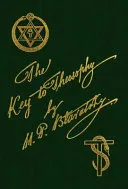
The Key to Theosophy
 80
80

The Key to Theosophy
Helena Blavatsky’s *The Key to Theosophy* functions as a candid, if sometimes dense, primer for her sprawling philosophical system. It bravely tackles the esoteric and the mundane, presenting Theosophy as a distinct spiritual path rather than a mere philosophical curiosity. The Q&A format, while aiding accessibility, occasionally leads to lengthy, intricate explanations that can test a reader's focus. A notable strength is Blavatsky’s directness in addressing criticisms and clarifying the practical aims of the Theosophical Movement, particularly her emphasis on universal brotherhood. However, the sheer scope of concepts introduced, from the seven principles of man to detailed cosmological cycles, can feel overwhelming without significant prior background or supplementary study. The section explaining the different stages of human evolution, detailing the various 'Races' and 'Rounds', exemplifies this challenge: it is intellectually stimulating but requires careful annotation. Ultimately, *The Key to Theosophy* remains a foundational text for understanding a significant current in modern Western esotericism, demanding patience but rewarding diligent readers.
📝 Description
80
Helena Blavatsky published The Key to Theosophy in 1889 to explain core Theosophical ideas.
This book is structured as a question-and-answer guide to the fundamental principles of the Theosophical Society. Blavatsky intended it to clarify complex Theosophical doctrines for a general readership. She sought to articulate the 'broad outlines of the Wisdom Religion,' which she saw as the universal spiritual teachings behind all major faiths.
The text covers both the philosophical and ethical doctrines central to Theosophy, as well as the stated aims and objectives of the Theosophical Movement. It is written for those new to Theosophical thought, particularly those interested in its philosophical basis and ethical structure. Students of comparative religion, esoteric philosophy, and late 19th-century spiritual movements will find it relevant. Readers interested in Western esotericism, the Theosophical Society's origins, and Blavatsky's own writings will also find it instructive. Members of the Theosophical Society can use it to articulate the movement's central beliefs.
Published in 1889, *The Key to Theosophy* emerged during a period of significant spiritual and intellectual change in Europe and America. The late Victorian era was marked by growing interest in Eastern religions, spiritualism, and occultism, often as a response to scientific materialism and rigid religious dogma. Theosophy positioned itself as a synthesis of ancient spiritual traditions and contemporary scientific and philosophical ideas. This book appeared as the Theosophical Society was gaining momentum.
💡 Why Read This Book?
• Learn about the doctrine of Karma and Reincarnation as explained by Blavatsky, providing a framework for understanding cause and effect across lifetimes, distinct from popular New Age interpretations. • Understand the historical context of the Theosophical Movement's founding in 1875 and its stated goals of promoting universal brotherhood, offering insight into late 19th-century spiritual reform. • Grasp the concept of the 'Seven Principles of Man,' a core Theosophical teaching that breaks down human consciousness into distinct, hierarchical aspects, offering a unique model for self-understanding.
⭐ Reader Reviews
Honest opinions from readers who have explored this book.
❓ Frequently Asked Questions
What is the primary purpose of Helena Blavatsky's 'The Key to Theosophy'?
The book serves as an introductory guide to the core principles of Theosophy, presented in a question-and-answer format. Blavatsky intended it to offer a clear perspective on the Theosophical teachings and the aims of the associated Movement.
When was 'The Key to Theosophy' first published, and why is its publication date significant?
'The Key to Theosophy' was first published in 1889. This date places it within a period of intense interest in spiritualism and Eastern philosophies in the West, a context crucial for understanding Theosophy's reception.
Does 'The Key to Theosophy' present a new religion?
No, Blavatsky explicitly states that Theosophy is not a religion, but a philosophy and a science, aiming to reveal the ancient Wisdom Religion underlying all faiths. It emphasizes universal truths over dogma.
What are some of the key esoteric concepts discussed in the book?
The book covers concepts such as karma, reincarnation, the seven principles of man, the cyclical nature of evolution (Rounds and Races), and the existence of spiritual guides known as Masters or Mahatmas.
Who are the intended readers for 'The Key to Theosophy'?
The book is designed for those seeking an introduction to Theosophical ideas, students of comparative religion and esoteric philosophy, and individuals interested in the history and aims of the Theosophical Movement.
How does 'The Key to Theosophy' relate to the Theosophical Movement?
It functions as an authoritative explanation of the Movement's objectives and teachings, written by one of its principal founders. It aims to clarify the philosophy and ethical basis upon which the Movement was established.
🔮 Key Themes & Symbolism
The Wisdom Religion
Blavatsky posits Theosophy as the unveiling of the 'Wisdom Religion,' an ancient, perennial philosophy she believed formed the basis of all world religions and esoteric traditions. This theme emphasizes the universality of spiritual truth, transcending cultural and sectarian differences. The book explores how this underlying wisdom manifests in various doctrines and practices, suggesting a common source from which all spiritual understanding originates. It's presented not as a new dogma but as a rediscovered ancient knowledge available to earnest seekers.
Human Evolution and Principles
A significant portion of 'The Key to Theosophy' is dedicated to explaining the Theosophical view of human nature and its evolutionary path. Blavatsky outlines the 'Seven Principles of Man,' a complex model dividing human existence into physical, vital, psychic, and spiritual aspects. This framework is intrinsically linked to the doctrine of reincarnation and the concept of spiritual progress through successive lives and different stages of cosmic evolution, known as Rounds and Races.
The Theosophical Movement
Beyond abstract philosophy, the book explicitly addresses the practical aims and organizational structure of the Theosophical Society. Blavatsky clarifies the Movement's objectives, particularly the promotion of universal brotherhood, the study of comparative religion and science, and the investigation of unexplained laws of nature and human faculties. This section serves to explain the Society's purpose and differentiate it from sectarian religious groups or purely academic pursuits.
Karma and Reincarnation
These two interconnected concepts form the bedrock of Theosophical ethics and cosmology. 'The Key to Theosophy' explains karma not as fatalistic punishment, but as the law of cause and effect governing moral and physical realms, shaping individual destinies across lifetimes. Reincarnation is presented as the mechanism through which souls progress, learning lessons and working out karmic consequences over vast cycles of existence, driven by the inherent spiritual nature of humanity.
💬 Memorable Quotes
Direct passages from the work, attributed to the author.
“The Theosophical Society has no dogma, no creeds to enforce.”
— This statement highlights Blavatsky's intention for Theosophy to be a path of inquiry rather than strict adherence. It underscores the Society's role as a platform for exploring spiritual truths without imposing a fixed set of beliefs.
“Karma is the ultimate law of the universe.”
— This assertion frames karma not merely as a principle of retribution, but as the fundamental operating mechanism of existence, governing all phenomena and individual destinies within a cosmic order.
“We are all sparks of the same divine fire.”
— This evocative phrase captures the Theosophical concept of the inherent divinity within all beings, suggesting a fundamental unity and interconnectedness that underlies apparent individual separation.
“The Masters are the custodians of the ancient Wisdom.”
— This refers to the Theosophical belief in enlightened spiritual teachers who preserve and transmit esoteric knowledge across ages, guiding humanity's spiritual evolution from behind the scenes.
💡 Key Ideas
Editorial paraphrase of the work's core concepts — not direct quotes.
Reincarnation is the necessary process through which the soul evolves.
This paraphrased concept emphasizes reincarnation as a vital, purposeful mechanism for spiritual development, enabling the unfolding of the higher principles of man through repeated earthly experiences.
🌙 Esoteric Significance
Tradition
The work is a core part of modern Theosophy, a tradition that sought to synthesize ancient esoteric doctrines from Eastern and Western sources. It positions itself within the lineage of the perennial 'Wisdom Religion,' drawing from Hermeticism, Neoplatonism, Kabbalah, and Vedantic philosophies. Blavatsky aimed to present a coherent, universal spiritual philosophy that departed from sectarian creeds, emphasizing spiritual evolution and the underlying unity of all faiths.
Symbolism
Key symbols include the 'Seven Principles of Man,' representing a multi-layered model of human consciousness and being, from the physical body to the divine spirit. The concept of 'Rounds' and 'Races' symbolizes vast cycles of cosmic and human evolution, illustrating a grand, unfolding process of spiritual development across immense timescales. The 'Lotus' is also a recurring motif, symbolizing purity, spiritual unfolding, and the connection between the earthly and the divine.
Modern Relevance
Contemporary esoteric thinkers, spiritual seekers, and scholars of comparative religion continue to engage with Blavatsky's work. Modern Theosophical societies worldwide still utilize 'The Key to Theosophy' as a primary text. Its concepts have influenced subsequent movements like Anthroposophy (through Rudolf Steiner) and various New Age philosophies, particularly regarding ideas of karma, reincarnation, and consciousness evolution.
👥 Who Should Read This Book
• Students of comparative religion and Western esotericism seeking to understand the origins and core tenets of Theosophy, a major spiritual movement of the late 19th century. • Individuals interested in esoteric philosophy who wish to explore concepts like karma, reincarnation, and the nature of consciousness as presented by a foundational author in the field. • Researchers of spiritual history and societal movements interested in the intellectual currents of the Victorian era and the development of alternative spiritual paths.
📜 Historical Context
Published in 1889, *The Key to Theosophy* emerged during a period of fervent spiritual exploration in the West. The late Victorian era witnessed a widespread reaction against scientific materialism and established religious dogma, fueling interest in spiritualism, occultism, and Eastern philosophies. Helena Blavatsky, a central figure in this milieu, founded the Theosophical Society in 1875 with Henry Steel Olcott. The book arrived as the Theosophical Movement was gaining international traction, establishing branches and engaging in public discourse. It sought to clarify its teachings amidst a landscape populated by diverse esoteric groups and burgeoning pseudoscientific claims. While Theosophy offered a synthesized spiritual framework, it faced scrutiny from both Christian authorities and the scientific establishment, particularly concerning its claims about hidden spiritual hierarchies and ancient wisdom. Contemporaries like Annie Besant would later play a central role in expanding the movement.
📔 Journal Prompts
The concept of the 'Seven Principles of Man' as a framework for self-understanding.
The law of Karma and its implications for personal responsibility.
The role of universal brotherhood within the Theosophical Movement.
The cyclical nature of evolution as described in the Rounds and Races.
The purpose and function of the Masters (Mahatmas) in Theosophical teachings.
🗂️ Glossary
Theosophy
A system of esoteric philosophy and spiritual teachings founded in the late 19th century, seeking to reveal the underlying unity of all religions and the ancient Wisdom Religion.
Karma
The universal law of cause and effect, where actions in one life influence the circumstances and experiences of future lives; a principle of moral and spiritual accountability.
Reincarnation
The cyclical rebirth of a soul or spiritual essence into a new physical body after death, serving as a process for spiritual evolution and karmic resolution.
Seven Principles of Man
A Theosophical doctrine outlining the complex constitution of human beings, comprising physical, vital, psychic, and spiritual aspects (e.g., body, astral body, mind, spirit).
Masters (Mahatmas)
Highly evolved spiritual beings believed by Theosophists to guide humanity's evolution and preserve esoteric knowledge, often associated with Helena Blavatsky.
Wisdom Religion
A term used by Blavatsky to denote the ancient, universal spiritual knowledge she believed underlies all world religions and esoteric traditions.
Universal Brotherhood
A core ideal of the Theosophical Movement, emphasizing the fundamental unity and interconnectedness of all humanity, regardless of race, creed, or gender.