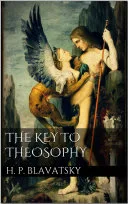
The Key to Theosophy
 79
79

The Key to Theosophy
Blavatsky's The Key to Theosophy, despite its age, remains a critical entry point for anyone serious about understanding the Theosophical movement. Its question-and-answer structure, while sometimes leading to lengthy explanations, effectively breaks down complex ideas like the Seven Principles of Man and the law of Karma. A notable strength is its direct engagement with criticisms and common misconceptions of the era, offering a clear defense of Theosophical tenets. However, the prose can occasionally feel dense, and the frequent references to specific contemporary debates might require supplemental historical context for modern readers. The section explaining the distinction between the physical body and the astral body, for instance, is particularly illuminating in its attempt to bridge scientific and spiritual understanding. It stands as a crucial, albeit demanding, exposition of a pivotal esoteric philosophy.
📝 Description
79
Published in 1889, The Key to Theosophy explains Helena Blavatsky's core ideas in a question-and-answer format.
Helena Blavatsky wrote The Key to Theosophy in 1889 as a direct explanation of the principles she and others established within the Theosophical Society. The book uses a question-and-answer structure to make complex ethical, scientific, and philosophical ideas about Theosophy more understandable to a general audience. This format helps to clarify the society's aims and doctrines for those seeking clear information.
The work is intended for individuals who want to understand the foundations and main beliefs of modern Theosophy. It will appeal to those interested in comparative religion, esoteric philosophy, and the history of spiritual movements from the late 19th century. Readers familiar with Blavatsky's earlier, more extensive works like Isis Unveiled will find this book a more straightforward introduction to her perspective.
Theosophy emerged in the late 19th century as a response to prevailing materialism and religious dogma. Blavatsky synthesized Western esoteric traditions with Eastern philosophies, particularly Hinduism and Buddhism. This synthesis aimed to present a universal wisdom, challenging contemporary scientific and religious views by positing a spiritual hierarchy and hidden laws governing existence. Theosophy sought to revive ancient teachings and promote universal brotherhood.
💡 Why Read This Book?
• Gain a structured understanding of core Theosophical concepts like Karma and Reincarnation, directly from Blavatsky's exposition, as presented in the Q&A format of 'The Key to Theosophy'. • Explore the historical milieu of the late 19th century's spiritual awakening and the Theosophical Society's foundational aims, as detailed in the book's historical context. • Grasp Blavatsky's definition of Theosophy as a universal wisdom-tradition, distinct from organized religion, as clarified in the foundational chapters.
⭐ Reader Reviews
Honest opinions from readers who have explored this book.
❓ Frequently Asked Questions
What is the primary purpose of H.P. Blavatsky's 'The Key to Theosophy'?
The book's primary purpose is to clearly explain the ethical, scientific, and philosophical principles upon which the Theosophical Society was founded, presented in an accessible question-and-answer format for students.
When was 'The Key to Theosophy' first published?
The original publication date for 'The Key to Theosophy' was 1889, making it a key text from the late Victorian era of esoteric thought.
How does 'The Key to Theosophy' explain the human constitution?
It explains the human constitution through the concept of the Seven Principles of Man, detailing the interplay between the physical, vital, and spiritual aspects of human existence.
Is 'The Key to Theosophy' a religious text?
Blavatsky explicitly states in the book that Theosophy is not a religion but a synthesis of universal wisdom and a path for spiritual development, distinct from dogma.
What is the significance of the Q&A format in this book?
The question-and-answer format was chosen to directly address common inquiries and potential misunderstandings about Theosophical concepts, making the material more digestible for newcomers.
Who were key figures associated with the Theosophical Society during its founding?
Key figures include Helena Blavatsky herself, along with Henry Steel Olcott, who served as the first president of the Theosophical Society, founded in New York in 1875.
🔮 Key Themes & Symbolism
The Seven Principles of Man
This work systematically breaks down the human constitution into seven distinct principles, ranging from the physical body (Sthula Sharira) to the spiritual essence (Atma). Blavatsky elucidates how these principles interact, forming the complex psycho-spiritual entity. Understanding this framework is crucial for grasping Theosophical views on reincarnation and spiritual evolution, differentiating it from simpler materialist or dualist perspectives on human nature.
Karma and Reincarnation
Central to the book is the doctrine of Karma, presented as the immutable law of cause and effect governing all existence. Blavatsky explains how this cosmic justice operates across multiple lifetimes through the process of reincarnation. This cyclical view of existence provides a framework for understanding suffering, inequality, and personal responsibility within a grand, impersonal cosmic order, moving beyond linear notions of time and destiny.
Theosophy as Universal Wisdom
Blavatsky defines Theosophy not as a religion with exclusive dogma, but as the underlying wisdom present in all world religions and philosophies. She posits a common source of spiritual knowledge accessible through dedicated study and ethical living. This perspective encourages a comparative approach to spirituality, seeking the unifying truths behind diverse exoteric traditions and practices.
The Nature of the Masters
The book addresses the concept of the 'Masters' or 'Mahatmas,' advanced spiritual adepts who, according to Theosophy, guide humanity's evolution. Blavatsky clarifies their role not as divine beings but as highly evolved humans who have transcended ordinary limitations. Their existence serves as an inspirational ideal and a proof of the potential for human spiritual attainment.
💬 Memorable Quotes
Direct passages from the work, attributed to the author.
“Theosophy is not a religion.”
— This statement underscores Blavatsky's intent to present Theosophy as a philosophical and ethical framework, rather than a system of dogma or worship, emphasizing its universal applicability across different faiths.
“Karma is the eighth principle of the soul, the source of all moral and physical effects.”
— This highlights Karma's fundamental role in Theosophical ethics, portraying it as an intrinsic law of the spiritual self that dictates the consequences of actions, shaping future experiences and evolution.
“Man is a spiritual being, clothed in matter.”
— This concise phrase expresses the core Theosophical view of humanity, emphasizing the primacy of the eternal spiritual self over its temporary material encasements and experiences.
“Reincarnation is the doctrine that the Ego does not die with the physical body.”
— This defines the essential mechanism of spiritual progression in Theosophy, explaining that the individual consciousness or soul persists and returns to physical life in successive embodiments to learn and evolve.
“The universe is governed by immutable laws.”
— This assertion points to the ordered and rational nature of the cosmos as understood by Theosophy, suggesting that all phenomena, spiritual or material, are subject to discoverable natural principles, not arbitrary divine will.
🌙 Esoteric Significance
Tradition
The Key to Theosophy is foundational to the Theosophical tradition, a syncretic spiritual movement Blavatsky herself largely shaped. It draws heavily on Hindu Vedanta and Buddhism, as well as Hermeticism, Kabbalah, and Neoplatonism. Blavatsky positions Theosophy as the 'Secret Doctrine' underlying all world religions, departing from purely Western esoteric lineages by integrating Eastern concepts like Karma and Reincarnation as central tenets.
Symbolism
The book frequently references concepts like the 'Seven Principles of Man,' symbolizing the layered nature of human consciousness from the physical to the divine spark. The cyclical nature of 'Karma' and 'Reincarnation' itself acts as a potent symbol of cosmic justice and continuous evolution, representing a departure from linear, eschatological views prevalent in Western thought.
Modern Relevance
Contemporary esoteric practitioners, New Age thinkers, and students of comparative religion continue to engage with Blavatsky's work. Concepts like the Seven Principles and the law of Karma, as articulated in The Key to Theosophy, inform modern discussions on consciousness, self-help, and spiritual development. Theosophical ideas have influenced numerous spiritual movements and alternative philosophies throughout the 20th and 21st centuries.
👥 Who Should Read This Book
['• Students of Western Esotericism seeking to understand the origins and core philosophy of Theosophy, particularly its synthesis of Eastern and Western thought.\n• Researchers of comparative religion and intellectual history interested in the spiritual movements of the late 19th century and their impact on modern spirituality.\n• Individuals exploring concepts of Karma, reincarnation, and the nature of consciousness who desire a foundational text from a key figure in modern esoteric thought.', '', '']
📜 Historical Context
The Key to Theosophy, published in 1889, emerged from the fertile ground of late 19th-century spiritual inquiry. This era witnessed a widespread reaction against the perceived materialism of Victorian science and a growing fascination with Eastern religions, particularly following figures like Swami Vivekananda's address at the Parliament of Religions in 1893. Theosophy, co-founded by Helena Blavatsky and Henry Steel Olcott in 1875, sought to synthesize esoteric traditions from both East and West. It directly engaged with and often critiqued established Christian theology and Western scientific assumptions. Blavatsky's work aimed to present a coherent philosophical system that could account for phenomena then being explored by Spiritualism, while also offering a sophisticated cosmology. The Theosophical Society's activities and publications, including this book, were met with both fervent support and sharp criticism from religious and scientific authorities, contributing to its significant cultural impact.
📔 Journal Prompts
The Seven Principles of Man: How do these distinct aspects of the human constitution inform your understanding of personal identity?
Karma's operation across lifetimes: Reflect on the implications of this doctrine for personal responsibility and the concept of justice.
Theosophy as Universal Wisdom: Consider how the idea of a common spiritual source might reconcile differing religious or philosophical viewpoints.
The role of the Masters: Analyze the function of advanced spiritual guides within a system emphasizing self-evolution.
The Q&A format's effectiveness: Assess how direct questioning aids in clarifying complex metaphysical ideas like the Astral body.
🗂️ Glossary
Theosophical Society
An organization founded in 1875 by Helena Blavatsky, Henry Steel Olcott, and others, dedicated to promoting the study of comparative religion, philosophy, and science, and to awaken spiritual potential in humanity.
Karma
In Theosophy, the universal law of cause and effect, where every action has a corresponding reaction that influences future experiences across multiple lifetimes.
Reincarnation
The doctrine that the essential spiritual self (Ego) undergoes a cycle of physical births, deaths, and rebirths to learn lessons and evolve spiritually.
Masters (Mahatmas)
Highly evolved spiritual beings or adepts, according to Theosophy, who have transcended ordinary human limitations and guide the spiritual evolution of humanity.
Astral Body
A subtle, non-physical body or vehicle of consciousness, considered to be the seat of emotions and desires, which can survive the death of the physical body.
Sthula Sharira
The Sanskrit term for the physical body, considered the lowest and most material principle in the Theosophical model of the human constitution.
Duqqan
A term Blavatsky uses, potentially referring to a state or principle related to the subtle bodies or the process of spiritual perception, distinct from the physical.