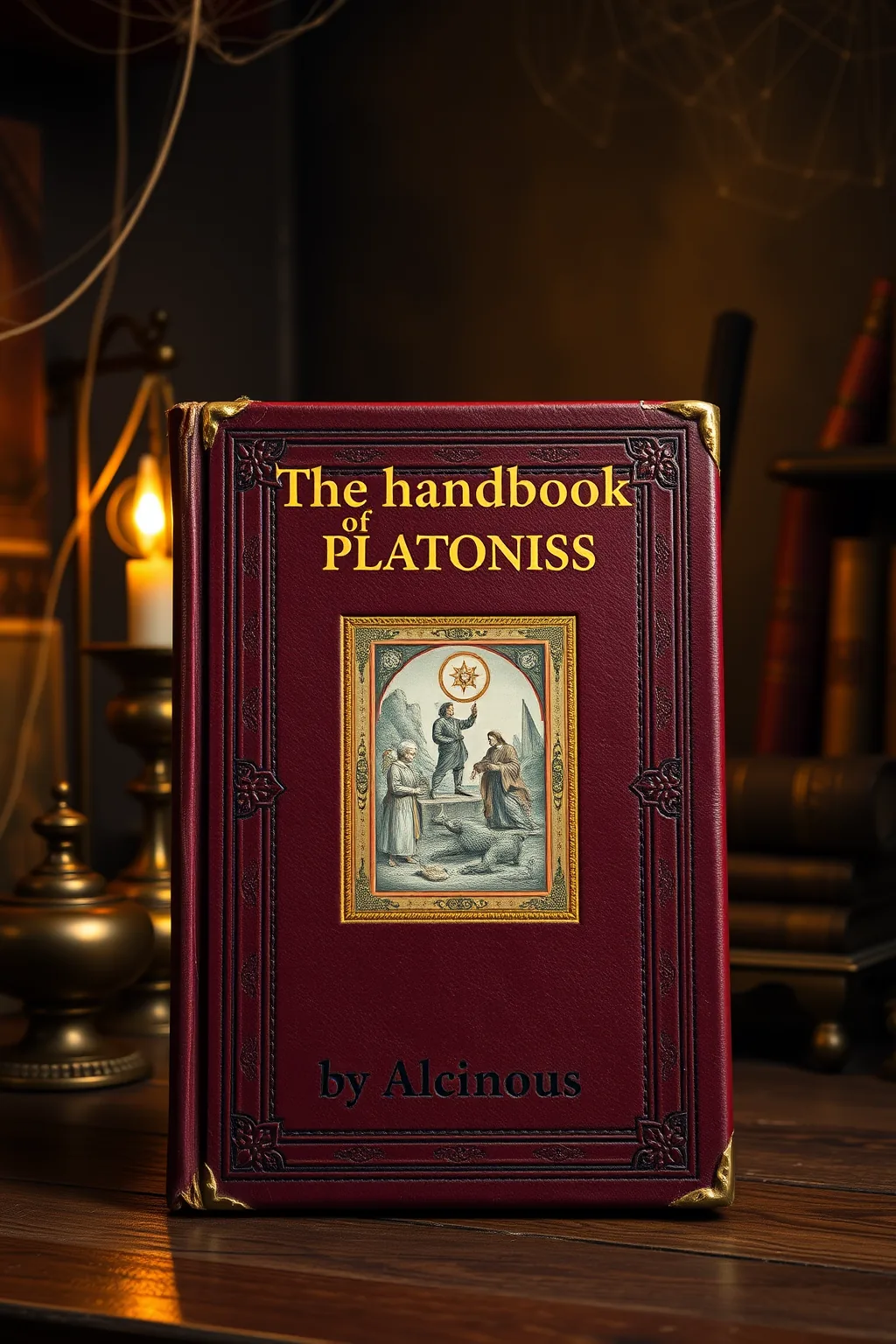
The handbook of Platonism
 79
79

The handbook of Platonism
Alcinous's Handbook of Platonism, as presented in its 1993 edition, offers a lucid, if somewhat dry, exposition of Platonic thought. Its strength lies in its systematic approach, laying out doctrines like the Theory of Forms with commendable clarity. However, the work can feel overly scholastic, lacking the vibrant philosophical engagement one might find in Plato's own dialogues or in more interpretive Neoplatonic texts. A particularly illustrative passage is its explanation of the soul's ascent, which, while accurate, could benefit from more evocative language to convey the spiritual dimension. The text's limitation is its academic detachment; it explains *what* Platonism is but rarely conveys *why* it moved so many thinkers for so long. It serves as a reliable primer but not as an inspiration for deeper philosophical inquiry.
📝 Description
79
Alcinous's Handbook of Platonism presents the core doctrines of Plato's philosophy for later antiquity.
Written by Alcinous, likely in the 2nd century CE, this handbook offers a structured summary of Plato's philosophical teachings. It aims to make the complex Platonic system understandable by outlining its fundamental principles. The text covers key ideas like the Theory of Forms, the soul's nature, and the concept of the Good.
This work is particularly useful for students of ancient philosophy and those tracing the development of Western thought. It lays out the intellectual foundations that influenced later philosophical movements and mystical traditions. The handbook serves as a guide to understanding Platonism as it was interpreted and transmitted through the centuries, especially within the Neoplatonic synthesis.
This handbook is a significant document for understanding the transmission of Platonic ideas into later esoteric traditions. By systematizing Plato's doctrines, Alcinous provided a framework that Neoplatonists and subsequent mystics would build upon. The emphasis on the hierarchy of being and the path to knowledge through dialectic directly informed mystical philosophies that sought union with the divine or ultimate reality. It shows how abstract philosophical concepts were adapted to serve spiritual aims.
💡 Why Read This Book?
• Gain a structured understanding of the Theory of Forms, including the concept of the intelligible realm and its relation to the sensible world, as presented in this handbook. • Grasp the Platonic conception of the soul's tripartite nature and its journey towards the One, a core element of ancient philosophical discourse. • Learn about the Platonic ethical framework, particularly the pursuit of the Good, and its influence on Western moral philosophy since antiquity.
⭐ Reader Reviews
Honest opinions from readers who have explored this book.
❓ Frequently Asked Questions
When was The Handbook of Platonism first published?
The Handbook of Platonism was first published in 1993, making it a relatively modern compilation of ancient philosophical teachings.
What is the primary focus of The Handbook of Platonism?
The primary focus is on systematically presenting the core doctrines of Platonism, including the Theory of Forms, the nature of the soul, and the concept of the Good.
Who is considered the primary author or compiler of this work?
The work is attributed to Alcinous, with Albinus also noted, reflecting ancient traditions of philosophical exposition and commentary on Plato's writings.
What philosophical tradition does The Handbook of Platonism belong to?
It belongs to the tradition of Platonism, particularly as synthesized and interpreted in late antiquity, often associated with Neoplatonism.
Is The Handbook of Platonism a primary source by Plato himself?
No, this handbook is a secondary source, compiling and explaining Plato's philosophy based on ancient interpretations and summaries, rather than being a direct work by Plato.
What is the "Theory of Forms" as discussed in the book?
The Theory of Forms posits that the physical world is not the real world; instead, ultimate reality exists beyond our physical world in the form of eternal, perfect concepts or 'Forms'.
🔮 Key Themes & Symbolism
The Theory of Forms
This handbook meticulously outlines Plato's Theory of Forms, positing a field of perfect, unchanging archetypes (the Forms) that serve as the true reality, of which the sensible world is merely an imperfect copy. It details how these Forms, such as the Form of the Good, Beauty, and Justice, are apprehended not through the senses but through intellect and dialectic. The work explains the hierarchical structure of these Forms and their role in providing intelligibility and existence to the particulars we perceive.
The Nature and Ascent of the Soul
The text elaborates on the Platonic understanding of the soul as an immortal entity, distinct from the body. It describes the soul's pre-existence and its fall into the material world, followed by its potential for recollection and ascent back to the divine realm. This process is often depicted as a purification, achieved through philosophical contemplation and the practice of virtues, aiming to reintegrate the soul with its intellectual source.
The Concept of the Good
Central to Platonic ethics and metaphysics, the Form of the Good is presented as the ultimate source of all reality, truth, and value. The handbook explains how the Good illuminates all other Forms and is the ultimate object of knowledge. Attaining knowledge of the Good is depicted as the highest goal of the philosopher, enabling one to live a virtuous and ordered life, both personally and politically.
Cosmology and the Demiurge
The book addresses the Platonic creation myth, particularly as presented in the Timaeus. It describes the Demiurge, a divine craftsman, who orders the pre-existing chaotic matter according to the eternal Forms to create the visible universe. This section explores the mathematical harmony and rational structure of the cosmos, reflecting the divine intellect that shaped it.
💬 Memorable Quotes
Direct passages from the work, attributed to the author.
“The Forms are the true reality, distinct from the mutable world of appearances.”
— This captures the core ontological claim of Platonism: that ultimate reality lies in an eternal, unchanging field of perfect concepts, not in the transient physical objects we perceive.
“The soul's journey is one of recollection and purification.”
— This highlights the ethical and soteriological aspect of Platonism, suggesting that self-knowledge and spiritual progress involve remembering innate truths and transcending bodily limitations.
“The Good is the source of all being and intelligibility.”
— This emphasizes the supreme status of the Form of the Good in Plato's philosophy, acting as the ultimate principle from which all existence and understanding derive.
“The cosmos is ordered by the Demiurge according to the Forms.”
— This refers to the creation narrative, where a divine artisan imposes rational structure and form onto primordial matter, reflecting an underlying divine intelligence.
“Dialectic is the method for apprehending the Forms.”
— This points to the philosophical method central to Platonism, involving rigorous questioning and intellectual reasoning to move beyond sensory experience towards true knowledge.
🌙 Esoteric Significance
Tradition
This work is foundational to the Western Esoteric tradition, particularly Neoplatonism, which deeply influenced Hermeticism, Gnosticism, and later mystical movements. It provides the philosophical bedrock for understanding concepts like the One, the Intellect (Nous), and the Soul as emanations from a divine source. The systematic presentation aligns with the esoteric goal of achieving spiritual ascent and direct knowledge of the divine, making it a key text for reconstructing ancient magical and philosophical systems.
Symbolism
The Handbook elucidates key Platonic symbols crucial to esoteric thought. The 'Allegory of the Cave' symbolizes the soul's ignorance in the material world and its liberation through philosophical enlightenment. The 'Form of the Good' represents the ultimate, ineffable divine principle, often equated with the One or the Godhead in esoteric cosmologies. The 'tripartite soul' (reason, spirit, appetite) symbolizes the internal struggle for self-mastery and the path to spiritual integration.
Modern Relevance
Contemporary esoteric practitioners, philosophers, and comparative religion scholars draw heavily on the Platonic system as outlined here. Schools of thought ranging from certain branches of Western Hermeticism to modern philosophical movements exploring consciousness and metaphysics often reference Platonic concepts like the Forms or the soul's immortality. Thinkers grappling with the nature of reality, the mind-body problem, and the pursuit of wisdom find enduring frameworks within this ancient philosophy.
👥 Who Should Read This Book
• Students of ancient philosophy and comparative religion seeking a structured overview of Platonic thought and its historical development. • Practitioners of Western Esoteric traditions, such as Hermeticism or Neoplatonism, who require a clear exposition of the philosophical underpinnings of their practices. • Academic researchers and intellectual historians interested in the lineage of Western metaphysics, ethics, and the concept of a transcendent reality.
📜 Historical Context
The Handbook of Platonism, published in 1993, emerges from a long tradition of interpreting Plato's philosophy, particularly its Neoplatonic synthesis. This school, reaching its peak in the 3rd to 6th centuries CE with figures like Plotinus and Porphyry, adapted Plato's ideas into a complex metaphysical system. The 1993 edition situates itself within modern scholarship that seeks to understand these ancient doctrines, often in contrast to Aristotelianism or later skeptical traditions. While not a direct contemporary of Plato, the authors Alcinous and Albinus were instrumental in codifying Platonic thought for later generations, influencing thinkers from Augustine to medieval philosophers. The work's scholarly presentation reflects a post-Enlightenment engagement with classical antiquity, aiming for clarity and systematic exposition, distinct from the more mystical or religious interpretations that characterized earlier periods.
📔 Journal Prompts
Reflect on the implications of the Theory of Forms for understanding everyday objects.
Consider the soul's journey described in the text; where does your own consciousness reside?
Analyze the Form of the Good's role as the ultimate source of value.
How does the Demiurge's role in ordering the cosmos differ from creation ex nihilo?
Explore the concept of recollection (anamnesis) in relation to your own learning experiences.
🗂️ Glossary
Forms (Ideas)
Perfect, eternal, unchanging archetypes or essences that exist in an intelligible realm, serving as the true reality of which the physical world is a mere reflection.
Theory of Forms
Plato's central philosophical doctrine positing the existence of an ultimate reality comprised of perfect, immaterial Forms, accessible only through reason.
The Good
The highest Form in Plato's hierarchy, considered the ultimate source of all being, truth, and goodness, clear all other Forms.
Soul (Psyche)
The immortal, immaterial principle of life and consciousness, distinct from the body, capable of reason and recollection, and destined for an afterlife or reincarnation.
Demiurge
In Platonic cosmology, the divine craftsman or artisan who fashions the physical universe by imposing the Forms onto pre-existing chaotic matter.
Dialectic
The philosophical method of rigorous logical argument and reasoned discussion, used to ascend from opinions about the sensible world to knowledge of the Forms.
Intelligible Realm
The non-physical, eternal realm where the Forms exist, apprehended by the intellect rather than the senses.
🔮 Readers Also Liked
Browse all →









More Free Occult Philosophy Books
View all →