The growth of the soul
 80
80

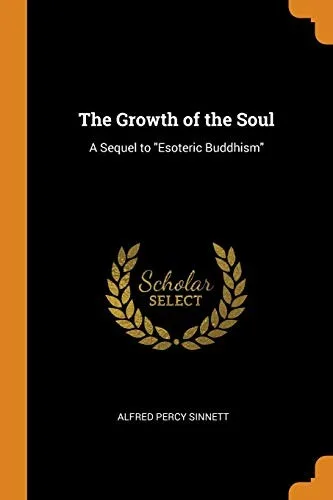
The growth of the soul
Sinnett's 'The Growth of the Soul' offers a remarkably clear, if somewhat dated, exposition of the Theosophical view of spiritual progress. Its strength lies in its systematic approach, laying out stages and mechanisms for soul evolution with a logic that appeals to the intellect. The concept of the 'astral body' as a vehicle for experience and development, particularly as described in its interactions with the physical world, remains a compelling idea for those exploring consciousness beyond the material. However, the prose, while clear, can feel didactic, lacking the evocative language found in more modern esoteric literature. The emphasis on rigid stages, while structured, might feel limiting to readers who perceive spiritual growth as more fluid. Despite this, the book provides a foundational text for understanding a particular current within Western esotericism.
📝 Description
80
Alfred Percy Sinnett's 1905 book, 'The Growth of the Soul,' outlines a structured path for spiritual development.
Alfred Percy Sinnett's 1905 work, 'The Growth of the Soul,' details a framework for spiritual evolution from an esoteric viewpoint. Sinnett posits that the soul's progression is governed by discoverable laws and unfolds in distinct stages. This development moves beyond the physical and mental to encompass subtler spiritual dimensions, and he argues that conscious effort and understanding are key to achieving this advancement.
The book is directed toward readers seriously investigating consciousness and spiritual evolution. Those with an interest in Theosophy, or Eastern philosophies adapted for Western esoteric study, will find considerable material here. Sinnett's approach is systematic, appealing to individuals seeking a structured method for inner growth rather than a purely intuitive one.
Published in 1905, 'The Growth of the Soul' emerged during a period of significant Western engagement with Eastern religions and spiritualism. Sinnett, a key figure in the Theosophical Society alongside Helena Blavatsky and Henry Steel Olcott, contributed to the popularization of Hindu and Buddhist concepts within a Western occult framework. His work offers a specific interpretation of soul evolution, contributing to the intellectual currents of late 19th and early 20th-century esotericism.
💡 Why Read This Book?
• Gain a structured understanding of spiritual evolution through the Theosophical lens, as Sinnett details the progression through different planes of existence. • Explore the mechanics of the 'astral body' and its purported role in consciousness beyond physical death, a concept central to Sinnett's framework. • Grasp the function of karma and reincarnation as evolutionary drivers, providing a rational basis for spiritual development as outlined in the text.
⭐ Reader Reviews
Honest opinions from readers who have explored this book.
❓ Frequently Asked Questions
When was Alfred Percy Sinnett's 'The Growth of the Soul' originally published?
While this edition was published in 2016, Alfred Percy Sinnett's 'The Growth of the Soul' was first published in 1897, reflecting the intellectual currents of the late Victorian era.
What is the primary esoteric tradition influencing 'The Growth of the Soul'?
The book is heavily influenced by Theosophy, a movement co-founded by Helena Blavatsky, which synthesizes elements of Eastern religions and Western occultism.
Does the book discuss reincarnation?
Yes, reincarnation is a fundamental concept in 'The Growth of the Soul', presented as the primary mechanism through which the soul progresses across multiple lifetimes.
What is the 'astral body' according to Sinnett?
Sinnett describes the astral body as a subtle, non-physical vehicle that carries consciousness and experiences, playing a crucial role in the soul's journey through different planes of existence.
Is this book suitable for beginners in esotericism?
It can be challenging for absolute beginners due to its specific terminology and systematic approach, but it offers a clear framework for those with some foundational knowledge of esoteric concepts.
Where does Sinnett place the soul's growth in relation to the mind?
Sinnett posits that soul growth transcends mere mental development, requiring the cultivation of higher spiritual faculties and an understanding of planes of consciousness beyond the intellectual.
🔮 Key Themes & Symbolism
Evolution of Consciousness
The core theme is the systematic evolution of human consciousness across lifetimes. Sinnett details how the soul progresses through various stages and planes, driven by karmic laws and conscious effort. This process is presented not as a mystical accident but as an ordered unfolding, moving from grosser material awareness towards subtler spiritual states, implying a directed spiritual science.
The Astral Body
Sinnett dedicates significant attention to the astral body, describing it as an essential vehicle for consciousness and experience beyond the physical. He outlines its composition, functions, and its role in navigating different dimensions of reality, particularly during sleep and after physical death, as well as its importance in spiritual development.
Karma and Reincarnation
These twin concepts form the bedrock of Sinnett's explanation for spiritual progress. Karma is presented as the law of cause and effect governing actions and their consequences across lifetimes, while reincarnation provides the temporal framework for the soul to learn, evolve, and work out its karmic debts. This cyclical process is key to the soul's ultimate purification.
Higher Self and Planes
The book explores the existence of a 'higher self' or spiritual monad and its connection to the individual personality. It posits multiple planes of existence, from the physical to the purely spiritual, and the soul's gradual ascent through these realms, requiring the development of specific faculties to perceive and interact with them.
💬 Memorable Quotes
Direct passages from the work, attributed to the author.
“The soul's progress is guided by natural law.”
— This concept underscores Sinnett's view that spiritual evolution is not arbitrary but follows discernible principles, much like physical laws, making it a subject of study and conscious participation.
“The astral body is the vehicle of consciousness.”
— This highlights the importance of the subtle body in Sinnett's system, positioning it as the essential medium through which awareness operates and experiences reality beyond the physical form.
“Reincarnation provides the opportunity for karmic adjustment.”
— This interpretation emphasizes the functional role of rebirth in Sinnett's philosophy, framing it as a necessary process for balancing past actions and facilitating the soul's learning and growth.
“Spiritual development requires conscious effort.”
— This suggests that inner growth is an active pursuit, not a passive state, requiring deliberate cultivation of certain qualities and understanding of esoteric principles to advance.
“The mind is but one aspect of the evolving soul.”
— This points to a hierarchy of being, where the intellectual faculty is subordinate to and part of a larger, more complex spiritual entity that is undergoing a long process of development.
🌙 Esoteric Significance
Tradition
This work is firmly rooted in the Theosophical tradition, which itself synthesizes Western Hermeticism, Neoplatonism, and Eastern philosophies (primarily Vedanta and Buddhism). Sinnett's contribution lies in systematizing concepts of soul evolution and consciousness planes, presenting a structured occult cosmology that influenced subsequent esoteric movements.
Symbolism
Key symbols include the 'planes of existence,' representing different states of consciousness and reality, and the 'astral body,' a vital subtle vehicle for spiritual experience. The concept of 'karma' functions as a symbolic representation of cosmic justice and the law of cause and effect governing spiritual progress across lifetimes.
Modern Relevance
Sinnett's ideas on consciousness, subtle bodies, and spiritual evolution continue to inform modern esoteric practitioners, New Age thought, and depth psychology. Concepts like the astral body and layered consciousness are explored in various contemporary spiritual disciplines and therapeutic approaches seeking to integrate mind, body, and spirit.
👥 Who Should Read This Book
• Students of Theosophy and Alfred Percy Sinnett's writings seeking a foundational text on soul evolution. • Esoteric practitioners interested in understanding the mechanics of consciousness and subtle bodies as described in late 19th-century occult thought. • Comparative religion scholars examining the Western reception and adaptation of Eastern spiritual concepts like karma and reincarnation.
📜 Historical Context
Published in 1897, 'The Growth of the Soul' emerged from the vibrant intellectual ferment surrounding the Theosophical Society, founded by Helena Blavatsky in 1875. This late Victorian era saw a significant Western interest in Eastern religions, occultism, and spiritualism, partly as a reaction against prevailing materialism. Sinnett, a prominent Theosophist and editor of The Theosophist journal, was instrumental in disseminating Blavatsky's teachings and developing them further. His work contributed to a growing body of esoteric literature that sought to reconcile scientific inquiry with spiritual understanding. Contemporaries like Annie Besant also played key roles in shaping Theosophical thought. The Theosophical movement itself drew heavily from Hinduism and Buddhism, reinterpreting concepts like karma and reincarnation for a Western audience, often in dialogue with, and sometimes in contrast to, established Christian theology and emerging psychological theories.
📔 Journal Prompts
The progression of the astral body through different planes.
Reflecting on the concept of karma as a driver of soul growth.
The role of the higher self in guiding personality evolution.
Stages of development beyond the purely intellectual mind.
Identifying personal experiences that align with the book's view of reincarnation.
🗂️ Glossary
Astral Body
A subtle, non-physical vehicle composed of 'astral matter' that carries consciousness and experiences, distinct from the physical body and believed to be active during sleep and after death.
Planes of Existence
Different levels or dimensions of reality, each characterized by a specific density and type of matter or energy, through which consciousness progresses during spiritual evolution.
Karma
The universal law of cause and effect, where actions in one life determine the circumstances and experiences in future lives, guiding the soul's evolution.
Reincarnation
The process by which the soul, or spiritual essence, is reborn into a new physical body after death, allowing for continued learning and spiritual development across multiple lifetimes.
Higher Self
The spiritual aspect of an individual, often considered the true, eternal nature, which guides the personality and works towards its eventual liberation and enlightenment.
Monad
In Theosophical terms, the ultimate divine spark or spiritual principle within an individual, from which the higher self and personality ultimately emanate.
Physical Plane
The lowest and densest plane of existence, corresponding to the material world perceived by the physical senses.
🔮 Readers Also Liked
Browse all →





More by Alfred Percy Sinnett
All books →

More Free Theosophy & Anthroposophy Books
View all →