The Golden Bough
 80
80

The Golden Bough
Frazer's ambition in The Golden Bough is undeniable, presenting a vast, if sometimes unwieldy, panorama of human belief. The sheer breadth of collected lore, from ancient Canaanite rituals to Germanic spring festivals, offers an unparalleled resource for tracing commonalities in human ritualistic thought. However, the work's significant limitation lies in its overarching, rigid evolutionary framework, which often forces diverse practices into a single, progressive narrative from magic to religion to science. The section detailing the mythical priest-king of Nemi, a figure central to Frazer's argument about the origin of the title's 'Golden Bough,' exemplifies this tendency. While the data itself is fascinating, Frazer's interpretation feels dated by contemporary anthropological standards. It remains a crucial historical document of early comparative studies, but one best approached with a critical eye toward its theoretical underpinnings.
📝 Description
80
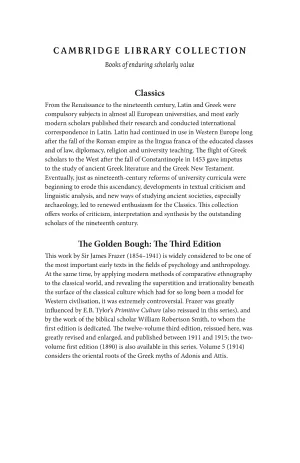
James George Frazer's The Golden Bough first appeared in full between 1911 and 1915.
Originally compiled by Sir James George Frazer, The Golden Bough is a comparative mythology study published in twelve volumes between 1911 and 1915. This extensive work collects rituals, myths, and magical beliefs from numerous cultures worldwide. Frazer's central argument was that magic preceded religion, and both were eventually superseded by science as human understanding of cause and effect advanced.
This book is aimed at scholars of comparative religion, mythology, anthropology, and folklore. It also serves as a key text for those interested in the historical development of human ideas about the divine, the natural world, and ritual practices. Readers should come with academic curiosity and a readiness to engage with a large volume of ethnographic data and theoretical arguments.
Published in its complete form during a time of strong academic interest in the origins of religion and society, Frazer's work synthesized a vast range of evidence. It influenced early psychological theories and was referenced by figures like Sigmund Freud and T.S. Eliot, though it also drew criticism for its evolutionary viewpoints and how it selected evidence.
Frazer's work sits within the late 19th and early 20th century's fascination with the origins of human belief systems. It connects to the academic study of folklore and comparative religion, aiming to find universal patterns in human ritual and myth. While presented as scientific anthropology, its broad comparisons and grand theories about magic, religion, and science tapped into a broader cultural search for underlying spiritual or psychological truths.
💡 Why Read This Book?
• Gain an expansive understanding of comparative mythology and the historical study of religion, exploring Frazer's controversial theory that magic preceded religion across disparate cultures. • Discover specific examples of ancient rituals and beliefs, such as the priest-king of Nemi, providing concrete data points for analyzing early human societies. • Analyze the evolution of Western thought on myth and ritual by examining a foundational text that heavily influenced anthropology and psychology in the early 20th century.
⭐ Reader Reviews
Honest opinions from readers who have explored this book.
❓ Frequently Asked Questions
What is the central thesis of James George Frazer's The Golden Bough?
Frazer's central thesis posits a developmental progression in human thought, moving from magic to religion and finally to science. He argues that early societies relied on sympathetic magic before developing religious systems, which were eventually supplanted by scientific understanding of natural laws.
What is the significance of the 'Golden Bough' itself in the book?
The 'Golden Bough' refers to a mythical branch that Aeneas carries to the underworld in Virgil's Aeneid. Frazer uses it as a symbol for a widespread belief in sacred trees and vegetation, and the ritualistic killing of a priest-king to ensure fertility and renewal.
When was the complete twelve-volume edition of The Golden Bough first published?
The complete and greatly enlarged twelve-volume third edition of The Golden Bough was published serially between 1911 and 1915.
Which academic fields were most influenced by The Golden Bough?
The Golden Bough profoundly influenced anthropology, comparative mythology, folklore studies, and the sociology of religion. Its ideas also had an impact on literary criticism and psychological theories of the early 20th century.
Is The Golden Bough still considered a definitive work in anthropology today?
While immensely influential historically, The Golden Bough is not considered a definitive work by contemporary anthropologists. Its evolutionary approach and selective use of evidence have been widely critiqued, though its vast collection of data remains valuable.
What historical period does The Golden Bough primarily examine?
The book examines a vast array of historical and prehistoric periods across numerous cultures, from ancient Near Eastern and Mediterranean civilizations to indigenous practices documented by colonial-era ethnographers.
🔮 Key Themes & Symbolism
Magic and Religion
Frazer posits a developmental trajectory where magic, based on perceived natural laws, precedes religion, which invokes supernatural beings. He meticulously catalogs instances of sympathetic magic—the belief that like affects like—and contagious magic—the belief that objects once in contact continue to influence each other. This framework, though debated, offers a way to categorize and compare diverse ritualistic practices across cultures, suggesting a universal human impulse to control the environment.
The Dying and Resurrecting God
A central recurring motif in Frazer's work is the widespread archetype of a divine being who dies and is reborn, often tied to agricultural cycles and the fertility of the land. This theme is exemplified by figures like Attis, Osiris, and the mythical king of Nemi. Frazer interprets these myths as symbolic representations of seasonal change and the human need for renewal, linking them to the ritualistic sacrifice and succession of leadership.
Totemism and Exogamy
Frazer dedicates significant attention to the social structures of totemism, where groups identify with specific animal or plant spirits, and exogamy, the prohibition against marrying within one's own group. He explores how these systems regulate social order, kinship, and ritualistic obligations, connecting them to broader patterns of belief and community formation in pre-modern societies.
The Divine King
The figure of the divine king, often embodying the health and prosperity of his people, is another pervasive theme. Frazer examines the practices surrounding the succession of such kings, which frequently involved ritualistic combat or assassination to ensure the king's potency and prevent decay. The priest-king of Nemi serves as a primary, albeit controversial, example of this concept.
💬 Memorable Quotes
Direct passages from the work, attributed to the author.
“It is a mistake to think that the possession of any attribute of divinity is a guarantee of immortality.”
— This statement challenges the assumption that divinity inherently confers eternal life. Frazer suggests that even figures considered divine might be subject to mortality, hinting at the complexities and varied interpretations of divine power across different belief systems.
“The study of the history of religion is the study of the ultimate problems of human existence.”
— This highlights Frazer's view of religion not merely as a set of doctrines or rituals, but as a fundamental human endeavor to grapple with existence, meaning, and the unknown. It underscores the deep philosophical import he attributed to religious beliefs and practices.
“The savage is not a fool; he is a man of sense, though his knowledge is limited.”
— This interpretation suggests that Frazer, despite his evolutionary framework, recognized the rationality and intelligence of individuals in non-Western or perceived 'primitive' societies. It implies that their practices, while different, were not necessarily irrational but based on their own understanding and available knowledge.
“The question of the origin of religion is one of the most difficult and obscure problems of science.”
— This acknowledges the inherent complexity and challenges in definitively tracing the origins of religious belief. It reflects Frazer's own wrestling with the subject and the limitations of the scientific methods available during his time.
“The worship of a god is a worship of himself.”
— This provocative statement suggests a psychological or projectionist element in religious devotion. It implies that the divine is, in part, a creation or reflection of the worshipper's own needs, desires, and self-perception.
🌙 Esoteric Significance
Tradition
While not strictly aligned with a single esoteric lineage like Hermeticism or Kabbalah, The Golden Bough significantly impacted the Theosophical movement and subsequent occult revivals. Helena Blavatsky's Theosophical Society (founded 1875) similarly sought universal truths across religions and mythologies. Frazer's work provided a vast empirical base for the Theosophical idea of a 'Wisdom Religion' underlying all faiths, offering comparative data that reinforced notions of ancient, shared spiritual knowledge and archetypal patterns.
Symbolism
The titular 'Golden Bough' itself symbolizes a sacred, potent object, often associated with fertility rites and the cyclical nature of life, death, and rebirth. The recurring motif of the dying and resurrecting god, exemplified by figures like Attis and Osiris, serves as a potent symbol of transformation, sacrifice, and the promise of renewal, resonating with initiatory themes found in many mystery traditions. Sacred trees and vegetation also represent cosmic order and the life force.
Modern Relevance
Contemporary practitioners of neo-paganism, witchcraft, and various forms of comparative mythology often engage with Frazer's work as a foundational text, albeit critically. His analysis of seasonal rituals, fertility cults, and the archetype of the divine king continues to inform modern earth-based spiritualities. Thinkers exploring archetypal psychology and the perennial philosophy also draw upon his extensive collection of myths and rituals to identify universal patterns in the human psyche and spiritual experience.
👥 Who Should Read This Book
• Students of comparative religion and mythology: To understand the historical development of these fields and engage with a foundational, albeit debated, theoretical framework. • Anthropologists and folklorists: To access an exceptional historical archive of global myths, rituals, and beliefs, serving as a reference for comparative analysis. • Scholars of Western Esotericism: To trace the influence of comparative mythology on movements like Theosophy and to identify recurring archetypes and symbolic motifs.
📜 Historical Context
Published in its definitive, twelve-volume form between 1911 and 1915, James George Frazer's The Golden Bough emerged during the zenith of Victorian and Edwardian anthropology, a period characterized by grand theories of human societal evolution. Intellectual currents favored comparative methods, seeking universal laws of development from 'savagery' to 'civilization.' Frazer's work synthesized an unprecedented breadth of ethnographic data, drawing from classical antiquity, biblical studies, and contemporary accounts of indigenous peoples worldwide. This encyclopedic scope was both its strength and its vulnerability. While lauded by many for its erudition and synthesis, it also drew criticism. For instance, thinkers like Andrew Lang, a contemporary and often a foil to Frazer, questioned his strict adherence to an evolutionary model and his tendency to interpret diverse phenomena through a single lens. The work's influence extended beyond academia, impacting literary figures like T.S. Eliot and influencing early psychoanalytic thought, even as its scientific underpinnings were increasingly scrutinized.
📔 Journal Prompts
The concept of sympathetic magic: How might perceived causal links between objects manifest in personal belief systems?
Frazer's interpretation of the dying and resurrecting god: Explore personal or cultural narratives of death and renewal.
The divine king and ritual sacrifice: Reflect on figures of authority and the concept of necessary loss for societal gain.
Totemism and exogamy: Consider the formation of in-groups and out-groups and their associated beliefs.
The transition from magic to religion to science: Analyze the evolution of explanatory frameworks in different aspects of life.
🗂️ Glossary
Sympathetic Magic
A form of magic based on the principle that 'like produces like.' It involves manipulating images or symbols of a person or object to affect the actual person or object, or using objects that have been in contact to exert influence.
Contagious Magic
A form of magic based on the principle that things which have been in contact continue to act on each other at a distance. This involves using hair, nails, or personal belongings to influence an individual.
The Golden Bough
The title refers to a mythical branch from the Aeneid, symbolizing sacred trees and vegetation. Frazer uses it to represent widespread beliefs in sacred groves and the ritualistic killing of a priest-king associated with fertility and renewal.
Priest-King of Nemi
A figure Frazer discusses as an example of a sacred king whose reign was tied to the health of his territory and whose succession involved ritual combat. He was the guardian of a sacred grove and had to kill his predecessor to assume the role.
Totemism
A system of belief in which humans are thought to be related to or descended from natural objects or animals (totems). It often involves social structures and taboos related to the totem.
Exogamy
A social rule or custom that prohibits marriage between individuals belonging to the same group or clan. This contrasts with endogamy, which requires marriage within a specific group.
Dying-and-Resurrecting God
A recurring archetype in mythology and religion where a divine figure undergoes death and subsequent rebirth, often symbolizing agricultural cycles, renewal, and the overcoming of mortality.
🔮 Readers Also Liked
Browse all →









More Free Occult Philosophy Books
View all →