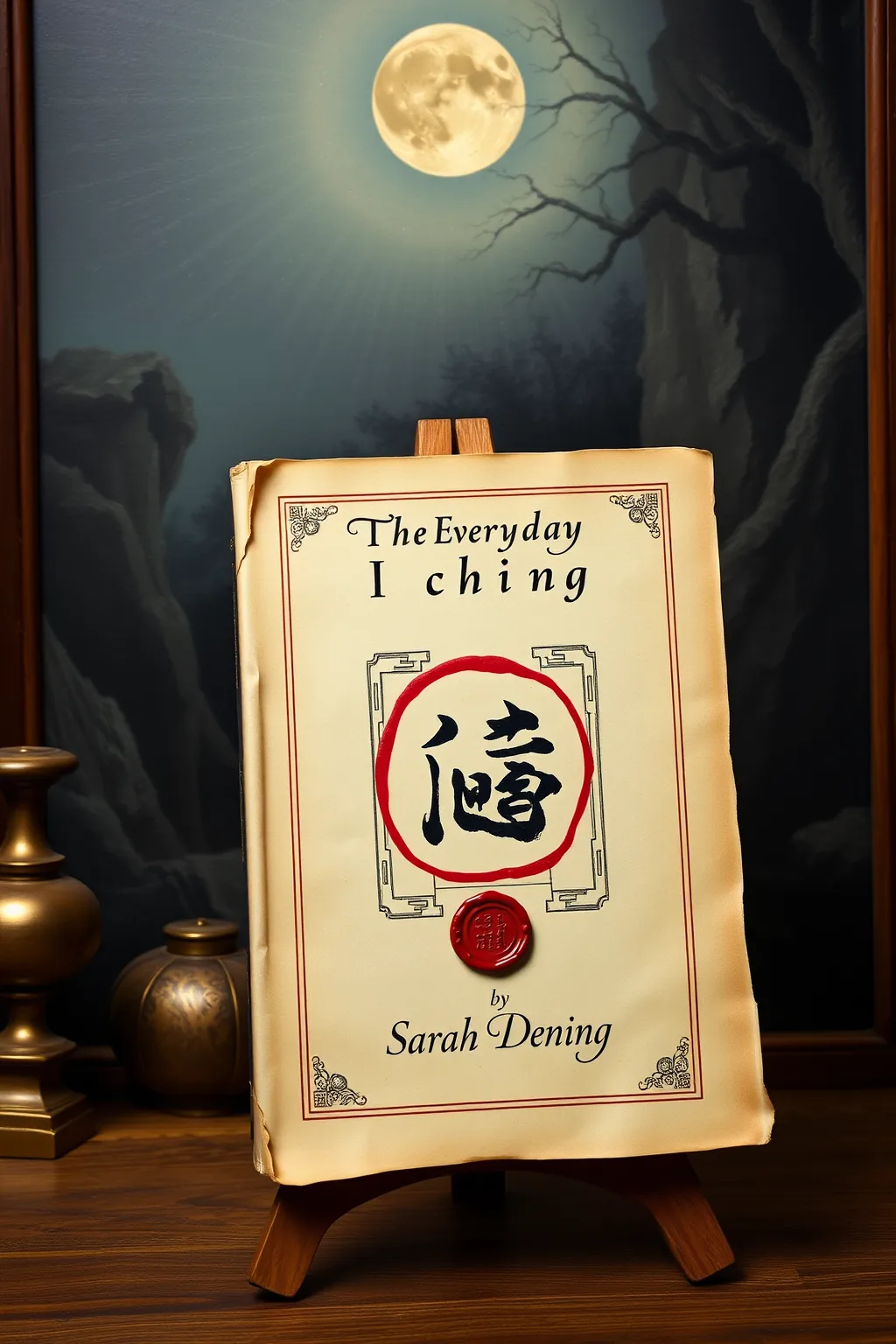
The Everyday I Ching
 82
82

The Everyday I Ching
Sarah Dening's approach to the I Ching in 'The Everyday I Ching' is commendably direct. Unlike many translations that drown the reader in arcane commentary, Dening foregrounds the practical application of the hexagrams. Her psychotherapeutic background lends a grounded perspective, translating ancient wisdom into language relevant to contemporary psychological concerns. The strength of the book lies in its clarity; it demystifies the process of consultation, making the oracle feel less like an esoteric puzzle and more like a dialogue partner. However, the book’s brevity, while contributing to its accessibility, occasionally sacrifices the nuanced layers of meaning found in more exhaustive treatments of the I Ching. For instance, the exploration of the changing lines, a critical element for deeper prognostication, could be more extensively detailed. Nevertheless, for those seeking an accessible entry point to the I Ching for personal guidance, Dening's work offers a clear and useful framework. It serves as a capable guide for understanding the forces shaping one's life.
📝 Description
82
Sarah Dening's 1997 book, The Everyday I Ching, presents the ancient Chinese oracle as a practical guide for modern life.
This book reintroduces the I Ching, the ancient Chinese oracle, as a tool for contemporary concerns rather than a purely mystical artifact. Sarah Dening, a psychotherapist, simplifies the sixty-four hexagrams, offering clear interpretations for today's challenges. The work bridges the gap between the text's historical roots and the needs of individuals seeking guidance.
The Everyday I Ching is suited for those interested in self-discovery and personal development who may have found other I Ching translations difficult. It offers a structured yet intuitive method for understanding life's complexities, making decisions, and gaining perspective on relationships. The book combines psychological depth with esoteric traditions, appealing to readers who value both.
The I Ching, originating in ancient China and dating to the Zhou Dynasty, is a foundational text in Chinese philosophy, linked to Confucianism and Taoism. Its extensive history includes significant commentaries from figures like Confucius and later scholars. Dening's 1997 work arrived during a period of increased Western interest in Eastern philosophies and divination, a trend influenced by earlier figures like Carl Jung who recognized the I Ching's principles of synchronicity.
💡 Why Read This Book?
• Gain practical insight into decision-making by learning to interpret the 64 hexagrams, as presented in Sarah Dening's accessible style, moving beyond abstract concepts to concrete guidance. • Understand the dynamic interplay of yin and yang, fundamental to Taoist philosophy and central to the I Ching's wisdom, as explained through Dening's focus on actionable advice. • Develop a more intuitive approach to life's challenges by consulting the oracle, using Dening's method to frame questions and interpret the hexagrams for personal growth.
⭐ Reader Reviews
Honest opinions from readers who have explored this book.
❓ Frequently Asked Questions
What makes 'The Everyday I Ching' different from other I Ching translations?
Sarah Dening's version prioritizes practical application and psychological relevance, making the I Ching accessible to a modern audience. It translates the wisdom of the hexagrams into clear guidance for everyday dilemmas, distinguishing it from more academic or purely philosophical translations.
Is 'The Everyday I Ching' suitable for beginners?
Yes, the book is specifically designed for those new to the I Ching or those who have found other translations difficult. Dening's clear explanations and focus on practical use make it an excellent starting point.
How does Sarah Dening's background as a psychotherapist influence the book?
Her psychotherapeutic perspective helps to frame the I Ching's wisdom in terms of personal growth, understanding internal states, and navigating relationships, making the oracle's advice more relatable and actionable for emotional well-being.
What is a hexagram in the context of the I Ching?
A hexagram is a symbol composed of six stacked lines, each being either solid (yang) or broken (yin). The I Ching uses 64 unique hexagrams to represent archetypal situations and provide guidance on how to act within them.
When was 'The Everyday I Ching' first published?
The book was first published on January 15, 1997, reflecting a period of growing interest in applying ancient wisdom traditions to contemporary life challenges.
Does the book teach how to cast the I Ching?
While the book focuses on interpreting the hexagrams, it assumes the reader has a method for generating them, such as using yarrow stalks or coins, and provides the framework for understanding the results.
🔮 Key Themes & Symbolism
Hexagram Interpretation
The book centers on explaining the 64 hexagrams of the I Ching, presenting them as archetypal situations rather than obscure prophecies. Dening provides clear, concise interpretations that connect the ancient symbols to modern psychological and practical concerns. This focus allows readers to engage with the oracle's wisdom in a direct and applicable manner, moving beyond rote memorization to intuitive understanding.
The Nature of Change
Central to the I Ching is the philosophy that change is the only constant. Dening's work emphasizes understanding the flow of events and adapting one's actions accordingly. The hexagrams are presented as maps of unfolding situations, guiding the reader on how to align themselves with the natural course of transformation, rather than resisting it.
Practical Divination
Dening frames the I Ching consultation as a practical tool for self-reflection and decision-making. The book aims to equip readers with the ability to ask pertinent questions and interpret the resulting hexagrams for actionable advice. This approach grounds the esoteric practice in everyday reality, making the oracle a useful companion for navigating life's complexities.
Yin and Yang Dynamics
The foundational principles of yin (passive, dark, feminine) and yang (active, light, masculine) are explored not just as abstract concepts but as dynamic forces influencing situations. Dening illustrates how the balance and interplay of these forces within each hexagram offer clues to understanding current circumstances and potential resolutions.
💬 Memorable Quotes
Direct passages from the work, attributed to the author.
“Each hexagram represents a fundamental human situation.”
— This interpretation emphasizes the archetypal nature of the I Ching's wisdom. It posits that the ancient symbols are not tied to specific historical events but represent universal patterns of experience that continue to be relevant across different eras.
“Consult the oracle to understand when to act and when to wait.”
— This interpretation focuses on the practical timing aspect of I Ching consultation. It suggests the oracle provides guidance on the opportune moment for action, emphasizing patience and strategic timing as crucial elements for success.
💡 Key Ideas
Editorial paraphrase of the work's core concepts — not direct quotes.
The I Ching is a mirror reflecting the forces at play in your life.
This paraphrased concept highlights the book's view of the oracle not as a predictor of destiny, but as a tool for self-awareness. It suggests the I Ching helps illuminate the underlying dynamics of a situation, allowing the user to see their own role within it more clearly.
Understanding the changing lines offers deeper insight into the unfolding situation.
This paraphrased concept points to a key element of I Ching practice: the changing lines within a hexagram indicate a transition or development. Dening's work likely guides readers to analyze these shifts for a more nuanced understanding of the present and future trajectory.
The wisdom of the I Ching is accessible through clear, direct language.
This paraphrased concept reflects the core aim of Dening's book: to make the I Ching understandable without jargon. It suggests that by stripping away complex or archaic phrasing, the essential message of the oracle can be grasped by a wider audience.
🌙 Esoteric Significance
Tradition
The I Ching belongs to the ancient Chinese Taoist and Confucian traditions, deeply embedded in cosmology and philosophy. While not typically categorized within Western esoteric lineages like Hermeticism or Kabbalah, its emphasis on understanding natural cycles, balance (yin/yang), and transformation aligns with universal esoteric principles of macrocosm-microcosm correspondence and the dynamic nature of reality.
Symbolism
The primary symbols are the 64 hexagrams, each formed from six lines (solid 'yang' or broken 'yin'). These lines and their combinations represent archetypal situations, cosmic forces, and stages of change. The trigrams (three-line combinations) within the hexagrams, such as Heaven (Qian) and Earth (Kun), are fundamental symbols of creative and receptive energies respectively.
Modern Relevance
Contemporary practitioners of mindfulness, self-help, and systems thinking often draw on the I Ching's principles for decision-making and understanding complex dynamics. Its emphasis on adaptability, cyclical change, and aligning with natural forces speaks to modern psychological approaches and fields like chaos theory, making it relevant for those seeking non-linear frameworks for understanding life.
👥 Who Should Read This Book
• Individuals seeking practical guidance for decision-making: Readers who want a structured yet intuitive method to gain clarity on personal or professional challenges will find Dening's direct interpretations valuable. • Students of Eastern philosophy and divination: Those interested in exploring the I Ching beyond academic texts or complex ritualistic approaches will appreciate the accessible, psychotherapeutic angle. • Psychologically-minded seekers of self-awareness: Readers who connect with the idea of using ancient wisdom for personal growth and understanding internal dynamics will find the book's framing particularly helpful.
📜 Historical Context
Published in 1997, Sarah Dening's 'The Everyday I Ching' emerged during a period of significant Western engagement with Eastern philosophies and divination systems. The I Ching, with its roots stretching back to the Zhou Dynasty (c. 1046–256 BCE) and influenced by thinkers like Confucius, had already seen numerous translations and interpretations. Dening's work arrived in the wake of popularizations by figures like Carl Jung, who famously explored the I Ching through the lens of synchronicity in the mid-20th century. While Jung's approach highlighted the psychological resonance of the oracle, Dening's contribution focused on making its practical application more direct and less encumbered by dense philosophical exegesis or complex ritualistic requirements, offering a psychotherapeutic angle distinct from earlier academic or purely esoteric treatments.
📔 Journal Prompts
The role of the hexagrams as mirrors of internal states.
Reflecting on the balance of yin and yang in a current situation.
How the concept of change, as depicted in the I Ching, applies to personal challenges.
Identifying moments of opportune action versus necessary waiting.
Interpreting a specific hexagram's guidance for daily life.
🗂️ Glossary
Hexagram
A symbol composed of six stacked lines, each either solid (yang) or broken (yin). The I Ching uses 64 unique hexagrams to represent archetypal situations and provide guidance.
Trigram
A three-line symbol, either solid or broken, that forms part of a hexagram. There are eight basic trigrams, each representing fundamental natural forces or concepts.
Yang
In I Ching philosophy, the active, masculine, light, and assertive principle, represented by a solid line (—).
Yin
In I Ching philosophy, the passive, feminine, dark, and receptive principle, represented by a broken line (– –).
Oracle
A source of divine or prophetic counsel; in this context, the I Ching itself, used for divination and self-reflection.
Consultation
The process of posing a question to the I Ching and interpreting the resulting hexagram(s) for guidance.
Changing Lines
Specific lines within a hexagram that indicate a transition or transformation, offering deeper insight into the evolving nature of a situation.