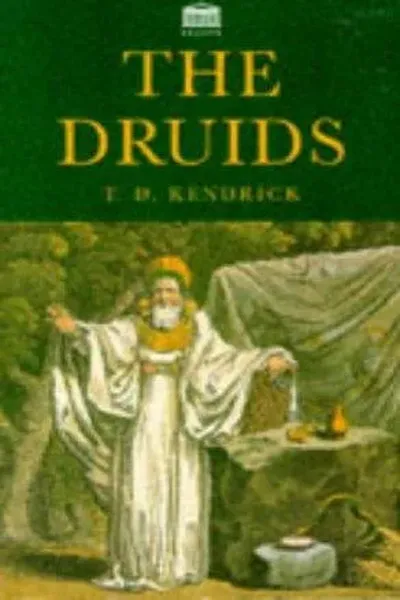
The Druids

 72
72

The Druids
Kendrick's "The Druids" offers a starkly academic perspective, a welcome antidote to more romanticized accounts. Its strength lies in its rigorous engagement with classical sources, particularly the often-contradictory accounts from Roman authors like Caesar and Tacitus, attempting to sift fact from propaganda. The work's limitation, however, is its adherence to the scholarship of its time, which sometimes overlooks or misinterprets later archaeological findings that have nuanced our understanding of Celtic culture. A passage discussing the Druids' supposed astronomical knowledge, while grounded in the evidence then available, feels somewhat dated when compared to contemporary analyses of megalithic structures and their potential calendrical uses. Ultimately, Kendrick provides a valuable, albeit period-specific, historical baseline for understanding early scholarly approaches to the Druids.
📝 Description
72
T. D. Kendrick's "The Druids," published in 1927, is an early academic look at Celtic figures.
First released in 1927, T. D. Kendrick's "The Druids" offers an early academic examination of ancient Celtic religious figures and their societal roles. The book predates much modern New Age interpretation of Druidry, focusing instead on historical and archaeological evidence available at the time. Kendrick attempts to reconstruct the beliefs, practices, and organizational structures attributed to the Druids, drawing from classical authors and material culture.
This work is for readers interested in the academic study of ancient European religions and the historical context of early Celtic societies. It will appeal to those seeking an understanding of Druidism before its 20th century revival and reinterpretation. Scholars of ancient history, Celtic studies, and comparative religion will find its historical approach useful, though it is not a guide to modern Druidic practice.
Published in the interwar period, "The Druids" appeared when interest in ancient civilizations and alternative spiritualities was increasing. The early 20th century saw significant archaeological finds and a growing academic field of Celtic studies. Kendrick's work engages with classical sources, such as Roman writers, while also considering the limited archaeological findings of its time. It reflects the scholarly methods and knowledge available then.
Kendrick's study positions itself against later, more spiritual interpretations of Druidry. It grounds its analysis in the scant historical records and archaeological finds accessible to scholars in the early 20th century. The book details the perceived roles of Druids as priests, judges, and lore-keepers within Celtic society, examining their philosophical ideas and relationship with nature. It also addresses how classical authors, particularly Romans, depicted and ultimately suppressed Druidic practices.
💡 Why Read This Book?
• Gain an understanding of the Druids through the lens of early 20th-century scholarship, referencing classical authors like Julius Caesar and Tacitus to reconstruct their societal roles. • Appreciate the historical development of Druidic studies by examining a foundational text from 1927, distinct from modern interpretations. • Explore the archaeological and literary evidence available prior to significant mid-20th century discoveries, providing context for later research.
⭐ Reader Reviews
Honest opinions from readers who have explored this book.
❓ Frequently Asked Questions
When was T. D. Kendrick's "The Druids" first published?
T. D. Kendrick's "The Druids" was first published in 1927, offering an early scholarly perspective on the ancient Celtic religious figures.
What is the primary focus of "The Druids" by T. D. Kendrick?
The book focuses on reconstructing the beliefs, practices, and societal roles of the ancient Druids based on historical and archaeological evidence available in the early 20th century.
Does "The Druids" discuss modern Druidry?
No, Kendrick's work predates the modern revival and reinterpretation of Druidry, concentrating instead on historical accounts and scholarly analysis of the ancient Celts.
Which classical authors are referenced in "The Druids"?
The book frequently references classical authors such as Julius Caesar and Tacitus, whose writings provide some of the earliest external descriptions of the Druids.
Is this book suitable for someone looking to practice Druidry today?
This book is primarily for academic and historical study. It examines historical Druidism and is not a guide for contemporary Druidic practices or beliefs.
What kind of evidence does Kendrick use to study the Druids?
Kendrick utilizes both literary evidence from classical writers and the archaeological findings available during the period of his research, which began before 1927.
🔮 Key Themes & Symbolism
Classical Sources Re-examined
Kendrick's "The Druids" meticulously scrutinizes the writings of Roman historians and geographers, such as Julius Caesar in "Commentarii de Bello Gallico," and Tacitus. He aims to disentangle historical observation from Roman political agenda, which often portrayed Druids as barbaric or as a threat to Roman authority. The work explores the descriptions of their initiation rites, their governance, and their judicial powers, presenting a critical analysis of these ancient narratives.
Druidic Societal Function
The book details the complex roles Druids occupied within ancient Celtic societies. Beyond their spiritual leadership, Kendrick investigates their positions as judges, educators, and keepers of tribal law and history. He examines the concept of Druidic learning, including their supposed emphasis on memorization and a cyclical view of time, as inferred from classical accounts and early linguistic studies.
Archaeological Interpretations
While limited by the discoveries of the early 20th century, Kendrick incorporates archaeological evidence to supplement textual sources. He discusses artifacts and potential ritual sites, attempting to connect material culture with the descriptions of Druidic practices. This section highlights the challenges of interpreting finds from the Iron Age and early Roman periods without the benefit of later, more extensive excavations.
The Druids and Roman Influence
A significant portion of Kendrick's analysis addresses the interactions between Druids and the Roman Empire. He examines the Roman attempts to suppress Druidic influence, particularly following the conquest of Britain, and the potential reasons behind this suppression – religious differences, political control, and the Druids' role in fostering resistance. This explores the impact of Roman expansion on indigenous belief systems.
💬 Memorable Quotes
Direct passages from the work, attributed to the author.
“The Druids... were a privileged order, exempt from war and from taxes.”
— This highlights the significant social and political standing of the Druids within Celtic society, suggesting their roles extended far beyond mere religious function to encompass aspects of governance and societal structure.
“Their doctrines concerning the immortality of the soul and the transmigration of souls were a principal cause of their contempt for death.”
— Kendrick interprets classical descriptions of Druidic beliefs about the soul, suggesting that a strong conviction in the afterlife or reincarnation contributed to their famed bravery and disregard for mortality in battle.
“They were careful to commit nothing to writing, though in other matters they made use both of Greek letters and of the native alphabet.”
— This points to a deliberate oral tradition maintained by the Druids, likely for esoteric or pedagogical reasons, distinguishing their sacred knowledge from secular records kept in writing.
“The Romans, under Claudius, took measures to suppress the Druids.”
— This refers to specific historical actions taken by the Roman authorities, indicating a period of direct conflict and persecution aimed at dismantling the influence and organization of the Druidic orders.
“The Druids appear to have been the principal figures in the Celtic tribal system.”
— This emphasizes the centrality of Druids not just in religious life but in the overall framework of Celtic society, suggesting they were key to maintaining social order, law, and tradition.
🌙 Esoteric Significance
Tradition
Kendrick's work, while academic, touches upon themes central to Western Esotericism's fascination with ancient priesthoods and lost wisdom. It engages with the historical perception of Druidry as a repository of ancient Celtic spirituality, a lineage often invoked by later esoteric orders seeking connections to pre-Christian European traditions. Though not a practitioner's manual, it provides foundational historical context for groups like the Hermetic Order of the Golden Dawn or early Theosophists who explored Celtic mythology and spiritual lineages.
Symbolism
The text implicitly explores the symbolism associated with Druids, such as their deep connection to the natural world – sacred groves, oak trees, and mistletoe, as recorded by Pliny the Elder. It also touches upon the concept of the Bardic tradition and the transmission of knowledge through oral poetry and song, symbolizing a form of sacred artistry and wisdom-keeping. The Druidic focus on cycles, both cosmic and terrestrial, hints at a symbolic understanding of time and renewal crucial in many esoteric systems.
Modern Relevance
Modern Druidry, particularly its various revivalist movements, often draws upon historical scholarship, even if it diverges significantly in practice and belief. Thinkers and practitioners in contemporary Neo-Paganism and reconstructionist movements might reference Kendrick's analysis of classical sources to understand the historical milieu from which Druidic practices emerged, or to debate interpretations of ancient Celtic religion. The scholarly foundation he provides, despite its age, remains a point of reference for those seeking to ground contemporary spirituality in historical inquiry.
👥 Who Should Read This Book
• Students of ancient European history and religion seeking an early scholarly perspective on the Druids, grounding their understanding in the context of 1927 research. • Comparative religion scholars interested in how classical authors described and interpreted indigenous spiritual practices, and how those descriptions have been historically analyzed. • Researchers of Celtic studies looking for a foundational text that examines the literary and archaeological evidence for Druidic societal roles and beliefs as understood in the early 20th century.
📜 Historical Context
T. D. Kendrick's "The Druids" emerged in 1927, a period marked by intense academic interest in Celtic civilizations and a growing public fascination with ancient mysteries. The early 20th century saw significant archaeological excavations across Britain and Europe, providing new material evidence that scholars like Kendrick grappled with. His work engaged directly with the classical tradition, particularly the accounts of Roman writers such as Julius Caesar and Tacitus, who described the Druids in their writings on the Gallic Wars and Roman Britain. At this time, comparative mythology and philology were key tools for understanding ancient religions. Kendrick's scholarly approach stood in contrast to more romantic or mystical interpretations that were also gaining traction, particularly within burgeoning esoteric movements. While not facing direct censorship, the academic reception of such works often involved debates over methodology and the interpretation of sparse evidence. Kendrick's analysis reflects the prevailing academic standards and the limited scope of archaeological data available before the mid-20th century.
📔 Journal Prompts
Druidic exemption from war and taxes: How did such privileges shape their authority?
The concept of Druidic contempt for death: Reflect on the philosophical underpinnings of this attitude.
Oral tradition versus written records: Consider the implications of Druids committing nothing to writing.
Roman suppression of the Druids: Analyze the motivations behind such actions by figures like Claudius.
The Druids' role as judges: Explore the intersection of spiritual and judicial power in ancient societies.
🗂️ Glossary
Druids
Priests, scholars, and judges of ancient Celtic societies, particularly prominent in Gaul, Britain, and Ireland, known for their religious, ethical, and scientific knowledge.
Transmigration of Souls
A belief in the movement of a soul after death into another body, either human or animal, a doctrine attributed to the Druids by classical writers.
Classical Authors
Writers from ancient Greece and Rome, such as Julius Caesar, Tacitus, and Pliny the Elder, whose works provide primary, though often biased, accounts of Celtic peoples and their Druids.
Gaul
The historical region of Western Europe inhabited by Celtic peoples, corresponding roughly to modern-day France, Belgium, Luxembourg, and parts of Switzerland, Germany, and the Netherlands.
Sacred Groves
Areas of woodland considered holy by ancient peoples, often used for religious rituals and ceremonies; Druids were particularly associated with such natural settings.
Bardic Tradition
The system of oral poetry, storytelling, and history-keeping practiced by bards, who were a distinct but often associated class with the Druids in Celtic society.
Claudius
Roman Emperor from 41 to 54 AD, who, according to some historical accounts, took measures to suppress Druidic practices in Britain.
🔮 Readers Also Liked
Browse all →
![ERIC ED085284: World History. Volumes I and II. [Sahuarita High School Career Curriculum Project].](/img/thumb/eric-ed085284-world-history-volumes-i-and-ii-sahuarita-high-school-career-curriculum-project-eric.webp)




![AD [frag.] Gela Hermann Büder Wittwe zu Rodenbach Clägerin. Contra Die Gemeindte desselbsten und sonderlich Johannes ... 1650-1651: Iss 180](/img/thumb/ad-frag-gela-hermann-b-der-wittwe-zu-rodenbach-cl-gerin-contra-die-gemeindte-desselbsten-und-sonderlich-johannes-1650-1651-iss-180-buder-gela.webp)


More by T. D. Kendrick
All books →

More Free Witchcraft & Paganism Books
View all →