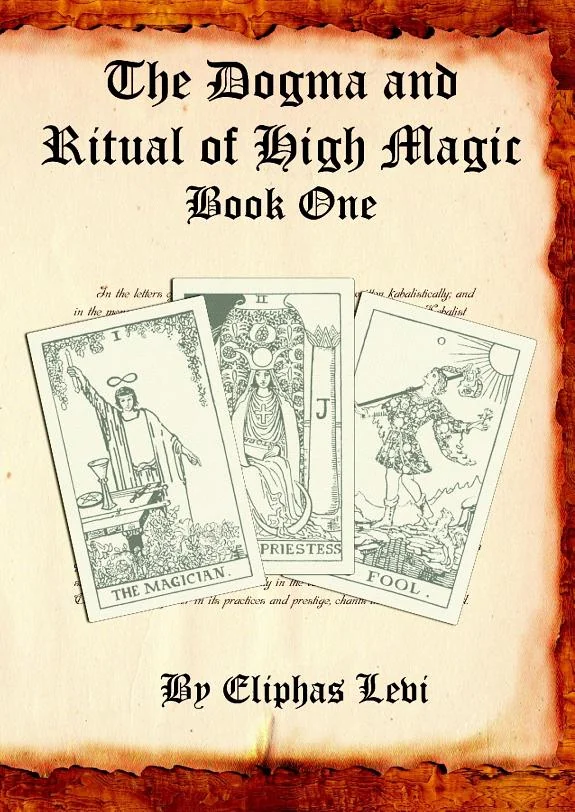
The Dogma of High Magic
 75
75

The Dogma of High Magic
Eliphas Lévi's 'The Dogma of High Magic' attempts a grand synthesis, presenting ceremonial magic as a rigorous, almost scientific discipline. The book's strength lies in its ambition to systematize what can often seem nebulous; Lévi provides a framework for understanding the magician's place in the cosmos. However, the prose can be dense, demanding considerable reader focus. A particular passage detailing the "Great Arcanum" underscores the text's reliance on symbolic interpretation, which, while insightful, may alienate those seeking purely practical, step-by-step instructions. The work is a significant historical document, but its direct applicability today requires careful discernment. It functions best as a historical and philosophical primer for the dedicated student.
📝 Description
75
Eliphas Lévi published 'The Dogma of High Magic' in 1854, codifying Western ceremonial magic.
Eliphas Lévi's 1854 work, 'The Dogma of High Magic,' offers a systematic account of ceremonial magic within Western esoteric traditions. It aims to organize the principles and practices of occultism for serious students, detailing the magician's role, spiritual forces, and methods of invocation and control. The book requires a commitment to rigorous magical development, making it unsuitable for casual readers. Aspiring occultists, esoteric history scholars, and practitioners seeking a structured framework for ceremonial magic will find its content particularly useful, though some background in philosophical concepts is recommended.
Lévi's writings emerged during a 19th-century occult revival, a time of renewed interest in Kabbalah, alchemy, and ancient mysticism. This period saw the formation of occult societies and the publication of numerous esoteric treatises that often countered prevailing scientific materialism. Lévi's work was significant for its synthesis of earlier magical traditions into a cohesive system. The text elaborates on core concepts such as the Astral Light as a universal medium, the Grand Arcanum's fundamental principles, and the necessity of the magician's will in directing magical energies. It also addresses the role of symbols, divine names, and ritual implements as conduits for power.
This book is situated within the 19th-century European occult revival, a period marked by a resurgence of interest in Western esotericism. Figures like Eliphas Lévi sought to synthesize and systematize traditions such as Kabbalah, alchemy, and older magical practices. This revival often occurred in opposition to the dominant scientific materialism of the era, aiming to establish a coherent framework for occult philosophy and ritual. Lévi's work contributed to this effort by presenting a structured approach to ceremonial magic.
💡 Why Read This Book?
• Understand the structure of ceremonial magic, including the roles of will and the Astral Light, as detailed in Lévi's foundational 19th-century system. • Explore the specific symbolism of the Great Arcanum, a central concept in Lévi's doctrine, to grasp its significance in Western occult thought. • Gain insight into the historical context of occult revival in the 1850s, a period when Lévi was actively shaping esoteric discourse.
⭐ Reader Reviews
Honest opinions from readers who have explored this book.
❓ Frequently Asked Questions
When was 'The Dogma of High Magic' first published?
The first publication of 'The Dogma of High Magic' by Eliphas Lévi was in 1854, marking it as a significant work from the mid-19th century occult revival.
What is the 'Astral Light' according to Eliphas Lévi?
In Lévi's system, the Astral Light is understood as a universal, invisible fluid or medium that permeates all existence, acting as a conduit for divine power and influencing both the physical and spiritual realms.
Is 'The Dogma of High Magic' suitable for beginners in occultism?
While it introduces fundamental concepts, the book is dense and theoretical. It is best suited for serious beginners who are prepared for rigorous study rather than those seeking introductory overviews.
What is the 'Great Arcanum' discussed in the book?
The Great Arcanum, central to Lévi's teachings, refers to the fundamental principles and the ultimate secret of magic, often symbolized by specific esoteric imagery such as the hermaphrodite or the caduceus.
Who was Eliphas Lévi?
Eliphas Lévi, born Alphonse Louis Constant, was a prominent French occultist and ceremonial magician of the 19th century, instrumental in reviving and synthesizing Western esoteric traditions.
Does the book provide practical ritual instructions?
The book focuses more on the theoretical dogma and philosophical underpinnings of high magic. While it describes principles, direct, step-by-step ritual instructions are less emphasized than the conceptual framework.
🔮 Key Themes & Symbolism
The Astral Light
Lévi posits the Astral Light as a universal medium, a dualistic force of life and spirit that is the fundamental substrate of reality. He describes it as the primary agent of magical operations, susceptible to being influenced by the magician's will and imagination. Understanding and manipulating this light is presented as key to unlocking occult powers and achieving spiritual transformation. The concept is central to his pantheistic view of the cosmos and the interconnectedness of all things.
The Great Arcanum
This theme addresses the supreme secret of magic, the fundamental principle that governs all existence and operation. Lévi often symbolizes the Great Arcanum through various esoteric images, such as the androgyne or the divine union, representing the balance of opposing forces and the potential for creation. It signifies the profound knowledge that allows the magician to effect change and understand the divine order, often linked to the Tarot's Fool card and its transformative journey.
Will and Imagination
The text emphasizes the critical role of the magician's own will and imaginative faculty in directing the Astral Light. Lévi argues that a focused, disciplined will, coupled with a vivid and controlled imagination, acts as the engine for magical manifestation. The ability to visualize and intend outcomes with absolute certainty is presented not as mere mental exercise, but as a practical force capable of shaping reality according to occult principles.
Symbolism and Analogy
Lévi's work is deeply steeped in symbolic language and analogical reasoning. He contends that the universe operates through a system of correspondences, where every element reflects a higher or lower principle. The book uses symbols from Kabbalah, Tarot, and ancient mythologies to illustrate complex magical doctrines. Understanding these symbols and their interrelationships is crucial for deciphering the hidden laws of nature and the spiritual world.
💬 Memorable Quotes
Direct passages from the work, attributed to the author.
“The great, universal agent is the light of the Astral Light.”
— This statement highlights Lévi's central concept of the Astral Light as the primary, all-pervading force in his magical cosmology, essential for all occult phenomena.
“The dogma of magic is the science of secrets.”
— This frames magic not as mere superstition, but as a structured discipline ('science') dedicated to understanding and utilizing hidden forces and knowledge ('secrets').
“The will of the magician is the key that opens the gate.”
— This interpretation underscores the absolute necessity of the magician's focused intent and mental power as the primary tool for initiating any magical work.
“The equilibrium of forces is the divine law.”
— This reflects Lévi's view of cosmic order being maintained through balance. Magic, in his system, often involves understanding and rebalancing these forces.
“The imagination is the faculty of the soul that creates realities.”
— This emphasizes the power of human imagination, when properly directed and imbued with will, to manifest changes in the world through magical means.
🌙 Esoteric Significance
Tradition
The Dogma of High Magic is firmly rooted in the Western Esoteric Tradition, drawing heavily from Hermeticism and Kabbalah. Lévi sought to create a unified system of magic, synthesizing elements from these ancient streams with his own interpretations. He positioned his work as a modern reinterpretation of older magical doctrines, aiming to present occultism as a rational, philosophical science rather than mere superstition, thereby bridging the gap between esoteric knowledge and contemporary intellectual currents.
Symbolism
Key symbols in the book include the Caduceus of Hermes, representing the balance of opposing forces and the union of opposites, and the Tarot, which Lévi interpreted as a profound symbolic language of the universe and the human psyche. The concept of the 'Great Arcanum' itself functions as a potent symbol for ultimate divine knowledge and the fundamental secret of creation and magic. These symbols are not merely decorative but are presented as keys to understanding the underlying structure of reality.
Modern Relevance
Lévi's work continues to be foundational for many modern occult and magical practitioners, particularly within Neoplatonic, Hermetic, and ceremonial magic circles. Thinkers and groups influenced by him include the Hermetic Order of the Golden Dawn, Aleister Crowley (who built upon Lévi's system), and contemporary authors exploring Western esotericism. His emphasis on the Astral Light and the power of will and imagination remains a significant influence on modern magical theory and practice.
👥 Who Should Read This Book
• Aspiring ceremonial magicians seeking a comprehensive theoretical framework before engaging in practical ritual. • Students of Western Esotericism interested in the intellectual history of occultism and the synthesis of Kabbalistic and Hermetic thought. • Philosophers and researchers of comparative religion examining the relationship between esoteric doctrines and broader spiritual traditions.
📜 Historical Context
Eliphas Lévi's 'Dogme de la Haute Magie' (The Dogma of High Magic), first published in 1854, emerged from a vibrant intellectual milieu in mid-19th century France. This era witnessed a significant resurgence of interest in esotericism, fueled by intellectual curiosity about ancient traditions and a reaction against the perceived limitations of rationalism and materialism. Lévi, born Alphonse Louis Constant, was a central figure in this occult revival, seeking to synthesize Kabbalah, Hermeticism, and other esoteric systems into a coherent philosophical framework. His work stood in contrast to the more spiritualist movements gaining traction at the time, offering a more structured and philosophically grounded approach to magic. Contemporaries like Bulwer-Lytton, whose novels explored occult themes, shared a cultural space with Lévi, though Lévi's work aimed for a systematic exposition of magical principles. The book's reception was mixed, with some embracing it as a key to hidden knowledge and others dismissing it as charlatanism, yet it undeniably influenced subsequent generations of occultists.
📔 Journal Prompts
The magician's will as the key to opening the gate: how does this concept apply to non-magical goals?
Reflect on the concept of the Astral Light: what are its potential parallels in modern scientific or philosophical ideas?
Analyze a personal symbol that holds significant meaning for you, considering Lévi's emphasis on symbolic language.
The equilibrium of forces as a divine law: identify an area in your life where balance is crucial.
How does Lévi's description of the imagination as a creative faculty challenge conventional views of reality?
🗂️ Glossary
Astral Light
A concept central to Lévi's magic, referring to a universal, invisible fluid or medium that permeates all existence, acting as a conduit for divine energy and influencing both the physical and spiritual realms.
Great Arcanum
The supreme secret of magic and the fundamental principle of the universe, often symbolized by esoteric imagery representing the union of opposites and the core of creation.
Will
In the context of high magic, the focused, disciplined intention and power of the magician, essential for directing the Astral Light and effecting magical operations.
Imagination
The faculty of the soul, as described by Lévi, that can create realities and influence the Astral Light when combined with a strong will and focused intent.
Kabbalah
A system of Jewish mysticism and esoteric philosophy that Lévi extensively drew upon, focusing on divine emanations, symbolic interpretation of scripture, and the structure of the cosmos.
Hermeticism
A philosophical and religious tradition based on the purported teachings of Hermes Trismegistus, emphasizing principles like 'as above, so below' and the interconnectedness of the universe.
Grand Arcanum
An alternative term for the Great Arcanum, referring to the ultimate secret or foundational principle of magical science.
This book appears in 1 collection
🔮 Readers Also Liked
Browse all →








From the “High Magic” Collection
View all →







More Free Magic & Ritual Books
View all →