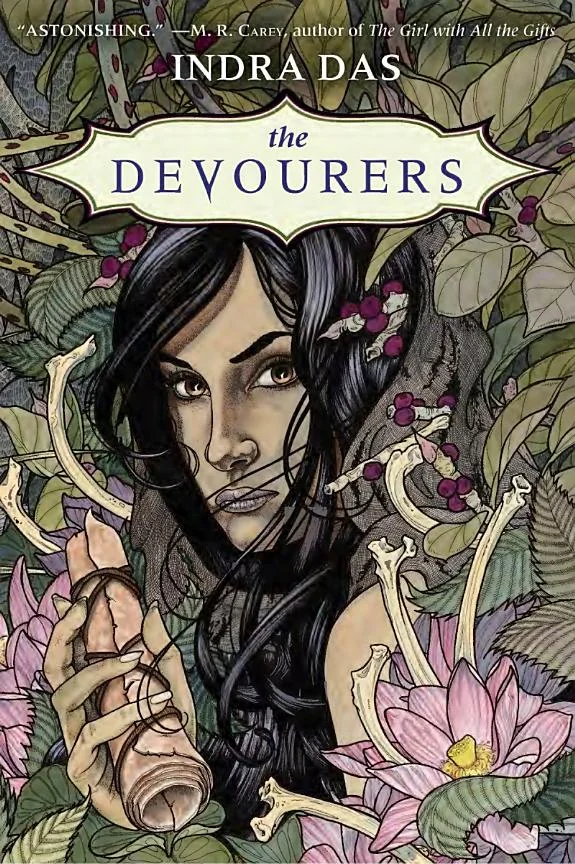
The Devourers
 81
81

The Devourers
Indra Das’s "The Devourers" is a work that dares to confront the void not with a scream, but with a chillingly rational gaze. The strength of the novel lies in its unflinching commitment to its premise: the universe as a cosmic feeding ground for entities beyond human comprehension. Das masterfully crafts a sense of immense scale, making terrestrial concerns feel infinitesimal. A particularly striking aspect is the depiction of the Devourers' methods, less as acts of malice and more as fundamental processes, akin to a star collapsing. However, the narrative's philosophical density can, at times, overshadow emotional engagement. The characters, while serving their thematic purpose, often feel like conduits for ideas rather than fully realized individuals. The passage describing the 'unmaking' of a star system, abstract yet viscerally rendered, encapsulates both the book’s power and its potential challenge to readers seeking more conventional character arcs. "The Devourers" offers a potent, albeit stark, meditation on cosmic insignificance.
📝 Description
81
Indra Das's 2016 novel, The Devourers, reimagines cosmic horror through the lens of world consuming entities.
The Devourers is a work of speculative fiction that examines existence through the actions of entities that consume worlds and consciousness. It functions as both a narrative and a philosophical inquiry, considering fundamental questions about creation and destruction. The book does not offer instructions for occult rituals but rather uses fictional scenarios to explore metaphysical ideas that are often unsettling. It is written for readers who enjoy speculative fiction that challenges philosophical assumptions. Those interested in the connections between existentialism, cosmology, and darker metaphysical questions will find it particularly engaging.
Readers looking for traditional genre fiction might find its abstract nature demanding. The novel is best suited for individuals who are comfortable with ambiguity and the examination of abstract, and potentially disturbing, existential themes. It asks readers to consider their place within a vast and indifferent universe, engaging with anxieties about scale and meaning.
Published in 2016, The Devourers echoes certain Gnostic ideas about cosmic antagonism and the material world as a flawed creation. While not directly tied to a specific historical occult movement, it fits within contemporary cosmic horror that reinterprets Lovecraftian themes through modern philosophical lenses. The novel engages with anxieties about humanity's scale and significance within an indifferent cosmos, a common thread in speculative fiction exploring esoteric or Gnostic undertones.
💡 Why Read This Book?
• Gain a unique perspective on cosmic entropy and oblivion, understanding the "Devourers" as a metaphor for forces beyond human control, as explored in the novel's speculative cosmology. • Confront the philosophical implications of consciousness facing ultimate dissolution, a central theme exemplified by the narrative's focus on existential annihilation. • Experience a narrative that grapples with the limitations of human perception when confronted by unfathomable cosmic phenomena, a core element of the book's existential horror.
⭐ Reader Reviews
Honest opinions from readers who have explored this book.
❓ Frequently Asked Questions
What is the central theme of Indra Das's "The Devourers"?
The central theme revolves around cosmic entities known as 'Devourers' that consume worlds and consciousness. It explores existential dread, the insignificance of human existence against vast cosmic forces, and the nature of oblivion.
Is "The Devourers" a science fiction novel or a philosophical work?
It functions as both. While it employs narrative and speculative elements common in science fiction, its primary focus is on philosophical inquiry into cosmology, existentialism, and the nature of reality.
When was "The Devourers" first published?
"The Devourers" by Indra Das was first published in 2016.
What kind of entities are the 'Devourers' in the book?
The 'Devourers' are depicted as ancient, colossal beings whose existence and purpose are centered around the consumption of entire realities, stars, and consciousnesses, representing a fundamental, perhaps indifferent, cosmic process.
Does the book offer any hopeful interpretations of existence?
The book's tone is predominantly bleak, focusing on existential annihilation rather than hope. Any 'hope' is abstract, perhaps found in the sheer scale of existence or the incomprehensibility of these cosmic processes, rather than solace.
What philosophical traditions influence "The Devourers"?
While not explicitly tied to one tradition, it echoes themes found in Gnosticism (cosmic antagonism, flawed creation) and existentialism (meaninglessness, confronting dread), alongside elements of cosmic horror.
🔮 Key Themes & Symbolism
Cosmic Consumption
The core concept of 'Devourers' as entities that consume stars, worlds, and consciousnesses. This theme explores ultimate entropy and oblivion, presenting a universe where existence is merely a temporary state before inevitable annihilation by these incomprehensible forces. It challenges anthropocentric views by positing beings whose scale and purpose dwarf all known existence, functioning as a cosmic process rather than malevolent actors.
Existential Annihilation
The book explores the philosophical implications of confronting absolute nothingness. Consciousness is portrayed as fragile, susceptible to being unmade or absorbed. This theme questions the inherent meaning of existence when faced with entities that can erase it without effort or intent, forcing readers to consider their place within a potentially indifferent cosmos.
Limits of Perception
Das explores how human understanding and scientific frameworks collapse when confronted with the truly alien and vast. The 'Devourers' and their actions operate beyond the scope of empirical observation or logical deduction, highlighting the profound limitations of our sensory and cognitive apparatus when faced with ultimate reality or its antithesis.
The Indifferent Universe
A pervasive sense of cosmic indifference permeates the narrative. The Devourers do not act out of malice but as fundamental forces, akin to natural phenomena. This perspective underscores the existentialist notion of a universe devoid of inherent purpose or concern for its inhabitants, where suffering and annihilation are simply byproducts of cosmic mechanics.
💬 Memorable Quotes
Direct passages from the work, attributed to the author.
“The stars were not born; they were consumed.”
— This statement reframes the origin of celestial bodies, suggesting a process of destruction rather than creation. It immediately establishes the book's cosmic horror premise, where fundamental aspects of the universe are understood through the actions of consuming entities.
“Consciousness is merely a flicker before the long dark.”
— This highlights the fragility and transience of sentient awareness. It positions human or any form of consciousness as insignificant and temporary in the face of overwhelming, eternal oblivion represented by 'the long dark'.
“They did not destroy. They simply unmade.”
— This distinction emphasizes the nature of the 'Devourers' actions. 'Unmaking' suggests a return to a primal state or absolute nothingness, distinct from active destruction, implying a process of cosmic erasure that is more absolute and terrifying.
“Our reality is a fleeting meal.”
— This metaphor frames the entire existence of the known universe as temporary sustenance for larger cosmic forces. It conveys a profound sense of insignificance and highlights the cyclical nature of creation and destruction on a universal scale.
“The silence that followed was the true hunger.”
— This suggests that the absence left after consumption is not mere emptiness but an active, potent force. It implies that the 'Devourers'' hunger is satisfied not just by consuming, but by the profound void they leave behind.
🌙 Esoteric Significance
Tradition
While not explicitly rooted in a single esoteric lineage, "The Devourers" draws thematic parallels with Gnostic cosmology, particularly the concept of a flawed or antagonistic creator/force (the Devourers acting as cosmic 'unmakers') and the idea of existing within a limited, ultimately doomed reality. It also speaks to certain interpretations of Buddhist concepts of impermanence (anicca) and emptiness (sunyata), albeit rendered through a lens of existential dread rather than liberation.
Symbolism
The primary symbol is the 'Devourer' itself, representing ultimate entropy, oblivion, or a force of cosmic negation that transcends mortal understanding. Stars and worlds consumed symbolize the transience of all phenomena. The 'silence' or 'void' left behind after consumption symbolizes absolute nothingness, a state beyond existence or non-existence, representing the ultimate end point of all things.
Modern Relevance
Contemporary writers and thinkers exploring the philosophical implications of cosmic horror and existential dread often find resonance in Das's work. It speaks to modern anxieties about humanity's place in an increasingly complex and seemingly indifferent universe, influencing speculative fiction that prioritizes philosophical depth and existential inquiry over conventional narrative resolution.
👥 Who Should Read This Book
• Readers interested in speculative fiction that engages deeply with existential philosophy and cosmic horror, seeking narratives that explore the void. • Philosophically inclined individuals grappling with themes of meaninglessness, oblivion, and the scale of the universe. • Fans of authors like H.P. Lovecraft, Cormac McCarthy, or Jeff VanderMeer who appreciate bleak, high-concept narratives that challenge conventional perceptions of reality.
📜 Historical Context
Indra Das's "The Devourers," published in 2016, arrived during a period of resurgent interest in cosmic horror, a subgenre heavily influenced by H.P. Lovecraft. While Lovecraft often explored ancient, unknowable entities and the insignificance of humanity, Das's work updates these themes with a more pronounced philosophical bent, engaging with existentialist ideas of meaninglessness and oblivion. The early 21st century saw numerous authors, including Jeff VanderMeer and Laird Barron, pushing the boundaries of horror fiction into more abstract and metaphysical territories, often blending it with speculative fiction. Unlike the more direct occultism of earlier eras, "The Devourers" engages with the *implications* of cosmic dread rather than providing a framework for magical practice. Its reception places it within contemporary literary discussions that question grand narratives and explore the anxieties of a vast, potentially indifferent universe, a counterpoint to more optimistic or human-centric science fiction prevalent in earlier decades.
📔 Journal Prompts
The nature of the 'Devourers' and their 'unmaking' process.
The concept of consciousness as a 'flicker before the long dark'.
Reflections on the universe as a 'fleeting meal'.
The implications of cosmic indifference as depicted in the text.
The distinction between 'destroy' and 'unmake' in the narrative.
🗂️ Glossary
Devourers
Vast, ancient entities in the narrative whose primary function is the consumption of stars, planets, and consciousnesses, representing forces of cosmic entropy or oblivion.
Unmaking
The process by which the Devourers erase existence. It is depicted as more absolute than destruction, suggesting a return to nothingness or a state beyond comprehension.
The Long Dark
A metaphorical representation of ultimate oblivion or the state of non-existence that follows the consumption of realities, emphasizing the vastness of time and space beyond any known existence.
Cosmic Indifference
The philosophical stance that the universe and its forces operate without regard for sentient life or any inherent purpose, a theme central to the actions of the Devourers.
Flicker of Consciousness
A metaphor describing consciousness as brief, transient, and insignificant when contrasted with the immense scale of cosmic time and the finality of oblivion.
Fleeting Meal
A description of our perceived reality or universe as temporary sustenance for the Devourers, highlighting its ephemeral nature on a cosmic scale.
Absolute Nothingness
The state of non-existence that the Devourers potentially represent or enact, a concept explored as the ultimate endpoint of all phenomena.
🔮 Readers Also Liked
Browse all →








More by Indra Das
All books →
More Free Occult Philosophy Books
View all →