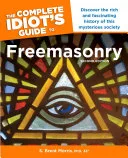
The Complete Idiot’s Guide to Freemasonry, 2nd Edition
 71
71

The Complete Idiot’s Guide to Freemasonry, 2nd Edition
S. Brent Morris's "The Complete Idiot’s Guide to Freemasonry, 2nd Edition" attempts to demystify a subject often obscured by myth and speculation. Its strength lies in its systematic approach, breaking down the complex history and symbolism of Freemasonry into digestible sections. Morris effectively addresses the public's recent surge of interest, largely fueled by popular fiction, by grounding the reader in established facts rather than conjecture. A particularly illuminating section details the transition from operative to speculative Masonry, providing crucial historical context often glossed over. However, the "Idiot's Guide" format, while aiming for accessibility, occasionally feels reductive, potentially oversimplifying the profound philosophical and spiritual dimensions that many Masons find compelling. The work is strongest when it focuses on verifiable historical development and the structure of Masonic degrees, offering a clear, if not deeply esoteric, introduction. It serves as a solid, factual primer for the genuinely curious, though those seeking the deeper mystical currents might need to look elsewhere.
📝 Description
71
S. Brent Morris’s 2004 guide systematically unpacks Freemasonry's history, rituals, and philosophy.
This second edition of S. Brent Morris's guide addresses Freemasonry, moving past sensationalized accounts. It details the fraternity's history, its rituals, and its philosophical foundations. The book aims to clarify Masonic practices for those unfamiliar with them and serve as a reference for existing members. It confronts common questions raised by popular culture, including novels like Dan Brown's, by presenting factual information on Masonic origins and customs. The guide is suitable for anyone curious about Freemasonry, whether due to literary mentions, historical interest, or a general wish to understand fraternal organizations. It particularly appeals to readers who prefer factual accounts to speculation and appreciate clear explanations of complex subjects. Newcomers will benefit from the straightforward language and logical structure. The book covers Freemasonry's roots in late 16th and early 17th-century operative stonemason guilds in Scotland and England, which evolved into the speculative fraternity of today. The Enlightenment profoundly influenced its philosophical ideas, stressing reason, tolerance, and self-improvement. The fraternity grew and gained influence in the 18th century, attracting notable figures, though its secretive character has consistently sparked public interest and some suspicion.
Freemasonry, as presented in this guide, sits within a tradition of Western esotericism that emphasizes allegorical interpretation of operative crafts. Its focus on moral and philosophical instruction through ritual, particularly the use of stonemasonry tools, aligns with practices found in other hermetic and fraternal traditions seeking self-improvement and understanding of universal principles. The Enlightenment's influence on Freemasonry, as noted by Morris, also connects it to a broader historical current of rational inquiry applied to spiritual and ethical development, a hallmark of many esoteric movements of that era.
💡 Why Read This Book?
• Gain a factual understanding of Freemasonry's origins and evolution, tracing its development from operative guilds to speculative lodges, a key historical pivot point. • Comprehend the core philosophical tenets and moral teachings that underpin Masonic practice, including the significance of the three degrees of Craft Masonry. • Discern verifiable information from popular myths and fictional portrayals, particularly those amplified by contemporary novels and films, providing a clear distinction between fact and fiction.
⭐ Reader Reviews
Honest opinions from readers who have explored this book.
❓ Frequently Asked Questions
What is the difference between operative and speculative Freemasonry?
Operative Freemasonry involved actual stonemasons who built cathedrals and castles. Speculative Freemasonry, which began to emerge around the late 16th century, adopted the language and symbols of these guilds but focused on moral and philosophical instruction rather than physical construction.
When did Freemasonry become widely known?
While its origins are debated, Freemasonry gained significant public visibility and influence in the 18th century, particularly after the formation of the Premier Grand Lodge of England in 1717, attracting prominent Enlightenment figures.
Are Dan Brown's novels accurate about Freemasonry?
Dan Brown's novels, such as "The Da Vinci Code," use Freemasonry as a backdrop and incorporate elements of its symbolism and history, but they are works of fiction. This guide provides factual information to distinguish between the novel's narrative and historical reality.
What are the main symbols used in Freemasonry?
Key symbols include the Square and Compasses, which represent morality and the bounds of conduct; the All-Seeing Eye, symbolizing divine providence; and the Trowel, representing the spreading of brotherly love. These tools are used allegorically.
How does one become a Freemason?
Generally, a man must be of lawful age and good repute, believe in a Supreme Being, and be recommended by existing Masons. He then petitions a lodge and must be accepted by ballot, typically progressing through the degrees of Entered Apprentice, Fellowcraft, and Master Mason.
Does Freemasonry have religious requirements?
Freemasonry requires belief in a Supreme Being but is not a religion itself. It does not prescribe specific religious doctrines and encourages members to adhere to their own faith, fostering tolerance among diverse beliefs.
🔮 Key Themes & Symbolism
Symbolism of Tools
The work meticulously details how operative tools like the square, compasses, level, and plumb line are reinterpreted within speculative Freemasonry. These are not mere instruments but allegorical devices used to teach moral lessons and principles of character development. For instance, the square represents morality and virtue, while the compasses symbolize the need to circumscribe desires and passions. This symbolic language forms the bedrock of Masonic instruction, allowing for complex philosophical ideas to be conveyed through tangible imagery familiar from the stonemason's craft.
Historical Evolution
Morris traces the fraternity's lineage from its probable origins in medieval stonemason guilds, particularly in Scotland, to its formalization in the early 18th century with the establishment of Grand Lodges in England. The text highlights the critical shift from 'operative' Masons, who practiced stonework, to 'speculative' Masons, who adopted the fraternity's structure and symbolism for philosophical and moral purposes. This transition, occurring around the Enlightenment, imbued the organization with ideals of reason, tolerance, and self-improvement, setting the stage for its global expansion.
Moral and Philosophical Instruction
Central to Freemasonry, as explained in the guide, is the pursuit of personal betterment and ethical conduct. The rituals and ceremonies associated with the three Craft degrees—Entered Apprentice, Fellowcraft, and Master Mason—are designed to impart lessons on virtues such as temperance, fortitude, prudence, and justice. The work emphasizes that Freemasonry aims to make 'good men better' by providing a framework for self-reflection and a commitment to principles that benefit both the individual and society.
Addressing Popular Fascination
The book directly confronts the public's heightened interest in Freemasonry, often fueled by fictional works like those by Dan Brown. Morris aims to provide accurate information to counter the sensationalism and misinformation that frequently surrounds the fraternity. By presenting a factual overview of its history, organization, and core tenets, the guide serves as an antidote to speculative theories, offering a clear, evidence-based perspective on what Freemasonry is and is not.
💬 Memorable Quotes
Direct passages from the work, attributed to the author.
“The Square and Compasses are the most familiar symbols of Freemasonry.”
— This statement underscores the iconic status of these tools within Masonic symbolism. It points to their fundamental role in conveying core ethical and philosophical principles, representing the balance between earthly conduct (the square) and spiritual or personal boundaries (the compasses).
“Freemasonry requires a belief in a Supreme Being.”
— This highlights a foundational tenet of the fraternity, emphasizing that while not a religion, it requires members to acknowledge a higher power. This principle allows for individuals of diverse faiths to unite within its structure, focusing on shared moral values.
“The transition from operative to speculative Masonry occurred over time.”
— This highlights a crucial historical development. It suggests that the fraternity didn't simply appear in its modern form but evolved organically, absorbing the traditions and symbols of medieval stonemasons into a new framework for moral and philosophical exploration.
“The degrees of Masonry are allegorical plays.”
— This interpretation frames the Masonic rituals not as literal events but as dramatic presentations designed to impart lessons. Each degree serves as a stage in a symbolic journey of personal growth and understanding, using narrative and symbolism to convey profound truths.
“Freemasonry is not a secret society, but a society with secrets.”
— This distinction is vital for understanding Masonic public perception. It suggests that while the organization's existence and general principles are known, specific modes of recognition and ritual details are intentionally kept private among its members, rather than the entire institution being hidden.
🌙 Esoteric Significance
Tradition
While Freemasonry is not strictly an esoteric lineage in the same vein as Hermeticism or Kabbalah, it draws heavily upon symbolic and philosophical traditions that have esoteric undertones. Its roots in operative guilds and its adoption of Enlightenment ideals connect it to Western esotericism's emphasis on moral allegory and the pursuit of hidden knowledge. The work fits within this broader context by explaining how Masonic rituals and symbols can be interpreted as vehicles for spiritual and personal development, aligning with the esoteric quest for self-understanding and enlightenment.
Symbolism
Central to Masonic symbolism are the Square and Compasses, representing morality and spiritual boundaries, respectively. The All-Seeing Eye signifies divine oversight and the omnipresence of a Supreme Being. The Trowel, used to spread cement, allegorically represents the spreading of brotherly love and affection. These symbols, drawn from the tools of stonemasons, are imbued with moral and philosophical meaning, serving as mnemonic devices and teaching aids within the ritualistic structure.
Modern Relevance
Contemporary interest in Freemasonry, often amplified by popular culture, means works like Morris's remain relevant for explaining the subject. Thinkers and practitioners exploring Western esotericism, fraternal orders, and the history of secret societies find value in its factual grounding. Its clear exposition of symbols and historical context provides a foundational understanding for those engaging with modern interpretations or seeking to differentiate Masonic traditions from more overtly mystical or occult groups that sometimes borrow Masonic imagery.
👥 Who Should Read This Book
• Curious individuals seeking a factual introduction to Freemasonry, wanting to understand its history and basic principles beyond sensationalized media portrayals. • Students of comparative religion and fraternal organizations who need a clear, structured overview of Masonic tenets and historical development. • Readers intrigued by the symbolism of the Square and Compasses, and the allegorical use of tools in moral and philosophical instruction.
📜 Historical Context
Published in 2013, S. Brent Morris's guide arrived during a period of renewed public interest in Freemasonry, largely stimulated by the popularity of Dan Brown's novels such as "The Da Vinci Code" (2003). This era saw a significant divergence between fictionalized accounts and factual inquiry. The work situates itself within the broader tradition of Masonic exposition, which has existed since the fraternity's formalization in the early 18th century. Key contemporaries in Masonic scholarship during the early 21st century included figures like David Stevenson, who explored Scottish Masonic origins, and Margaret Jacob, whose work focused on the Enlightenment context. Morris's approach, aligned with the "Complete Idiot's Guide" series, prioritizes clarity and accessibility, differentiating it from more academic or esoteric analyses, aiming to provide a widely understandable reference point amidst a sea of speculation.
📔 Journal Prompts
The symbolic meaning of the Square and Compasses in Masonic ethics.
The historical transition from operative to speculative Freemasonry.
Allegorical interpretations of Masonic rituals and their moral lessons.
The requirement of belief in a Supreme Being within Freemasonry.
Distinguishing Freemasonry from fictional portrayals in popular culture.
🗂️ Glossary
Speculative Masonry
Freemasonry as it exists today, focusing on moral and philosophical instruction, as distinct from operative masonry which involved actual stonework.
Entered Apprentice
The first degree in Craft Masonry, symbolizing the initial stage of a Mason's journey, often associated with learning the basics and the symbolic use of the 24-inch gauge.
Fellowcraft
The second degree in Craft Masonry, representing a period of intellectual and moral development, often linked to the symbolic use of the plumb rule and level.
Master Mason
The third and highest degree in Craft Masonry, symbolizing completion and the attainment of wisdom, often associated with the symbolic use of the trowel.
Supreme Being
A required belief for Freemasons, representing a higher power or God, without dictating specific religious dogma, allowing members of various faiths to join.
Lodge
The basic organizational unit of Freemasonry, a local assembly of Masons who meet regularly for ritual work, fellowship, and business.
Ritual
The prescribed ceremonies and forms of worship or instruction used in Masonic lodges, employing symbolism and allegory to convey moral and philosophical lessons.