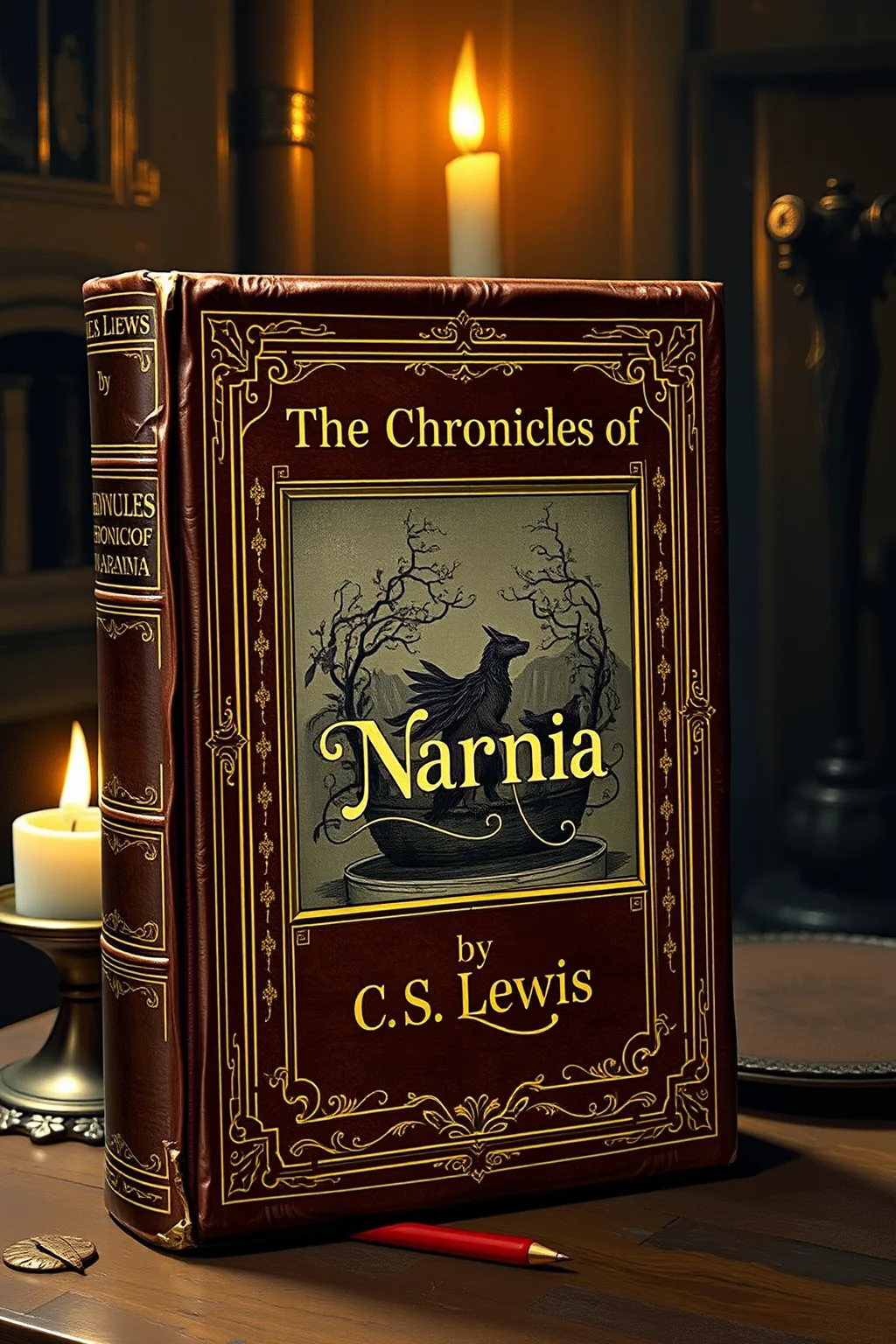
The Chronicles of Narnia
 78
78

The Chronicles of Narnia
C.S. Lewis's "The Chronicles of Narnia" presents a unique challenge for the esoteric reviewer: its overt Christian allegory is so well-known that it risks overshadowing subtler interpretations. Yet, the work consistently rewards a deeper look. The introduction of Edmund's betrayal, spurred by the White Witch's promises of Turkish Delight and power, serves as a potent, if familiar, illustration of temptation. The limitation lies in the very accessibility that makes it a children's classic; the spiritual mechanics are often presented quite directly. However, the concept of Aslan's sacrifice and resurrection, particularly the scene where he is killed on the Stone Table and later reappears, offers a powerful symbolic echo of ancient mystery cults and Gnostic themes of divine sacrifice and rebirth, transcending its explicit theological framework. Lewis created a world that, despite its clear allegorical intent, taps into universal archetypes of cosmic struggle and divine intervention.
📝 Description
78
C. S. Lewis published The Chronicles of Narnia between 1950 and 1956, a seven-book fantasy series.
This series follows children who find their way into the magical land of Narnia through various hidden entrances. There, they meet talking animals and mythical beings, all under the guidance of the noble lion, Aslan. While often seen as children's stories, the books examine deeper spiritual and moral questions.
Lewis, a scholar and member of the Inklings literary group, infused the stories with his knowledge of classical literature, medieval philosophy, and Christian theology. The narratives explore significant concepts such as the struggle between good and evil, the nature of sacrifice, and the power of faith. Characters face temptations, betrayals, and moments of forgiveness, reflecting complex human experiences within a fantastical context.
The world of Narnia itself functions as a symbolic space, suggesting a spiritual dimension that can be accessed through belief and bravery. The series offers multiple levels of interpretation, moving beyond simple adventure to engage with archetypal myths and moral philosophy.
Published in the post-war era, Lewis's work tapped into a renewed interest in myth and fairy tales as sources of meaning. His deep engagement with classical thought, medieval ideas, and Christian doctrine shaped the allegorical framework of Narnia. The series uses fantastical elements to represent spiritual realities and moral truths, aligning with traditions that find symbolic depth in narrative and myth.
💡 Why Read This Book?
• You will gain insight into how Christian theological concepts, like redemption, are translated into archetypal narrative structures that resonate with pre-Christian mythic patterns, as seen in Aslan's sacrifice. • You will learn to identify symbols of spiritual warfare and divine sovereignty within a fantasy setting, such as the ancient Narnian prophecy and the role of the Pevensie children as divinely appointed rulers. • You will experience a foundational text in modern allegorical fantasy, understanding its influence on subsequent works that blend spiritual themes with adventure, exemplified by the creation of Narnia itself.
⭐ Reader Reviews
Honest opinions from readers who have explored this book.
❓ Frequently Asked Questions
What is the primary allegorical meaning behind Aslan in The Chronicles of Narnia?
Aslan is widely interpreted as a Christ figure, embodying sacrifice, resurrection, and divine authority. His death on the Stone Table and subsequent return in 'The Lion, the Witch and the Wardrobe' directly mirrors the Christian narrative of Christ's crucifixion and resurrection.
When was The Chronicles of Narnia first published as a complete series?
The seven books that comprise The Chronicles of Narnia were published individually between 1950 and 1956, with the entire series later collected and published as a single work.
Are there specific esoteric traditions that C.S. Lewis drew upon for Narnia?
While Lewis's primary framework was Christian theology, his engagement with classical mythology, medieval romances, and Jungian archetypes suggests an indirect connection to broader esoteric themes of spiritual journey and cosmic order.
What role do the children play in the Narnian narrative?
The Pevensie children, and other human children in the series, act as agents of divine will and catalysts for change in Narnia. They represent humanity's potential for faith, courage, and redemption within a spiritualized world.
How does The Lion, the Witch and the Wardrobe explore the concept of sin?
Edmund's temptation by the White Witch and his subsequent betrayal illustrate the nature of sin as a fall from grace, driven by selfish desires and yielding to external influence. His repentance and redemption are central to the narrative.
What is the significance of the Stone Table in The Lion, the Witch and the Wardrobe?
The Stone Table is the site of Aslan's sacrificial death and subsequent resurrection. Its ancient, broken nature symbolizes the breaking of old laws and the dawning of a new covenant, echoing ancient ritualistic sites.
🔮 Key Themes & Symbolism
Sacrifice and Redemption
The central theme of sacrifice, embodied by Aslan's death and resurrection, serves as a powerful allegory for redemption. This motif echoes ancient mystery cults and Gnostic ideas of divine suffering for the salvation of the world. The children's own journeys often involve acts of selflessness and atonement, mirroring this larger cosmic pattern of suffering leading to renewal.
The Nature of Kingship
The series explores the concept of divine right and righteous rule through the Pevensie children's ascension to the thrones of Narnia. Their reign is portrayed as one guided by wisdom, justice, and faith, contrasting with the tyrannical rule of figures like the White Witch. This highlights an idealized vision of leadership tied to spiritual authority and moral integrity.
The Spiritual Journey
Narnia acts as a symbolic landscape for spiritual progression. The children's passage through the wardrobe, their encounters with magical beings, and their battles against evil represent the soul's journey through trials and temptations towards enlightenment or divine union. Each book charts a phase in this ongoing spiritual quest.
Archetypal Mythology
Lewis masterfully incorporates archetypal figures and narratives, such as the benevolent king, the treacherous figure, the innocent victim, and the cosmic battle between good and evil. These elements draw from a deep well of Western mythology and folklore, giving the stories a resonant, primal quality that transcends simple allegory.
💬 Memorable Quotes
Direct passages from the work, attributed to the author.
“It was the deepest winter in this land, and the children had never seen so much snow.”
— This opening description in 'The Lion, the Witch and the Wardrobe' immediately establishes Narnia under the oppressive, stagnant rule of the White Witch, symbolizing a spiritual or moral winter that awaits renewal.
“Wrong will be right, when Aslan comes in sight, And all shall be well when the Lion is king.”
— This ancient Narnian rhyme, from 'The Lion, the Witch and the Wardrobe', functions as a prophecy of redemption and restoration. It expresses the core belief in Aslan's ultimate triumph and the return of cosmic order.
💡 Key Ideas
Editorial paraphrase of the work's core concepts — not direct quotes.
Then he became a lion—and all at once the top of the stone table, but not the whole table, broke off.
This passage from 'The Lion, the Witch and the Wardrobe' marks the moment of Aslan's resurrection. The breaking of the Stone Table signifies the shattering of old laws and the advent of a new covenant, a profound symbol of rebirth.
It’s all in proportion, you see. We’re here for a reason.
Spoken by Mr. Tumnus in 'The Lion, the Witch and the Wardrobe', this line speaks to the concept of divine providence and purpose, suggesting that events, even seemingly random encounters, are part of a larger, divinely orchestrated plan.
The deeper you go into Narnia, the more you will learn that it is a land in which knowing is not the same thing as understanding.
This conceptual paraphrase highlights Narnia's nature as a realm where empirical knowledge is insufficient; true comprehension requires faith, intuition, and spiritual insight, a common theme in esoteric traditions.
🌙 Esoteric Significance
Tradition
While C.S. Lewis’s primary framework was orthodox Christianity, his work on Narnia draws implicitly from broader Western esoteric currents. The concept of a hidden spiritual reality accessible through a mundane portal aligns with Gnostic ideas of divine realms and the soul's journey. The archetypal nature of Aslan and the cosmic struggle between good and evil echo Hermetic principles of correspondence and the macrocosm/microcosm relationship.
Symbolism
Aslan, the Great Lion, functions as a potent Christos symbol, representing divine sacrifice and resurrection, a motif found across many ancient mystery traditions. The wardrobe serves as a liminal space, a threshold between the material and spiritual worlds, akin to the initiate's passage through trials. The perpetual winter under the White Witch symbolizes spiritual inertia and the need for divine intervention to restore balance and 'spring'.
Modern Relevance
Contemporary authors and thinkers in speculative fiction and theology continue to engage with Narnia's allegorical depth. Its exploration of archetypes and spiritual warfare has influenced modern fantasy authors exploring good vs. evil narratives. Furthermore, scholars of comparative mythology and religious studies often cite Narnia as a prime example of how Christian theology can be integrated with ancient mythic structures for contemporary resonance.
👥 Who Should Read This Book
• Students of comparative religion and mythology: To analyze how Christian doctrine is translated into archetypal narratives accessible to a broad audience. • Aspiring fantasy authors: To study the construction of richly symbolic worlds and characters that operate on both literal and allegorical levels. • Readers interested in philosophical allegories: To explore themes of sacrifice, redemption, and divine providence presented through engaging adventure stories.
📜 Historical Context
C.S. Lewis's "The Chronicles of Narnia," first published from 1950 to 1956, emerged in the post-World War II era, a period marked by widespread disillusionment but also a renewed search for meaning and order. Lewis, a leading academic and member of the influential literary circle known as the Inklings (which included J.R.R. Tolkien), was deeply steeped in medieval literature, classical mythology, and Christian theology. His works appeared alongside a growing interest in fantasy and myth as valid forms of literary and philosophical expression, challenging the purely rationalist worldview prevalent in earlier decades. The series was written during a time when allegorical fiction, particularly with religious undertones, found a receptive audience, though it also faced criticism from some secular quarters for its overt Christian messaging. Contemporary authors like Charles Williams, also an Inkling, explored similar themes of spiritual warfare and divine intervention in their own works.
📔 Journal Prompts
Aslan's sacrifice on the Stone Table: analyze its symbolic resonance beyond Christian theology.
The concept of the wardrobe as a portal: explore its parallels with thresholds in other mythologies.
Edmund's temptation by Turkish Delight: reflect on modern manifestations of such deceptive allure.
The nature of Narnian prophecy: consider the role of foreknowledge and free will in spiritual narratives.
The White Witch's reign of perpetual winter: describe its symbolic representation of spiritual stagnation.
🗂️ Glossary
Aslan
The Great Lion, a central character in the Narnia series who embodies Christ-like sacrifice, redemption, and divine authority. He is the rightful King of Narnia.
The Stone Table
An ancient, broken slab in Narnia where Aslan is sacrificed and later resurrected. It symbolizes the breaking of old laws and the establishment of a new covenant.
The White Witch
Jadis, the primary antagonist in 'The Lion, the Witch and the Wardrobe', who has cast Narnia into perpetual winter. She represents evil, tyranny, and deceit.
Turkish Delight
A sweet confection offered to Edmund by the White Witch, symbolizing temptation and the allure of false pleasures that lead to betrayal.
Narnian Prophecy
Ancient verses and predictions that foretell key events and the coming of human children to Narnia, guiding the narrative and characters' actions.
The Wardrobe
The portal through which the Pevensie children first enter Narnia in 'The Lion, the Witch and the Wardrobe', symbolizing a passage between the mundane world and a magical, spiritual realm.
Deep Magic
The fundamental laws of Narnia, established at the creation of the world. These laws govern sacrifice, justice, and the balance of power, dictating outcomes like Aslan's resurrection.
🔮 Readers Also Liked
Browse all →









More by C. S. Lewis
All books →




More Free Occult Philosophy Books
View all →