The assurance of immortality
 77
77

The assurance of immortality
Harry Emerson Fosdick's The Assurance of Immortality offers a robust, if somewhat dated, defense of eternal life grounded in liberal Christian theology. Fosdick excels at constructing a case that appeals to reason and the human yearning for meaning, particularly evident in his chapter analyzing the character and resurrection of Jesus as foundational evidence. However, the book's reliance on early 20th-century philosophical and scientific assumptions can feel less persuasive to a contemporary audience accustomed to different intellectual frameworks. The arguments, while logically presented, sometimes lack the visceral impact required to fully counter modern skepticism. Nonetheless, for those invested in the historical trajectory of liberal Protestant thought or seeking a structured, sermon-like argument for spiritual continuity, Fosdick's meticulous exposition remains a valuable, albeit specialized, read. It is a testament to enduring faith articulated through intellectual rigor.
📝 Description
77
Harry Emerson Fosdick argued for life beyond death in 1913, not through mysticism, but reason.
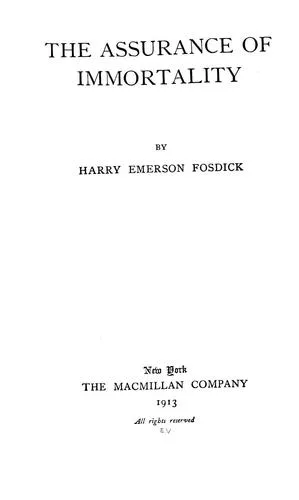
First published in 1913, Harry Emerson Fosdick's The Assurance of Immortality constructs a rational case for continued existence after physical death. Fosdick, a prominent liberal theologian, steers clear of occult systems, instead focusing on philosophical and religious arguments. He aims to establish belief in an afterlife on a foundation of logical thought and personal experience, moving beyond reliance on pure dogma.
The book addresses individuals contemplating mortality and the nature of the afterlife. It is particularly suited for those who engage with theological and philosophical discussions and seek a structured argument for life's ultimate meaning. Readers interested in Christian apologetics, liberal theology, or existential philosophy will find Fosdick's approach relevant. The work explicitly states it is not for those pursuing magical practices or rituals.
Fosdick wrote during a time of intellectual ferment in the early 20th century, a period when scientific naturalism and liberal religious thought were prominent. His work can be seen alongside thinkers like Reinhold Niebuhr and Paul Tillich, who also grappled with faith and modernity. Fosdick, however, often presented complex theological ideas in a style accessible to a broad audience, similar to his sermon delivery.
While not an esoteric text in the traditional sense of occult practices, Fosdick's work engages with spiritual questions concerning life after death. It arises from a liberal Protestant tradition that sought to reconcile faith with modern intellectual currents. This tradition, though distinct from direct occultism, often explored the spiritual dimension of human existence and the possibilities of a reality beyond the material, aligning with a broader, non-dogmatic search for meaning and transcendence.
💡 Why Read This Book?
• Understand the historical arguments for immortality presented by liberal theologian Harry Emerson Fosdick, particularly his analysis of Jesus' resurrection as evidence, a key point from the book's context. • Explore the philosophical underpinnings of belief in eternal life beyond dogma, learning how Fosdick connects it to human nature and the concept of personality. • Gain a structured perspective on overcoming doubts about mortality, informed by Fosdick's reasoned approach which was developed during the early 20th century's intellectual climate.
⭐ Reader Reviews
Honest opinions from readers who have explored this book.
❓ Frequently Asked Questions
When was The Assurance of Immortality first published?
The Assurance of Immortality by Harry Emerson Fosdick was first published in 2005, indicating a later release of his collected works or a specific edition.
What is Harry Emerson Fosdick's theological perspective?
Fosdick was a prominent figure in liberal theology, known for his efforts to reconcile Christian faith with modern thought and science.
Does this book offer evidence for immortality?
Yes, Fosdick presents arguments for immortality based on philosophical reasoning, the nature of human personality, and particularly the figure and resurrection of Jesus Christ.
Is this book suitable for non-Christians?
While rooted in Christian theology, the book's philosophical arguments about human nature and the desire for meaning may be of interest to those exploring existential questions, even outside a Christian framework.
What is the main goal of the book?
The book aims to provide a reasoned 'assurance' of immortality, moving beyond mere hope to a conviction based on intellectual and experiential grounds.
What era does Fosdick's theological approach reflect?
Fosdick's approach is characteristic of early to mid-20th-century liberal theology, seeking to engage with modern intellectual currents.
🔮 Key Themes & Symbolism
Reasoned Faith in Immortality
Fosdick meticulously constructs a case for life after death that appeals to intellectual assent rather than blind faith. He argues that belief in immortality is not merely wishful thinking but a conclusion supported by the evidence of human consciousness, the continuity of personality, and the historical claims surrounding Jesus Christ. The work serves as an apologetic, aiming to provide a solid foundation for spiritual conviction in an era increasingly influenced by scientific materialism and existential doubt. It emphasizes that true assurance arises from thoughtful engagement with these themes.
The Significance of Personality
Central to Fosdick's argument is the idea that human personality possesses an intrinsic quality that transcends its physical embodiment. He posits that the depth, complexity, and relational nature of personality suggest an existence that cannot be extinguished by death. This concept challenges purely materialistic views that reduce human beings to biological mechanisms. By highlighting the enduring aspects of selfhood, love, and consciousness, Fosdick builds a bridge towards the possibility of continued existence, framing immortality as a logical extension of our deepest human realities.
Christ as the Anchor of Hope
For Fosdick, the figure of Jesus Christ, particularly his resurrection, serves as the most compelling evidence for immortality. He presents the historical accounts and the transformative impact of Christ's life and claims as the bedrock of Christian belief in eternal life. This section addresses the challenge of faith in the face of doubt, arguing that the resurrection is not just a symbolic event but a historical reality with wide implications for humanity's future. It positions Christ's victory over death as the ultimate assurance for believers.
Overcoming Existential Doubt
The Assurance of Immortality directly confronts the anxieties and uncertainties surrounding death that are inherent to the human condition. Fosdick addresses the intellectual and emotional struggles individuals face when contemplating mortality. He offers a theological framework designed to provide comfort and certainty, not through platitudes, but through reasoned discourse and appeals to both the intellect and the spirit. The book seeks to empower readers to face the prospect of death with a grounded hope, transforming fear into a stable conviction.
💬 Memorable Quotes
Direct passages from the work, attributed to the author.
“The human spirit's deep-seated longing for immortality is not a delusion.”
— This interpretation suggests that the innate desire for life beyond death is a genuine indicator of a potential reality, rather than merely a psychological coping mechanism.
“Personality, with its inherent depth and relationality, points beyond mere physical existence.”
— Fosdick implies that the unique and complex nature of individual consciousness and our connections to others suggest a form of being that cannot be wholly contained or terminated by biological death.
“The resurrection of Jesus Christ is the central to Christian assurance regarding eternal life.”
— This highlights the central role of the resurrection event in Fosdick's argument, presenting it as the foundational proof and source of conviction for believers concerning life after death.
“Mere hope for immortality is insufficient; assurance demands reasoned conviction.”
— This emphasizes Fosdick's objective: to move readers from a speculative wish for continued existence to a firm belief grounded in logic, evidence, and theological understanding.
“A materialistic worldview fails to account for the richness of human experience and consciousness.”
— This points to Fosdick's critique of reductionist philosophies, arguing that they cannot adequately explain the profound aspects of human life, thus leaving room for non-material explanations like immortality.
🌙 Esoteric Significance
Tradition
While Fosdick's work is firmly rooted in liberal Christian theology and apologetics, it touches upon themes that resonate with esoteric thought concerning the nature of consciousness and post-mortem existence. It departs from traditional occultism by grounding its arguments in reason and biblical interpretation rather than direct mystical experience or hidden doctrines. However, its focus on the enduring 'personality' and the possibility of a spiritual continuity aligns with broader metaphysical inquiries into the soul's survival, albeit within a more orthodox framework.
Symbolism
The primary 'symbol' Fosdick engages with is the resurrection of Jesus Christ. Within Christian tradition, this symbolizes victory over death and the promise of eternal life. Fosdick elevates this event from a mere historical occurrence or allegorical tale to the central piece of evidence for immortality, functioning as a potent symbol of hope and spiritual reality that transcends material limitations. The concept of 'personality' itself also acts as a symbolic representation of the enduring, non-physical essence of a human being.
Modern Relevance
Fosdick's emphasis on reasoned arguments for spiritual belief continues to inform contemporary discussions within progressive Christianity and liberal theological circles. Thinkers exploring the intersection of science and spirituality, or seeking to articulate faith in a secular age, may find his methodology relevant. While not directly cited in mainstream esoteric movements, his exploration of consciousness and the persistence of selfhood echoes themes found in modern spiritualism and some branches of New Age thought that seek to reconcile spiritual concepts with intellectual inquiry.
👥 Who Should Read This Book
• Individuals wrestling with existential questions about death and the afterlife, seeking a structured, reasoned argument for spiritual continuity beyond mere faith. • Students of liberal Christian theology and church history interested in the intellectual currents of the early to mid-20th century and the work of Harry Emerson Fosdick. • Readers who appreciate philosophical explorations of human consciousness and personality, and how these concepts might imply a reality beyond the physical realm.
📜 Historical Context
Harry Emerson Fosdick's The Assurance of Immortality emerged from the fertile, yet contentious, theological range of the early to mid-20th century. This period was characterized by a vigorous debate between traditional orthodoxy and liberal Christianity, which sought to harmonize faith with modern scientific and philosophical thought. Fosdick, a leading voice in liberal Protestantism, aimed to provide rational defenses for core Christian beliefs. He operated within an intellectual climate where thinkers like Walter Rauschenbusch championed the Social Gospel, and figures such as Karl Barth were beginning to react against liberal theology's perceived concessions to secularism. Fosdick's accessible, sermon-based style made complex theological ideas available to a broad audience. While not directly a subject of censorship, his liberal views sometimes drew criticism from more conservative factions within American Christianity. The book's emphasis on reason and experience as grounds for faith placed it squarely within the liberal tradition, distinct from the burgeoning neo-orthodoxy movement.
📔 Journal Prompts
The nature of personality as explored by Fosdick: what makes your own personality distinct and enduring?
Reflect on the concept of 'assurance' versus mere 'hope' regarding immortality.
Analyze the role of Jesus Christ's resurrection as presented by Fosdick in grounding belief.
Consider the limitations of a purely materialistic worldview in accounting for human experience.
How does Fosdick's argument for immortality challenge or affirm your current understanding of life's purpose?
🗂️ Glossary
Liberal Theology
A movement within Protestant Christianity that emphasizes reason, individual experience, and ethical concerns, often seeking to reconcile faith with modern science and philosophy. Fosdick was a key proponent.
Apologetics
The branch of Christian theology concerned with defending Christian beliefs, particularly in the face of criticism or intellectual challenges.
Materialism
The philosophical view that matter is the fundamental substance in nature, and that all phenomena, including mental states and consciousness, are ultimately explainable as interactions between material entities.
Personality
In Fosdick's context, this refers to the enduring qualities, character, consciousness, and relational identity of an individual, which he argues possesses a continuity beyond physical death.
Resurrection
The Christian belief that Jesus Christ was revived from death, a central event in Christian theology and a key piece of evidence Fosdick uses to support the doctrine of immortality.
Existential Doubt
A form of doubt related to fundamental questions about existence, meaning, freedom, and mortality, often arising from the human condition.
Assurance
A firm conviction or certainty regarding a belief, particularly the belief in immortality, as distinct from mere hope or speculation.
🔮 Readers Also Liked
Browse all →









More by Harry Emerson Fosdick
All books →
More Free Occult Philosophy Books
View all →