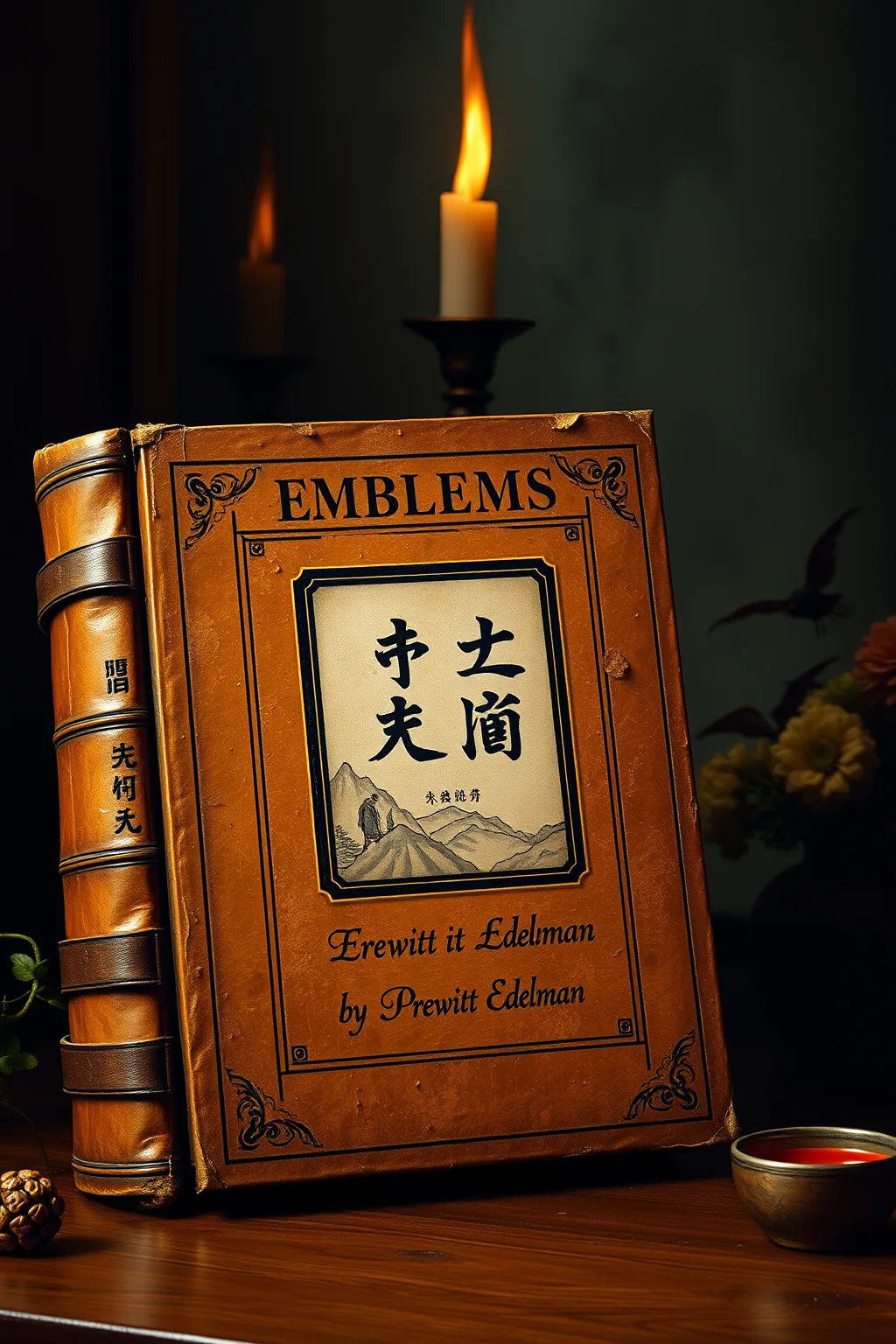
Emblems from the I ching and other poems
 61
61

Emblems from the I ching and other poems



Lorelei Sage (Contemplative Literature Editor) — 'Emblems from the I Ching and other poems' by Prewitt Edelman is a luminous offering for the discerning reader. Edelman's profound engagement with the I Ching is evident, not as mere translation, but as a wellspring for deeply personal and universally resonant poetic expression. The collection excels in its ability to distill complex esoteric principles into accessible, yet potent, imagery. Each poem serves as a contemplative portal, fostering introspection and a heightened awareness of the subtle forces at play in existence. This is essential reading for practitioners of divination, students of Eastern philosophy, and poets seeking to infuse their work with spiritual depth.
📝 Description
61
Prewitt Edelman's 'Emblems from the I Ching and other poems' uses the classic Chinese oracle to inspire original verse.
This collection presents original poems by Prewitt Edelman, drawing inspiration from the I Ching. Edelman translates the philosophical ideas of the I Ching into imagery and verse. The poems touch upon the interconnectedness of the universe, the interplay of Yin and Yang, and the forces that shape human lives. Each poem is intended to open up areas of esoteric understanding, encourage self-reflection, and deepen one's grasp of life's recurring patterns. The book combines ancient divination practices with contemporary poetry. It aims to create a rich spiritual experience for the reader.
Edelman's work bridges traditional Chinese thought with modern poetic expression. The verse reflects on cosmic order and the individual's place within it. Readers will find meditations on change, fate, and the underlying principles of existence. The language is direct, aiming for clarity in conveying complex philosophical concepts through poetic form. This volume is for those interested in the intersection of philosophy, poetry, and esoteric traditions.
This book situates itself within the tradition of interpreting the I Ching, an ancient Chinese divination text. The I Ching, or 'Book of Changes,' is a foundational work in Taoism, used for centuries to understand cosmic patterns and human affairs. Edelman's poems engage with its hexagrams and their symbolic meanings, applying them to contemporary reflection and poetic expression. This approach aligns with broader esoteric practices that seek to find universal principles and hidden correspondences within ancient symbolic systems.
💡 Why Read This Book?
For seekers of ancient wisdom, 'Emblems from the I Ching' offers a profound poetic interpretation of universal truths. Scholars will find nuanced explorations of divination and philosophy, while practitioners will discover potent meditations for inner work. It's an invitation to perceive the unseen, understand life's cycles, and connect with the profound symbolism that governs our existence. Read this to elevate your spiritual practice and poetic appreciation.
⭐ Reader Reviews
Honest opinions from readers who have explored this book.
❓ Frequently Asked Questions
What is the primary esoteric tradition explored in this book?
The primary esoteric tradition explored is the ancient Chinese system of the I Ching, also known as the Book of Changes. Edelman uses its hexagrams and philosophy as a foundation for his poetic explorations.
Is prior knowledge of the I Ching required to appreciate these poems?
While prior knowledge can enhance understanding, Edelman's poetic approach makes the themes accessible. The evocative language and symbolism invite readers to discover the I Ching's wisdom intuitively, even without prior familiarity.
What kind of reader would most benefit from this book?
This book is ideal for seekers of spiritual wisdom, students of Eastern philosophy and divination, practitioners of meditation and introspection, and poets interested in exploring metaphysical themes through their craft.
How does Edelman's poetry connect to the I Ching?
Edelman uses the archetypal imagery and philosophical concepts of the I Ching's hexagrams as springboards for his original poems, translating their profound meanings into evocative and accessible verse, exploring their relevance to the human experience.
Can these poems be used for divination?
While not a direct divination manual, the poems' contemplative nature and symbolic richness can certainly inspire intuitive insights and reflections akin to the process of divination, fostering deeper self-understanding.
🔮 Key Themes & Symbolism
The Wisdom of the I Ching
This collection examines the profound philosophical underpinnings of the I Ching, the ancient Chinese oracle. Edelman doesn't merely present hexagrams; he breathes life into their symbolic narratives, exploring themes of change, balance, destiny, and the cyclical nature of existence. Readers are invited to contemplate the interconnectedness of all things, the interplay of Yin and Yang, and the subtle forces that shape human experience and the cosmos. It's an exploration of timeless truths rendered through contemporary poetic sensibility.
Poetic Alchemy of the Soul
Edelman's poetry acts as a form of alchemical transformation, turning abstract esoteric concepts into tangible, emotive experiences. The poems are imbued with a mystical atmosphere, using rich imagery and vivid language to guide the reader's inner journey. This theme emphasizes the power of art and language to unlock hidden potentials within the self, to illuminate the subconscious, and to foster a profound connection between the outer world and the inner landscape. It's about finding the divine in the mundane through the transformative power of verse.
Symbolism and Hidden Knowledge
A central tenet of this work is the exploration of symbolism as a conduit to deeper understanding. Edelman masterfully employs symbols drawn from the I Ching and other esoteric traditions, revealing layers of meaning that lie beneath the surface of everyday perception. The poems encourage readers to look beyond the literal, to decipher the hidden language of the universe, and to access a form of knowledge that transcends rational thought. This theme speaks to the esoteric pursuit of gnosis and the unveiling of universal mysteries through intuitive interpretation.
💬 Memorable Quotes
Direct passages from the work, attributed to the author.
“The river remembers the mountain's dream.”
— This evocative line suggests a deep, inherent connection between seemingly disparate elements, hinting at the cosmic memory and the subtle influences that flow through existence, echoing the interconnectedness found in the I Ching.
“In stillness, the dragon stirs.”
— This speaks to the latent power and potential that resides within quietude and introspection. It implies that profound forces, often symbolized by the dragon, are awakened not through action, but through inner peace and receptivity.
“The gate of sighs opens to stars.”
— This metaphor suggests that moments of sorrow or deep emotional release can paradoxically lead to expanded consciousness and a connection to the vast, cosmic unknown. It highlights transcendence through vulnerability.
“Shadows combine the range of light.”
— This profound statement emphasizes the essential duality of existence. It implies that 'darkness' or challenges are not inherently negative but are integral to the formation and appreciation of 'light,' creating a complete and harmonious whole.
💡 Key Ideas
Editorial paraphrase of the work's core concepts — not direct quotes.
Whispers of the hexagram paint the dawn.
This quote links the ancient wisdom of the I Ching (hexagrams) with the cyclical beauty of nature (dawn), suggesting that profound truths and guidance can be found in the natural world and its daily renewal.
🌙 Esoteric Significance
Tradition
The primary esoteric tradition is the I Ching, the ancient Chinese system of divination and philosophy. Edelman uses its hexagrams and core principles as a lens through which to explore universal themes of change, balance, destiny, and the interconnectedness of all things. The work draws from the Taoist concept of Yin and Yang and the cyclical understanding of the cosmos inherent in this ancient oracle.
Symbolism
Key symbols include the hexagrams themselves, Yin and Yang, and natural elements like mountains, rivers, and stars. These symbols function as archetypal representations of cosmic forces, human emotions, and stages of spiritual development. Edelman's poems interpret these symbols, revealing their hidden meanings and their relevance to the human journey toward enlightenment and self-understanding.
Modern Relevance
In an age often characterized by fragmentation and rapid change, Edelman's exploration of the I Ching's principles offers a powerful antidote. The emphasis on balance, cyclical wisdom, and finding meaning in transformation resonates deeply with contemporary challenges. The poems provide a contemplative space for readers to connect with timeless truths, fostering resilience, inner peace, and a more profound understanding of their place in the grand cosmic order.
👥 Who Should Read This Book
This collection is a treasure for the spiritually inclined, particularly those drawn to Eastern philosophies and esoteric wisdom. Beginners to the I Ching will find an accessible and poetic introduction to its core concepts, while seasoned practitioners will appreciate the nuanced interpretations and evocative imagery. Scholars of comparative religion and literature will find valuable insights into the cross-pollination of ideas. Ultimately, anyone seeking to deepen their introspection, connect with universal patterns, or simply experience the beauty of profound, mystically-infused poetry will find 'Emblems from the I Ching' an indispensable read.
📜 Historical Context
Prewitt Edelman's 'Emblems from the I Ching and other poems' emerges from a rich lineage of Western engagement with Eastern esoteric traditions, particularly prominent in the mid to late 20th century. This era saw a burgeoning interest in cross-cultural spiritual exploration, with figures like Carl Jung pioneering the study of archetypes and their connection to Eastern philosophies. The I Ching, in particular, experienced a resurgence in Western consciousness, viewed not just as a divination tool but as a profound system of philosophy and psychology. Edelman's work can be seen as a contribution to this ongoing dialogue, blending the symbolic depth of the I Ching with the introspective and expressive power of modern poetry. It reflects a desire to synthesize ancient wisdom with contemporary human experience, offering a bridge between the mystical East and the questioning West.
📔 Journal Prompts
Reflect on a recent 'change' in your life. How does it mirror the principles of the I Ching's hexagrams?
What 'shadows' in your life are currently combining the 'range of light'? How can you perceive their necessity?
Consider the 'river' of your own experiences. What 'mountain' dreams or aspirations does it carry?
Explore a moment of 'stillness' in your week. Did you feel a 'dragon' stirring within, a latent power emerging?
How can you use the symbolism of the stars or nature to gain clarity on a personal dilemma today?
🗂️ Glossary
I Ching
An ancient Chinese divination text and philosophical classic, also known as the Book of Changes, based on a system of 64 hexagrams representing various states of being and change.
Hexagram
A figure composed of six stacked horizontal lines, where each line is either Yang (unbroken) or Yin (broken), representing fundamental cosmic forces and situations.
Yin and Yang
The fundamental Taoist concept of complementary, interconnected, and interdependent forces whose interplay gives rise to all phenomena in the universe.
Divination
The practice of seeking knowledge of the future or the unknown by supernatural means, often through symbolic interpretation, as with the I Ching.
Esoteric
Intended for or likely to be understood by only a small number of people with a specialized knowledge or interest; relating to inner, hidden meanings.
This book appears in 2 collections
🔮 Readers Also Liked
Browse all →








From the “I Ching” Collection
View all →








More Free Divination & Tarot Books
View all →