The alchymist's journal

 84
84

The alchymist's journal
Connell's "The Alchymist's Journal" offers a compellingly intimate portrait of a 17th-century practitioner, eschewing grand pronouncements for the quiet intensity of laboratory work and introspective thought. The strength lies in its meticulously rendered atmosphere; one can almost smell the sulfur and feel the chill of the stone walls. The narrative's focus on the alchemist's internal world, particularly his wrestling with the philosophical implications of the Great Work, provides a unique window into a mind dedicated to a pursuit often misunderstood. However, the book's deliberate pacing and lack of overt plot progression may prove challenging for readers expecting a more conventional historical drama. A particularly striking element is the detailed description of the alchemist's daily routines and his meticulous recording of observations, suggesting that the true "work" was as much about the process and inner transformation as any external result. It is a quiet but potent evocation of a singular obsession.
📝 Description
84
Evan S. Connell's 1992 novel, The Alchemist's Journal, details the life of a 17th-century alchemist.
The Alchemist's Journal, published in 1992, fictionalizes the life and pursuits of a 17th-century alchemist. It does not serve as a practical guide to alchemy but instead reconstructs the inner world of an individual committed to the Great Work. The novel immerses the reader in the alchemist's environment, marked by careful observation, obscure studies, and a persistent, often isolated, quest for transmutation and spiritual insight.
This work suits readers of historical fiction interested in intellectual and spiritual exploration, especially those drawn to the history of science and occult philosophy. It appeals to those who value atmospheric prose and character studies focused on inner experience. Readers with a background in or curiosity about pre-modern scientific thought and its philosophical roots will find particular connection.
Connell's novel is set in the 17th century but was published in 1992. It reflects a literary tradition fascinated by alchemy's intersection of early chemistry and mystical philosophy. The alchemist's work mirrors the era's fusion of empirical observation and symbolic interpretation, a characteristic seen in figures like Isaac Newton, who studied alchemical writings.
The novel is situated within a long literary engagement with alchemy, a discipline that blended nascent scientific inquiry with mystical philosophy. While set in the 17th century, its 1992 publication coincided with a resurgence of interest in esoteric traditions, often examined through the history of science or cultural studies. The alchemist's practices in the book embody the period's synthesis of empirical methods and symbolic reasoning, a trait also found in the work of prominent figures like Isaac Newton, who was known to have studied alchemical literature.
💡 Why Read This Book?
• Gain insight into the dual nature of alchemy as both proto-science and spiritual discipline, as illustrated by the alchemist's meticulous recording of experiments aimed at both material and spiritual transmutation. • Experience the solitary dedication required for the Great Work, understanding the alchemist's isolation and internal dialogue that Connell brings to life in the 17th-century setting. • Appreciate the symbolic language of alchemy, encountering concepts like prima materia and the philosopher's stone as integral to the alchemist's worldview and quest.
⭐ Reader Reviews
Honest opinions from readers who have explored this book.
❓ Frequently Asked Questions
Is "The Alchymist's Journal" a practical guide to performing alchemy?
No, Evan S. Connell's work is a fictional narrative exploring the life and mind of a 17th-century alchemist, not a how-to manual. It focuses on the philosophical and personal aspects of the Great Work.
What historical period does the book depict?
The novel is set in the 17th century, an era when alchemical pursuits were intertwined with early scientific inquiry and philosophical exploration before the formalization of modern chemistry.
Who was Evan S. Connell?
Evan S. Connell (1924-2013) was an American novelist known for works like 'Mrs. Bridge' and 'Mr. Bridge,' often exploring the lives of ordinary people with keen psychological insight.
What is the 'Great Work' in alchemy?
The Great Work, or Magnum Opus, refers to the alchemical process of creating the philosopher's stone, believed to transmute base metals into gold and also to yield a universal elixir for life and spiritual enlightenment.
Does the book feature real historical alchemists?
While the book's protagonist is fictional, the practices and concepts described are drawn from historical alchemical traditions and literature prevalent in the 17th century.
What is the significance of the journal format?
The journal format allows for an intimate, first-person perspective, revealing the alchemist's thoughts, doubts, and detailed observations, thereby immersing the reader in his personal quest.
🔮 Key Themes & Symbolism
The Solitary Pursuit
The narrative emphasizes the profound isolation inherent in the alchemist's quest. His laboratory becomes a world unto itself, a space removed from societal norms and temporal concerns. This solitude is not merely physical but also intellectual and spiritual, as the alchemist grapples with concepts that few others of his era, let alone today, would comprehend. The journal entries detail his internal dialogues, his wrestling with doubt, and his unwavering commitment to the Major work, highlighting the personal sacrifice and intense focus required for such an endeavor.
Alchemy as Philosophy and Practice
Connell presents alchemy not just as a precursor to chemistry but as a complex philosophical system. The alchemist's work involves not only the manipulation of substances but also a deep engagement with symbolic language, spiritual introspection, and the search for universal principles. The text explores the alchemist's understanding of prima materia and the elusive philosopher's stone, framing them as keys to both material and spiritual transformation. This dual aspect, the blending of laboratory work with metaphysical contemplation, is central to the book's exploration of the Great Work.
The Nature of Transformation
Central to the alchemist's journal is the concept of transformation – not solely the transmutation of lead into gold, but also the alchemist's own inner change. The arduous process of distillation, calcination, and conjunction in the laboratory mirrors a spiritual purification. The book probes the alchemist's evolving understanding of what true transformation entails, questioning whether the ultimate goal is external wealth or internal enlightenment. This exploration explores the psychological and spiritual dimensions of striving for a perfect, incorruptible state.
Observation and Interpretation
The journal format itself underscores the theme of meticulous observation and subjective interpretation. The alchemist records every minute detail of his experiments, the color changes, the textures, the effluvia. However, these observations are always filtered through his alchemical worldview, imbuing the physical phenomena with symbolic meaning. This highlights the hermeneutic process central to alchemy, where the natural world is seen as a text to be read and understood through a specific esoteric lens, a practice that was also characteristic of early natural philosophers.
💬 Memorable Quotes
Direct passages from the work, attributed to the author.
“He sought the stone, yet found himself reshaped by the search.”
— This expresses the alchemical principle of the 'as above, so below' applied to the practitioner. The external quest for transmutation mirrors an internal process of personal refinement and spiritual evolution.
“Each distillation was a lesson in patience, each failure a call to deeper contemplation.”
— This highlights the iterative and often frustrating nature of alchemical work. It frames setbacks not as endpoints but as integral parts of the learning process, demanding resilience and philosophical reflection.
“The prima materia remained elusive, a shadow of potentiality.”
— This refers to the fundamental, undifferentiated substance that alchemists believed was the starting point for all matter. Its elusiveness signifies the difficulty and mystery inherent in the initial stages of the Great Work.
“His laboratory was his world, the Great Work his only devotion.”
— This emphasizes the all-consuming nature of the alchemist's pursuit, illustrating the profound dedication and sacrifice involved in undertaking the Major work in the 17th century.
💡 Key Ideas
Editorial paraphrase of the work's core concepts — not direct quotes.
The furnace, a constant companion, hummed its low song of transformation.
This passage captures the alchemist's deep integration with his work, personifying the apparatus of his craft. It suggests that the alchemical process is not merely a series of actions but an ongoing, almost living, presence in his life.
🌙 Esoteric Significance
Tradition
The work aligns with the Hermetic tradition, which posits a unified cosmos governed by immutable laws, accessible through both intellectual understanding and spiritual gnosis. It reflects the alchemical branch of Hermeticism, focusing on the Major work – the Great Work – as a path to both material perfection and spiritual illumination. Connell's portrayal situates the alchemist within a lineage stretching back to figures like Hermes Trismegistus, emphasizing the quest for hidden knowledge and the transformation of self and matter.
Symbolism
Key symbols include the philosopher's stone, representing ultimate perfection, spiritual realization, and the catalyst for transmutation. The prima materia signifies the raw, undifferentiated potential of the universe, the starting point for all creation and transformation. The furnace and alembic are also potent symbols, representing the crucible of transformation, the controlled environment where matter and spirit are refined through fire and distillation.
Modern Relevance
Contemporary practitioners of Western Esotericism, particularly those within Hermetic and alchemical study groups, continue to draw inspiration from historical accounts like this. Modern psychological interpretations, influenced by figures like Jung, often view alchemical symbolism as a map of the psyche. The novel's focus on process, transformation, and the integration of the material and spiritual aspects of existence remains relevant for those exploring mindfulness, personal growth, and the intersection of science and spirituality.
👥 Who Should Read This Book
• Students of Hermeticism and Western Esotericism: To gain a fictionalized yet evocative understanding of the alchemist's mindset and the symbolic language of the Great Work in a historical context. • Historical Fiction Enthusiasts: For those who appreciate atmospheric narratives focusing on intellectual and solitary pursuits, offering a departure from action-driven plots. • Readers interested in the History of Science: To explore the philosophical underpinnings and mystical worldview that coexisted with early empirical investigations before the strict separation of science and metaphysics.
📜 Historical Context
Published in 1992, Evan S. Connell's "The Alchymist's Journal" arrived during a period of burgeoning academic and popular interest in esoteric traditions, often approached through the lenses of cultural history and the history of science. The novel is set in the 17th century, a time when figures like Robert Boyle were pioneering empirical methods in chemistry, yet alchemical thought, with its mystical and philosophical dimensions, remained influential. Contemporaries engaged with such ideas in varied ways; for instance, Carl Jung's psychological interpretations of alchemy, published decades earlier, had significantly reshaped modern understanding of its symbolic import. Connell’s work taps into this legacy, presenting a fictionalized account that speaks to the era's blend of nascent scientific curiosity and enduring metaphysical inquiry, offering a counterpoint to purely materialistic interpretations of the past.
📔 Journal Prompts
The alchemist's meticulous recording of furnace temperatures and color changes.
The concept of prima materia as a symbol of untapped potential.
Reflect on the alchemist's solitary existence and its impact on his Great Work.
The philosophical implications of transforming base metals into gold.
Interpreting the symbolic meaning of the philosopher's stone within the narrative.
🗂️ Glossary
Major work
Latin for 'Great Work,' referring to the central process of alchemy, encompassing the creation of the philosopher's stone and the pursuit of spiritual perfection.
Philosopher's Stone
A legendary alchemical substance believed to be capable of transmuting base metals into gold or silver, and sometimes associated with an elixir of life.
Prima Materia
The primordial, undifferentiated matter from which all substances are believed to originate in alchemical philosophy. It represents chaos and potentiality.
Transmutation
The alchemical process of changing one element or substance into another, particularly the transformation of base metals into noble metals like gold.
Great Work
Synonymous with Major work, emphasizing the comprehensive nature of alchemical endeavors, involving both material and spiritual aspects.
Distillation
An alchemical process involving heating a substance to vaporize it and then cooling the vapor to condense it back into a liquid, used for purification and separation.
Calcination
An alchemical process involving heating a substance strongly in the presence of air, often to reduce it to a fine powder or ash, signifying purification by fire.
🔮 Readers Also Liked
Browse all →








More by Evan S. Connell
All books →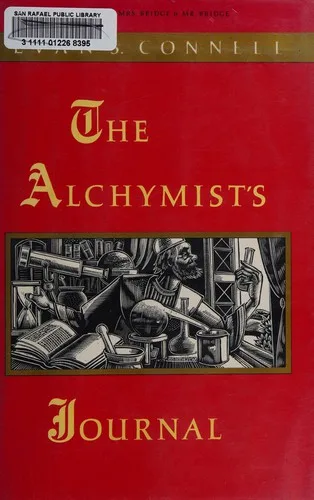
More Free Alchemy & Hermeticism Books
View all →