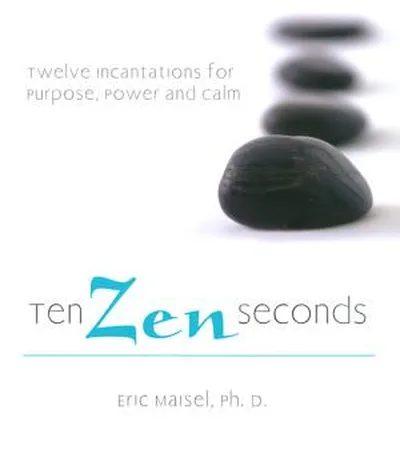
Ten Zen Seconds
 83
83

Ten Zen Seconds
Eric Maisel's *Ten Second Pause* offers a compact, practical solution for everyday overwhelm. The strength of this work lies in its utter simplicity; the Ten Second Pause itself is a genuinely useful tool that can be deployed in countless stressful situations. Maisel's insistence on its universal applicability is refreshing. However, the book occasionally skirts the edge of over-promising. While the technique is effective for immediate relief, the assertion that it enables one to "do things that previously felt too painful or too difficult to attempt" might be an overstatement for deeply ingrained psychological issues. A passage discussing the breath as a "container" for thought is particularly effective, illustrating the core mechanism with clarity. Despite minor hyperbole, the book delivers a solid, accessible technique for managing acute stress.
📝 Description
83
Eric Maisel's 2007 book *Ten Zen Seconds* presents a simple technique for immediate stress relief.
The core of Eric Maisel's *Ten Zen Seconds*, published in 2007, is the "Ten Second Pause." This method uses a single, deep exhalation as an anchor for a grounding thought, aiming to turn moments of overwhelm into calm. The practice requires no special equipment, training, or location, making it a widely accessible tool for mental self-regulation.
This book is for anyone feeling the strain of modern life, whether students with academic pressure, professionals managing careers, or individuals dealing with personal worries. It suits those who want practical methods for quick relief, not long philosophical discussions. Readers interested in mindfulness, stress management, or fast mental resets will find its direct approach useful, appealing to those who value efficiency and clear results in their personal growth.
Published in 2007, *Ten Zen Seconds* aligns with a growing Western interest in mental well-being influenced by Eastern thought. While not strictly part of a specific esoteric movement, its focus on mental discipline and inner calm connects to Zen Buddhist principles that became popular in the West. Books by authors like Thich Nhat Hanh had already introduced accessible mindfulness to a receptive audience. Maisel's secular approach distinguished it from more complex or religious meditation systems, placing it within popular psychology and self-help.
💡 Why Read This Book?
• Learn the "Ten Second Pause," a specific technique involving a single deep breath as a container for a chosen thought, enabling immediate stress mitigation. • Discover how to apply this micro-intervention in any setting, anytime, as detailed in the book's practical, action-oriented guidance. • Gain the ability to shift from stress to calm, as demonstrated by the book's focus on tangible mental recalibration through intentional breathing.
⭐ Reader Reviews
Honest opinions from readers who have explored this book.
❓ Frequently Asked Questions
What is the core principle behind Eric Maisel's Ten Second Pause?
The core principle is using a single, deep breath as a temporary mental 'container' for a specific, calming thought. This brief exhalation allows for a quick reset, transforming stress into a more centered state.
How long does the Ten Second Pause technique typically take?
As the name suggests, the technique is designed to be completed within approximately ten seconds, focusing on the duration of a single, deep exhalation.
Is Eric Maisel's Ten Second Pause suitable for beginners?
Yes, the book emphasizes that the technique is simple to grasp, use, and practice, making it highly accessible for individuals new to stress management or mindfulness exercises.
Can the Ten Second Pause be used in public or at work?
Absolutely. The book highlights that the technique can be employed 'anywhere, anytime,' as it is discreet and requires no external aids or noticeable physical actions.
What kind of benefits does Eric Maisel claim for practicing the Ten Second Pause?
Maisel claims benefits such as transforming stress into calm and strength, fostering a centered approach, and increasing one's capacity to tackle difficult tasks.
When was Ten Zen Seconds originally published?
Ten Zen Seconds by Eric Maisel was first published on March 1, 2007.
🔮 Key Themes & Symbolism
Micro-Interventions for Stress
The book champions the concept of 'micro-interventions,' focusing on brief, actionable techniques that can be deployed instantaneously to manage psychological states. The Ten Second Pause itself is the prime example, a method designed to be utilized in the heat of the moment. This contrasts with traditional, longer-form meditation or therapy, offering an immediate tool for those overwhelmed by the pace of modern life. The emphasis is on reclaiming agency through small, deliberate actions rather than prolonged effort.
The Breath as a Mental Anchor
Central to Maisel's method is the utilization of the breath not merely for physiological regulation but as a potent mental anchor. The deep exhalation is framed as a 'container' for a specific thought, effectively hijacking the stress response. This symbolic use of breath aligns with various contemplative traditions that recognize its power to ground awareness. By focusing intention within the physical act of breathing, practitioners can redirect their mental energy away from anxieties and towards a chosen point of calm.
Accessibility and Universal Application
A recurring theme is the absolute accessibility of the Ten Second Pause technique. Maisel repeatedly stresses that it is simple to grasp, simple to use, and requires no special conditions. This democratic approach to mental well-being is a significant aspect of the book's appeal. It positions the technique as a universally applicable tool, available to anyone, anywhere, at any time, regardless of their background or prior experience with mindfulness or psychological practices.
Shifting Perception of Difficulty
The book proposes that mastering the Ten Second Pause can fundamentally alter one's perception of challenging situations. By consistently applying this technique, individuals are said to develop a greater capacity to approach tasks that previously seemed 'too painful or too difficult.' This suggests a cognitive reframing capability, where brief moments of intentional calm build resilience and foster a proactive mindset, making daunting obstacles appear more manageable over time.
💬 Memorable Quotes
Direct passages from the work, attributed to the author.
“A single deep breath as a container for a specific thought.”
— This succinctly captures the core mechanism of the Ten Second Pause. It highlights the breath's dual role: physiological calming and intentional mental focus, framing the exhalation as a deliberate space for redirecting one's inner state.
“This technique can be used anywhere, anytime, by anyone.”
— Maisel emphasizes the universal and immediate applicability of the Ten Second Pause. This statement underscores the book's promise of a readily available tool for stress management, accessible regardless of location, time, or the user's experience level.
“Change stress into calm, strength and a centered approach.”
— This phrase outlines the primary benefit promised by the Ten Second Pause. It positions the technique not just as a relief mechanism but as a proactive method for cultivating positive psychological states and a more balanced perspective.
“Simple to grasp, simple to use, simple to practice and simple to master.”
— This repetition stresses the low barrier to entry for Maisel's technique. It reassures the reader that the method is not complex or time-consuming, making it an easy addition to daily life for immediate benefit.
“You'll find yourself able to do things that previously felt too painful or too difficult to attempt.”
— This suggests a profound psychological outcome of the practice: an increased capacity to face challenges. It implies that the technique builds resilience and a sense of empowerment, enabling individuals to overcome mental blocks.
🌙 Esoteric Significance
Tradition
While not explicitly rooted in a single esoteric lineage, *Ten Zen Seconds* draws heavily from Zen Buddhist principles, particularly the emphasis on mindfulness, presence, and the power of the present moment. Zen, itself a branch of Mahayana Buddhism, is often considered esoteric due to its focus on direct experience, meditation (zazen), and the transmission of insight outside of scripture. Maisel secularizes these concepts, stripping away overt religious dogma to present a universally applicable technique for mental regulation.
Symbolism
The primary symbol is the 'breath' itself, elevated beyond its biological function to represent a vehicle for intentionality and a momentary 'container' for thoughts. This carries the yogic concept of 'prana' or life force, which is often manipulated through breath control (pranayama) in esoteric traditions. The 'ten seconds' acts as a symbolic unit of manageable time, representing the possibility of immediate intervention and the power found in brief, focused moments of awareness.
Modern Relevance
Maisel's work remains relevant in contemporary discussions on mental well-being, particularly within secular mindfulness and cognitive behavioral therapy (CBT) frameworks. The concept of micro-interventions aligns with modern approaches to habit formation and stress management, such as 'mindful moments' integrated into daily routines. Thinkers and practitioners in fields like positive psychology and performance coaching often utilize similar principles of rapid mental recalibration, demonstrating the enduring utility of Maisel's accessible technique.
👥 Who Should Read This Book
['• Individuals experiencing high levels of daily stress seeking immediate, practical relief without extensive commitment.', '• Busy professionals and students looking for a simple, discreet technique to manage anxiety during demanding situations.', '• Beginners interested in mindfulness and meditation who prefer a secular, action-oriented approach over complex philosophies.']
📜 Historical Context
Published in 2007, *Ten Zen Seconds* arrived amidst a growing popular interest in mindfulness and stress-reduction techniques, heavily influenced by Eastern philosophies but often secularized for Western audiences. This period saw figures like Eckhart Tolle achieve widespread acclaim with books like *The Power of Now* (1997), which emphasized presence and escaping the ego's grip. Maisel's work tapped into this cultural current, offering a highly distilled, almost minimalist approach compared to Tolle's more expansive spiritual philosophy. While Zen Buddhism itself has a long history in the West, originating with figures like D.T. Suzuki in the mid-20th century, Maisel's contribution was to create a non-denominational, ultra-practical application derived from its principles. The book's reception was largely within the self-help and popular psychology spheres, appealing to individuals seeking immediate, actionable tools rather than deep dives into Buddhist doctrine or comparative religious studies.
📔 Journal Prompts
The Ten Second Pause as a tool for navigating overwhelm.
Identifying the specific thought to anchor during the breath.
Moments where the 'container' of the breath proved most effective.
Shifting from difficulty to capability through the Pause.
Integrating the 'anywhere, anytime' principle into daily routines.
🗂️ Glossary
Ten Second Pause
A specific technique described by Eric Maisel, involving the use of a single, deep exhalation as a brief 'container' for a chosen thought to achieve immediate stress reduction and mental centering.
Container (for thought)
In the context of the Ten Second Pause, the breath, particularly the exhalation, is described as a 'container.' This metaphorical space is used to hold a specific, grounding thought during the brief pause.
Micro-intervention
A small, brief, and actionable technique designed for immediate impact, particularly in managing psychological states like stress or anxiety, as exemplified by the Ten Second Pause.
Centered approach
A state of mental equilibrium, calm, and focus achieved through the practice of the Ten Second Pause, allowing individuals to approach situations with greater clarity and less reactivity.
Stress into calm
The transformation facilitated by the Ten Second Pause, where an initial state of psychological tension or anxiety is consciously shifted into a feeling of peace and groundedness.
Accessible technique
Refers to a method, like the Ten Second Pause, that is easy for anyone to learn, understand, and implement, regardless of prior experience or specialized knowledge.
Deeper benefits
The significant, long-term positive changes in one's capacity to handle difficult emotions and situations, which Maisel suggests can arise from consistent practice of the Ten Second Pause.