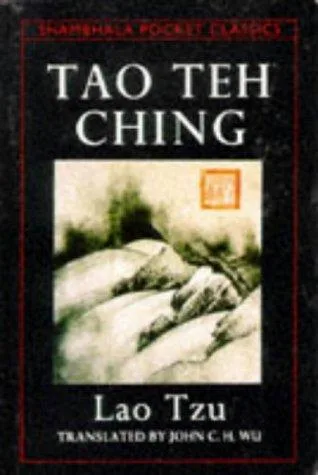
Tao Teh Ching
 76
76

Tao Teh Ching
The Tao Teh Ching’s enduring power lies in its radical simplicity and profound paradoxes. Rather than offering prescriptive doctrines, Lao Tzu presents observations on the nature of existence that feel both ancient and startlingly current. The emphasis on yielding, on the strength found in softness, and the critique of societal artifice are particularly striking. For instance, Chapter 64’s assertion that "a journey of a thousand miles begins with a single step" is not merely practical advice but a metaphor for the cumulative power of small, consistent actions aligned with the natural flow. However, the text’s very conciseness can be a barrier. Without extensive commentary, some verses remain opaque, demanding considerable reader intuition or scholarly interpretation to fully grasp their implications. It is a text that rewards slow, meditative engagement. The work's ultimate verdict is its persistent relevance; it remains a vital source for understanding a perspective fundamentally different from much Western thought.
📝 Description
76
Lao Tzu's Tao Teh Ching, compiled around the 6th century BCE, articulates the principles of the Tao.
The Tao Teh Ching, attributed to Lao Tzu, is a collection of aphorisms and poetic verses rather than a narrative. It outlines the fundamental principles of the Tao, the ineffable 'Way' that underlies all reality. The text's origins are often placed around the 6th century BCE, though scholarly discussion continues regarding its exact authorship and compilation date.
This work is valuable for students of Eastern philosophy, comparative religion, and those interested in contemplative practices. Its teachings offer a path toward living in harmony with natural rhythms and cultivating inner calm. Individuals seeking alternatives to Western systematic thought or those drawn to spiritual paths that value subtlety and effortless action will find ample material for reflection.
The Tao Teh Ching arose during China's Spring and Autumn period (771–476 BCE), a time of intellectual ferment. While philosophies like Confucianism focused on social order, the Tao Teh Ching proposed a different approach centered on wu wei, or non-action, and naturalness. Its significance grew over centuries, forming a core element of Taoist belief and practice.
As a central text of Taoism, the Tao Teh Ching articulates a cosmology and ethical system distinct from more socially oriented philosophies of ancient China. It describes the Tao not as a deity but as the fundamental, spontaneous, and unnamable principle of existence. The concept of wu wei encourages alignment with natural processes rather than forceful intervention, a principle that resonates within various contemplative and mystical traditions emphasizing surrender and effortless being. The text's focus on naturalness and the inherent virtue (De) found in all things positions it within a lineage of thought that seeks direct experience of reality's underlying order.
💡 Why Read This Book?
• You will learn about wu wei, the principle of effortless action, and how to apply its philosophy of non-striving to reduce internal conflict, a concept central to chapters like 37 and 48. • You will gain an understanding of the Tao, the ineffable cosmic principle, and its relationship to the natural world, as described throughout the text, particularly in its opening verses. • You will encounter the concept of the 'uncarved block' (pu), symbolizing primal simplicity, and explore how its return to this state can foster genuine contentment, a theme discussed in various chapters.
⭐ Reader Reviews
Honest opinions from readers who have explored this book.
❓ Frequently Asked Questions
When was the Tao Teh Ching originally written?
The exact date of the Tao Teh Ching's composition is debated among scholars, but it is generally attributed to Lao Tzu (老子) and is often placed around the 6th century BCE, during China's Spring and Autumn period.
What is the core philosophy of the Tao Teh Ching?
The core philosophy revolves around the Tao, the fundamental, unnamable principle of the universe, and emphasizes living in harmony with its natural flow through principles like wu wei (non-action) and simplicity.
Is the Tao Teh Ching a religious text?
While it is a foundational text for Taoism, a major world religion, the Tao Teh Ching itself is more philosophical and spiritual than strictly religious, focusing on natural principles rather than deities or rituals.
What does 'wu wei' mean in the context of the Tao Teh Ching?
Wu wei translates to 'non-action' or 'effortless action.' It signifies acting in accordance with the natural flow of the Tao, without forcing or artificial effort, achieving results with minimal resistance.
Are there different versions of the Tao Teh Ching?
Yes, there are various versions and translations. The earliest surviving manuscripts date to the Han Dynasty, and different translations can emphasize different aspects of the text's meaning, such as its philosophical or poetic qualities.
What is the significance of the 'uncarved block' (pu)?
The 'uncarved block' (pu) symbolizes the state of original simplicity, naturalness, and potential before it is shaped by desires or external influences. Returning to this state is seen as a path to genuine contentment.
🔮 Key Themes & Symbolism
The Ineffable Tao
The text centers on the Tao, the ultimate, nameless principle that is the origin and sustainer of all things. It is described as formless, eternal, and beyond human comprehension, yet it is the natural order that governs existence. Chapters like the first and the twenty-fifth explore its fundamental nature, emphasizing that the Tao that can be named is not the eternal Tao, highlighting its ineffable quality and its role as the source from which the myriad things arise.
Wu Wei: Effortless Action
Wu wei, often translated as non-action or effortless action, is a core practice advocated in the Tao Teh Ching. It does not mean passivity but rather acting in harmony with the natural flow of the Tao, without force or artificiality. The text suggests that by yielding and acting spontaneously, one can achieve more with less effort. This principle is illustrated through natural phenomena and contrasted with the often counterproductive striving of human endeavors, as seen in chapters like 37 and 48.
Simplicity and Naturalness
A recurring theme is the virtue of simplicity and returning to a natural state, often symbolized by the 'uncarved block' (pu). The Tao Teh Ching critiques societal complexities, artificial distinctions, and excessive desires, suggesting that true contentment lies in embracing original simplicity. This theme encourages a rejection of elaborate systems and a reconnection with one's innate nature, finding wisdom in what is unadorned and spontaneous, as presented throughout the work.
The Paradox of Strength
The text frequently explores paradoxes, particularly the idea that apparent weakness can be a source of profound strength. Softness overcomes hardness, yielding overcomes force. Water, for example, is depicted as the gentlest element yet capable of wearing away the hardest stone. This principle challenges conventional notions of power and resilience, suggesting that true strength lies in adaptability, humility, and non-resistance, a concept explored in chapters like 76 and 78.
💬 Memorable Quotes
Direct passages from the work, attributed to the author.
“The Tao that can be told is not the eternal Tao.”
— This opening statement immediately establishes the ineffable nature of the ultimate reality. It suggests that any attempt to define or label the Tao through language is inherently limited, pointing towards a truth that must be experienced rather than intellectually grasped.
“Under heaven, all things are born of being. Being is born of non-being.”
— This verse points to the Taoist understanding of creation emerging from a primordial void or non-existence. It suggests a cyclical process where apparent emptiness is the fertile ground from which all manifest phenomena arise.
“Nature does not hurry, yet everything is accomplished.”
— This observation emphasizes the principle of wu wei and the power of natural timing. It suggests that forcing action leads to inefficiency, while allowing events to unfold naturally, much like the seasons, leads to the completion of all necessary tasks.
“He who knows does not speak. He who speaks does not know.”
— This aphorism speaks to the limitations of language and the depth of true understanding. Profound knowledge, it implies, is often beyond articulation, while mere pronouncements may indicate a lack of genuine insight.
💡 Key Ideas
Editorial paraphrase of the work's core concepts — not direct quotes.
The sage stays behind, and therefore is ahead. He is content with his lot, and therefore is renewed. He does not display his superiority, and therefore is distinguished. He does not boast of his achievements, and therefore is credited.
This passage highlights the paradoxical nature of true leadership and virtue. By embracing humility and non-assertion, the sage paradoxically gains greater respect and influence, demonstrating that genuine accomplishment does not require outward proclamation.
🌙 Esoteric Significance
Tradition
The Tao Teh Ching is the foundational text of Taoism, a tradition that, while often considered a philosophy, possesses profound esoteric dimensions. It fits within a lineage that seeks direct experience of the fundamental reality (the Tao) rather than adherence to dogma. Its emphasis on inner cultivation, alignment with natural forces, and the pursuit of a transcendent state of being aligns it with broader esoteric currents that value intuitive wisdom and direct gnosis over exoteric religious structures.
Symbolism
Key symbols include the 'uncarved block' (pu), representing primal simplicity and potential before societal conditioning. Water is another potent symbol, representing yielding strength, adaptability, and the ability to overcome hardness through persistent gentleness. The 'valley spirit' or 'mysterious female' often symbolizes the receptive, generative power of the Tao, emphasizing receptivity and the power found in emptiness and stillness.
Modern Relevance
Contemporary thinkers and practitioners across various disciplines, from psychology to environmentalism and martial arts, draw heavily on the Tao Teh Ching. Its principles of wu wei inform approaches to leadership and stress management, while its ecological perspective speaks to modern environmental ethics. Various meditation and mindfulness practices implicitly or explicitly incorporate its emphasis on stillness, naturalness, and non-judgmental observation of reality.
👥 Who Should Read This Book
• Students of comparative philosophy and Eastern religions seeking foundational texts beyond the more commonly studied Confucian classics. • Individuals interested in contemplative practices and philosophies that emphasize inner harmony, naturalness, and reducing societal pressures. • Practitioners of various disciplines, from martial arts to mindfulness, looking to understand the philosophical underpinnings of concepts like yielding, flow, and effortless action.
📜 Historical Context
The Tao Teh Ching emerged during China's tumultuous Spring and Autumn period (771–476 BCE), a time marked by the decline of central authority and the rise of competing philosophical schools. While Confucianism focused on social order, ethics, and ritual, and Mohism advocated for universal love and utilitarianism, Lao Tzu's work offered a radically different perspective. It presented a philosophy centered on the natural order (Tao), individual spontaneity, and the efficacy of non-action (wu wei). This proto-Taoist text challenged the prevailing emphasis on societal structures and moral codes by advocating for a return to naturalness and simplicity. Its influence was gradual, but by the Han Dynasty (206 BCE – 220 CE), it had become a foundational text for the developing Taoist religion and philosophy, influencing figures like Zhuang Zhou.
📔 Journal Prompts
The Tao's ineffable nature and its naming.
Wu wei as effortless action in daily tasks.
The 'uncarved block' and personal simplicity.
Reflecting on the paradox of yielding strength.
The concept of 'emptiness' as potential.
🗂️ Glossary
Tao (Dao)
The fundamental, ineffable principle of the universe; the Way. It is the source and underlying order of all existence, characterized by naturalness and spontaneity.
Wu Wei
Literally 'non-action' or 'effortless action.' It refers to acting in accordance with the natural flow of the Tao, without force, striving, or artificiality, achieving results with minimal resistance.
De (Te)
Often translated as virtue, power, or integrity. It signifies the manifestation of the Tao within individuals and phenomena; one's inherent nature or moral force when aligned with the Tao.
Pu
The 'uncarved block.' It symbolizes original simplicity, naturalness, and potentiality before being shaped by external desires, societal conditioning, or artificial distinctions.
Yin and Yang
While not extensively detailed by name in the Tao Teh Ching, the text is based on the interplay of complementary opposites (e.g., hard/soft, movement/stillness), which are fundamental to the Taoist concept of Yin and Yang.
Ch'i (Qi)
Vital life force or energy that flows through all things. While the term itself is not prominent, the concept of vital flow and energetic balance is implicit in Taoist principles.
The Ten Thousand Things
A Taoist expression referring to the multiplicity of all phenomena and creatures that arise from the Tao; the entirety of the manifest universe.
🔮 Readers Also Liked
Browse all →









More by 老子
All books →





More Free Occult Philosophy Books
View all →