System of the Vedanta

 75
75

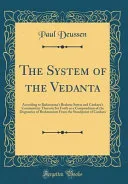
System of the Vedanta
Paul Deussen's "System of the Vedanta" offers a structured, if somewhat dry, dissection of a vast philosophical tradition. Deussen, a key figure in early Western Indology, meticulously categorizes and explains the core tenets of Vedanta, particularly Advaita. His strength lies in presenting complex metaphysical ideas with academic rigor, creating a coherent framework for understanding concepts like Brahman and Atman. However, this systematic approach can sometimes feel detached, lacking the vibrant, lived experience that often accompanies discussions of spiritual philosophy. A notable passage is his detailed explanation of the Upanishadic concept of the "Four States of Consciousness" (jagrat, svapna, susupti, and turiya), which he renders with characteristic precision. While invaluable for its scholarly depth, the book might leave practitioners seeking immediate spiritual application wanting. It is a foundational text for academic study, not a spiritual manual.
📝 Description
75
Paul Deussen's 1990 "System of the Vedanta" rigorously analyzes core Hindu philosophical doctrines.
Paul Deussen, a German Indologist, published "System of the Vedanta" in 1990. This academic work presents a systematic analysis of the philosophical and theological foundations of the Vedanta school of Hindu thought. Deussen's approach offers a rigorous examination of concepts that have shaped Indian intellectual history for centuries, rather than functioning as a devotional text.
The volume is intended for serious students of comparative philosophy and religious studies. It requires prior engagement with philosophical inquiry and comfort with abstract ideas. Deussen builds upon his extensive scholarship from the late 19th and early 20th centuries, a time of growing Western interest in Eastern philosophies. His work engaged with the emerging field of Indology, seeking to synthesize Indian thought for a Western academic audience through a systematic method that contrasted with more impressionistic accounts.
Paul Deussen's work situates Vedanta within a Western academic framework, aiming to clarify its philosophical structure for a non-Indian audience. By tracing concepts from the Upanishads through later commentaries and focusing on non-duality, Deussen makes accessible a tradition often perceived as mystical. His systematic approach to concepts like Brahman and Atman provides a logical entry point for those studying comparative philosophy or the intellectual underpinnings of Hindu traditions.
💡 Why Read This Book?
• Gain a structured understanding of Brahman and Atman, the foundational concepts of Vedanta, as systematically presented by Deussen in his 1990 publication, allowing for comparative philosophical analysis. • Explore the doctrine of Maya and its implications for understanding reality, as detailed in Deussen's examination of Advaita Vedanta, offering a unique perspective on illusion and perception. • Grasp the interconnectedness of Karma and Samsara within the Vedanta framework, as explained by Deussen's scholarly synthesis, providing concrete philosophical underpinnings for these crucial concepts.
⭐ Reader Reviews
Honest opinions from readers who have explored this book.
❓ Frequently Asked Questions
What is the primary focus of Paul Deussen's "System of the Vedanta"?
The book focuses on a systematic, academic analysis of the philosophical and theological principles of Vedanta, particularly the Advaita school, as understood by Western Indology.
When was "System of the Vedanta" first published?
The work, by Paul Deussen, was first published in 1990, though it draws on his extensive scholarship from the late 19th and early 20th centuries.
Who is Paul Deussen and why is his work significant?
Paul Deussen was a prominent German Indologist and philosopher, known for his rigorous academic approach to Indian philosophy, which significantly shaped Western understanding of texts like the Upanishads.
Does "System of the Vedanta" discuss the Upanishads?
Yes, Deussen's work traces the development of Vedanta concepts from the Upanishads, offering an analysis of their philosophical implications.
Is this book suitable for beginners in Eastern philosophy?
While foundational, the book's academic rigor and systematic approach are better suited for those with some prior familiarity with philosophical inquiry rather than absolute beginners.
What key concepts are explored in the book?
The book explores core Vedanta concepts such as Brahman, Atman, Maya, Karma, and Samsara, examining their interrelationships within the Advaita tradition.
🔮 Key Themes & Symbolism
The Nature of Brahman
Deussen meticulously outlines Brahman as the singular, unconditioned reality underlying all existence within the Vedanta framework. He analyzes its attributes (or lack thereof) as described in the Upanishads and subsequent philosophical discourse, emphasizing its role as the ground of being and consciousness. The text explores the philosophical challenges and implications of conceiving such an ultimate principle, distinguishing it from any empirical or phenomenal reality.
The Concept of Atman
Central to Deussen's exposition is Atman, the inner self or soul, and its identity with Brahman. The work systematically examines scriptural passages and philosophical arguments that assert the non-duality of Atman and Brahman. Deussen presents the Advaita Vedanta perspective that the perceived individual self is ultimately identical with the universal consciousness, a core tenet explored through detailed textual analysis.
Maya and the World of Appearances
The book studies Maya, the concept of cosmic illusion or phenomenal appearance, as presented in Vedanta. Deussen explains how Maya accounts for the multiplicity and diversity of the empirical world, which, from the ultimate perspective, obscures the singular reality of Brahman. This theme is crucial for understanding the Vedanta position on the relationship between the Absolute and the relative.
The Cycle of Samsara
Deussen's "System of the Vedanta" also addresses Samsara, the cycle of birth, death, and rebirth, and its driving force, Karma. The work examines how these concepts function within the Vedanta worldview, explaining the process of transmigration and the conditions that perpetuate it, as well as the ultimate aim of liberation (Moksha) from this cycle.
💬 Memorable Quotes
Direct passages from the work, attributed to the author.
“The world of appearances is Maya, which veils the true nature of Brahman.”
— This interpretation focuses on Deussen's explanation of Maya, the principle of illusion that makes the phenomenal world seem real and obscures the underlying, singular truth of the Absolute.
“Brahman is the one without a second.”
— This concise phrasing, often found in Upanishadic texts discussed by Deussen, signifies the non-dualistic nature of ultimate reality in Vedanta, emphasizing its absolute and singular existence.
“The path to liberation involves overcoming ignorance through true knowledge.”
— This interpretation reflects Deussen's discussion on Moksha, emphasizing that freedom from the cycle of rebirth is achieved not through ritual or action alone, but through the direct realization of truth.
💡 Key Ideas
Editorial paraphrase of the work's core concepts — not direct quotes.
The ultimate aim of the Vedanta is the knowledge of the identity of Atman and Brahman.
This paraphrased concept highlights the central goal of Vedanta philosophy as presented by Deussen: realizing the fundamental oneness of the individual soul and the supreme reality.
The individual soul (Atman) is not different from the universal soul (Brahman).
This paraphrased assertion captures the essence of Advaita Vedanta's core teaching on non-duality, as systematically explored in Deussen's analysis of the relationship between the individual and the absolute.
🌙 Esoteric Significance
Tradition
While "System of the Vedanta" is primarily an academic philosophical text, its detailed exposition of Brahman, Atman, and Maya places it within the broader context of Indic traditions that have esoteric dimensions. These concepts are foundational to Yogic and Vedantic practices aimed at realizing non-dual consciousness. Deussen's work, though not esoteric itself, provides the philosophical scaffolding upon which many esoteric interpretations and practices within Hinduism and its global offshoots are built.
Symbolism
Key symbolic concepts explored include Brahman, often described as pure consciousness or 'neti neti' (not this, not that), representing the ineffable Absolute. Atman, the inner self, is symbolized by the innermost core of being, distinct from the transient physical and mental sheaths. Maya, the cosmic illusion, is symbolized by the veil that obscures reality, creating the appearance of a diverse, material world from the singular divine source.
Modern Relevance
Contemporary thinkers and practitioners in fields ranging from transpersonal psychology to various schools of yoga and meditation draw heavily on the conceptual framework of Vedanta, as systematically laid out by scholars like Deussen. Modern Advaita teachers and Western interpreters of Hindu philosophy often reference the core ideas of Brahman and Atman to explain non-dual awareness and consciousness studies.
👥 Who Should Read This Book
• Academic researchers in comparative religion and philosophy seeking a structured overview of Vedanta's core doctrines and their historical context. • Students of Indology and Sanskrit studies needing a foundational text for understanding Hindu philosophical systems from a Western scholarly perspective. • Philosophically inclined readers interested in exploring non-dualistic metaphysics and the concepts of ultimate reality and the self as presented in a major Indian tradition.
📜 Historical Context
Paul Deussen's "System of the Vedanta," first published in 1990, emerges from a rich tradition of Western scholarship on Indian philosophy that gained momentum in the late 19th century. Deussen himself was a key figure, alongside scholars like Max Müller, in introducing Sanskrit texts and Indian philosophical systems to a European academic audience. This era saw a significant intellectual current of comparative religion and philosophy, driven by both academic curiosity and, at times, colonial influence. Deussen's work was notable for its attempt to present Vedanta not as a mystical creed but as a coherent philosophical system, akin to Western metaphysics. He engaged with the German idealist tradition, particularly Kant and Schopenhauer, seeking parallels and contrasts. While his systematic approach was lauded for its clarity, it also faced criticism for potentially oversimplifying or Westernizing Indian thought, a debate that continued with later Indologists and Indian scholars.
📔 Journal Prompts
The nature of Brahman as described by Deussen.
Reflections on the identity of Atman and Brahman.
The implications of Maya for daily perception.
Understanding Karma's role in Samsara.
The path to liberation (Moksha) as a philosophical goal.
🗂️ Glossary
Brahman
In Vedanta, the ultimate, unchanging reality that is the source and ground of all existence. It is considered absolute, infinite, and without attributes (Nirguna Brahman) or with attributes (Saguna Brahman).
Atman
The self, the inner spirit, or soul. In Advaita Vedanta, Atman is considered identical to Brahman, the true essence of an individual being.
Maya
Cosmic illusion or the power that conceals the true nature of reality and projects the phenomenal world. It is the principle that creates the appearance of multiplicity and individuality.
Samsara
The cycle of birth, death, and rebirth. It is a continuous process driven by Karma and ignorance, from which liberation (Moksha) is sought.
Karma
The law of cause and effect governing actions and their consequences. It determines the nature of future existences within the cycle of Samsara.
Advaita Vedanta
A prominent school of Vedanta philosophy emphasizing non-duality, asserting that the individual self (Atman) is identical with the ultimate reality (Brahman).
Upanishads
Ancient Sanskrit texts that form the theoretical basis of Vedanta Hinduism. They contain philosophical discussions on the nature of ultimate reality and the self.
🔮 Readers Also Liked
Browse all →









More by Paul Deussen
All books →




More Free Occult Philosophy Books
View all →