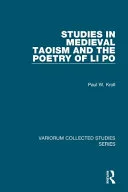
Studies in Medieval Taoism and the Poetry of Li Po
 80
80

Studies in Medieval Taoism and the Poetry of Li Po
Paul W. Kroll's "Studies in Medieval Taoism and the Poetry of Li Po" offers a scholarly and detailed exploration of a crucial period in Chinese religious and literary history. Kroll, a recognized expert, brings a meticulous eye to the development of Taoism between the 3rd and 8th centuries, tracing its emergence as a distinct religious tradition. The integration of Li Po's poetry into this discussion is particularly illuminating, moving beyond superficial connections to reveal genuine thematic and imagistic resonance. A strength lies in the depth of textual analysis, which provides a solid foundation for understanding early Taoist concepts and their expression. However, for the non-specialist, the density of academic argument may present a significant barrier to entry. The chapter discussing Li Po's engagement with the *Far Roaming* poem, for instance, is exceptionally dense, requiring considerable background knowledge. Despite this, the book remains a vital contribution for those dedicated to the serious study of Chinese esotericism and classical poetry, offering a nuanced perspective on how religious thought permeates cultural output.
📝 Description
80
Paul W. Kroll's 1994 collection examines Taoism's formative centuries and its connection to Li Po's poetry.
This volume gathers twelve studies by Paul W. Kroll, focusing on the development of Taoism from the 3rd to the 8th centuries CE. Kroll analyzes early Taoist texts and their cultural impact. The work also investigates how Taoist ideas and imagery shaped the poetry of Li Po, a significant figure of the T'ang Dynasty.
Intended for advanced students and scholars of Chinese history, religion, and literature, the book requires a background in East Asian cultural history and comfort with detailed textual analysis. It is for those interested in the evolution of Chinese religious and philosophical traditions and their artistic expressions during imperial China. Kroll situates Taoism's growth into an organized religion within the intellectual climate of its time, which included Confucianism and Buddhism.
This collection is situated within the study of Chinese religious history, specifically the development of Taoism as a major philosophical and religious system. It traces concepts from early philosophical Taoism through its institutionalization and its impact on classical Chinese literature, particularly the poetry of Li Po. The work engages with the historical formation of doctrines and practices that would become central to Taoist traditions.
💡 Why Read This Book?
• Gain a nuanced understanding of Taoism's formative centuries (3rd-8th CE), moving beyond generalized notions to specific textual developments and religious practices discussed in Kroll's analyses. • Explore the concrete influence of Taoist concepts, such as immortality and transcendence, on the poetry of Li Po, as detailed through specific examples of his verses and their thematic connections. • Appreciate the scholarly methodology applied to early Chinese religious texts and poetry, providing a model for critical engagement with historical esoteric traditions and their literary expressions.
⭐ Reader Reviews
Honest opinions from readers who have explored this book.
❓ Frequently Asked Questions
What historical period does "Studies in Medieval Taoism and the Poetry of Li Po" primarily cover?
The book focuses on the 3rd through 8th centuries CE in China, a period critical for the development of Taoism as an organized religion and a flourishing time for T'ang Dynasty poetry, including the works of Li Po.
Who is Paul W. Kroll and what is his expertise?
Paul W. Kroll is a leading scholar of medieval China, specializing in its history, religion, and literature. His work in this volume draws on extensive textual research and deep knowledge of the period.
What is the relationship between Taoism and Li Po discussed in the book?
The book examines how Taoist philosophy, cosmology, and imagery, prevalent during Li Po's era (T'ang Dynasty), influenced his poetry, shaping its themes and the poet's persona.
Are there specific Taoist texts analyzed in "Studies in Medieval Taoism and the Poetry of Li Po"?
Yes, the work includes studies on early Taoist texts and concepts, as well as essays on specific poems like 'Far Roaming', demonstrating Kroll's engagement with primary sources.
Is this book suitable for absolute beginners in Taoism?
While comprehensive, the book is written for an academic audience. Beginners might find it beneficial to have some prior exposure to Chinese history and philosophy before engaging with Kroll's detailed textual analysis.
When was "Studies in Medieval Taoism and the Poetry of Li Po" first published?
The book was first published in 2009, making it a relatively modern scholarly work on these ancient subjects.
🔮 Key Themes & Symbolism
Taoist Religious Development
This theme addresses the crucial 3rd to 8th centuries CE, a period when Taoism solidified its identity as China's indigenous higher religion. Kroll details the transition from disparate philosophical schools and folk practices into a more structured religious system with developing canons and doctrines. The work scrutinizes how concepts like longevity and transcendence were articulated, and how monasticism began to take shape, laying the groundwork for later Taoist traditions and influencing broader Chinese culture.
Influence on T'ang Poetry
A significant focus is placed on the intersection of Taoist thought and the literary output of the T'ang Dynasty, particularly the poetry of Li Po. Kroll meticulously analyzes how Li Po's verses incorporated Taoist cosmology, imagery of immortals, and philosophical underpinnings. This theme explores not just thematic resonance but the deep stylistic and conceptual integration, demonstrating how religious ideas provided a rich source of inspiration and expression for one of China's greatest poets.
Textual Analysis of Early Works
The volume engages directly with early Taoist texts, including the proto-Taoist poem 'Far Roaming,' and considers the formation of religious canons. Kroll's scholarly approach involves close reading and exegesis, revealing the nuances of the language and philosophical ideas present in these foundational writings. This theme highlights the importance of textual scholarship in understanding the historical evolution of religious and philosophical traditions.
Li Po's Persona and Mysticism
Beyond the direct influence on his poetry, the studies also consider the cultivated persona of Li Po himself, often depicted through a Taoist lens. This theme examines how Li Po presented himself and his experiences, frequently aligning with Taoist ideals of freedom, spontaneity, and connection to the cosmos. Kroll examines how the poet's life and work together created an image deeply intertwined with the mystical and philosophical currents of his time.
💬 Memorable Quotes
Direct passages from the work, attributed to the author.
“The emergence of Taoism during the 3rd through 8th centuries as China's indigenous higher religion affected all areas of culture.”
— This statement frames the central argument of Kroll's work, emphasizing Taoism's pervasive impact on Chinese society, arts, and philosophy during a critical formative period, setting the stage for its deep integration into the cultural fabric.
“This volume... illuminates selected aspects of Taoism in texts dating to this period and also considers its influence in the works of the great T'ang-dynasty poet, Li Po.”
— This highlights the dual focus of the book: rigorous academic exploration of early Taoist textual traditions and a sophisticated analysis of how these traditions found expression in the highly regarded poetry of Li Po.
“Essays on the proto-Taoist poem Far Roaming”
— This points to a specific textual focus within the collection, indicating Kroll's engagement with foundational or precursor texts that predate more organized Taoist scriptures, offering insights into its earliest conceptualizations.
“A monograph on Li Po's use of...”
— This signals a detailed, book-length study within the larger collection dedicated to a specific aspect of Li Po's work, likely focusing on his utilization of particular Taoist themes, symbols, or philosophical ideas.
“Leading scholar of medieval China”
— This descriptor establishes the author's credentials and the scholarly weight behind the presented research, assuring readers of the academic rigor and expertise guiding the analysis of Taoism and Li Po.
🌙 Esoteric Significance
Tradition
This work is situated within the broad lineage of East Asian esoteric traditions, specifically Taoism. While not aligning with Western Hermetic or Kabbalistic systems, it explores concepts central to Taoist practice and philosophy, such as immortality, alchemy (both internal and external), and the pursuit of harmony with the Tao. Kroll's study contributes to understanding how these indigenous Chinese esoteric principles developed, diverged from, and interacted with other major belief systems within China.
Symbolism
Key symbols explored include the pursuit of immortality, often depicted through themes of celestial ascent, longevity elixirs, and transcendent realms. The figure of the immortal (xian) itself is a potent symbol of spiritual attainment and detachment from worldly concerns. Furthermore, the work likely touches upon cosmological symbols and imagery prevalent in T'ang Dynasty art and literature, reflecting an esoteric understanding of the universe and humanity's place within it, as filtered through Li Po's poetic lens.
Modern Relevance
Contemporary practitioners and scholars of Taoism, as well as those interested in comparative religion and classical Chinese literature, draw upon Kroll's research. His detailed textual analyses and historical contextualization provide a solid foundation for understanding the roots of modern Taoist practices and philosophical interpretations. Thinkers and artists exploring themes of nature, transcendence, and the spiritual dimensions of existence in a globalized world can find echoes and origins in the medieval Taoist thought Kroll elucidates.
👥 Who Should Read This Book
• Scholars of Chinese religion and philosophy: Gain in-depth, textually-grounded insights into the development of Taoism during its formative medieval period, building upon established scholarship. • Students of classical Chinese literature: Understand the lasting impact of Taoist concepts and imagery on the poetry of Li Po, moving beyond superficial literary analysis to grasp deeper thematic connections. • Researchers in comparative esotericism: Explore the specific characteristics and historical trajectory of an influential Eastern esoteric tradition, facilitating cross-cultural comparisons with other mystical systems.
📜 Historical Context
The period from the 3rd to the 8th centuries CE was a crucible for Chinese religious and intellectual life. Taoism, evolving from diverse philosophical currents and popular cults, began to coalesce into a more formally organized religion, competing for influence with established Confucianism and the increasingly prominent Buddhism. This era saw the compilation of foundational Taoist texts and the development of distinct schools and practices. The T'ang Dynasty (618-907 CE), a golden age of cosmopolitanism and artistic flourishing, provided a unique environment where religious ideas, particularly Taoist mysticism and cosmology, profoundly shaped poetry. Paul W. Kroll's work emerged within a scholarly landscape increasingly interested in the nuances of Chinese religious history, moving beyond earlier Sinocentric views. While specific contemporary reception events for Kroll's 2009 volume are not detailed, his scholarship engages with the ongoing discourse established by scholars like Holmes Welch and Anna Seidel, who also explored the historical development and cultural impact of Taoism.
📔 Journal Prompts
The concept of *wu wei* in early Taoism:
Li Po's integration of immortal imagery:
The textual evolution of Taoist canons:
Proto-Taoist elements in 'Far Roaming':
The T'ang Dynasty's cultural synthesis:
🗂️ Glossary
Taoism
A philosophical and religious tradition originating in China, emphasizing living in harmony with the Tao (the Way), often involving practices aimed at longevity, spiritual cultivation, and understanding the natural order of the universe.
Li Po
One of the most celebrated poets of the T'ang Dynasty (618-907 CE), known for his romantic and imaginative verses that often drew upon Taoist themes, nature, and personal freedom.
T'ang Dynasty
A period in Chinese history (618-907 CE) considered a golden age for art, literature, and culture, marked by cosmopolitanism and significant developments in both Buddhism and Taoism.
Proto-Taoist
Referring to philosophical and spiritual ideas or texts that predate or are foundational to the more organized and systematized forms of Taoism that emerged later.
Far Roaming
A significant early Chinese text, often considered proto-Taoist, that explores themes of spiritual journeying, cosmic exploration, and transcendence, influencing later Taoist thought.
Wu Wei
A core Taoist concept literally meaning 'non-action' or 'effortless action.' It signifies acting in accordance with the natural flow of the Tao, without force or artificiality.
Immortal (xian)
In Taoism, a person who has achieved a state of spiritual transcendence, often attaining physical immortality or an ethereal existence, embodying Taoist ideals of harmony and detachment.